Why In News?
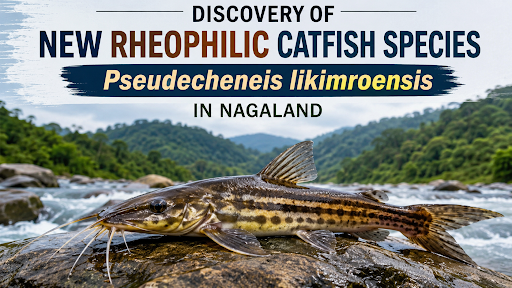
Researchers from Kohima Science College discovered a new species of rock-clinging catfish, Pseudecheneis likimroensis, in the Likimro River.
What is Pseudecheneis likimroensis?
|
Aspect |
Details |
|
Discovery |
New species discovered from the Likimro River, Kiphire district, Nagaland by researchers from Kohima Science College and the Zoological Survey of India (ZSI). |
|
Habitat |
Rheophilic hillstream catfish inhabiting fast-flowing, rocky mountain streams with highly oxygenated water. |
|
Meaning of Rheophilic |
Derived from Greek "Rheos" (flow/current) and "Philos" (loving); refers to organisms adapted to live in swift-flowing waters. |
|
Major Adaptations |
Dorso-ventrally flattened body, thoracic adhesive organ (suction plate), strong pectoral fins and streamlined profile enable attachment to rocks in turbulent streams. |
|
Distinctive Features |
Adhesive organ with parallel ridges and grooves, deep body, unique bony spur on first dorsal-fin pterygiophore, distinct fin-ray counts and vertebral characteristics. |
|
Diet |
Carnivorous; feeds mainly on aquatic insects, insect larvae and small benthic organisms attached to rocks. |
|
Size |
Holotype: 11.53 cm; Largest recorded specimen: 13.19 cm. |
|
Diagnostic Characters |
Distinguished from congeners by body depth, pectoral fin-ray count, vertebral structure, exposed lower tooth band and dorsal bony spur. |
|
Local Names |
Known as "Nupedro" by the Chirr Naga community; also called "Jetfighter" or "Aeroplane Fish" due to wing-like pectoral fins and camouflage appearance. |
|
Ecological Importance |
Indicator of pristine, highly oxygenated hill streams; regulates aquatic insect larvae and contributes to stream ecosystem stability. |
About Likimro River
-
Location: Eastern Kiphire District, Nagaland, along the India–Myanmar border.
-
Origin: Originates near Mount Saramati, the highest peak of Nagaland.
-
River Type: Fast-flowing mountain river with deep valleys, rocky substrates and boulder-strewn channels.
-
Drainage System: Tributary of the Tizu River, part of the Chindwin–Irrawaddy Basin, unlike most Northeast Indian rivers that drain into the Brahmaputra.
Source: mongabay
PRACTICE QUESTIONQ. With reference to Indian freshwater ecosystems, how is a "rheophilic" organism best described? A) An organism adapted exclusively to stagnant, highly alkaline lentic wetlands. B) A species that undergoes migration from saltwater oceans to freshwater rivers to spawn. C) An organism that thrives in fast-flowing, highly oxygenated mountain streams. D) A highly invasive species that outcompetes native coldwater fishes for food. Answer: C Explanation: Rheophilic organisms (from Greek "rheos" meaning current, and "philos" meaning loving) are species biologically adapted to living and thriving in fast-moving, swift, and highly oxygenated mountain stream waters |