Why In News?
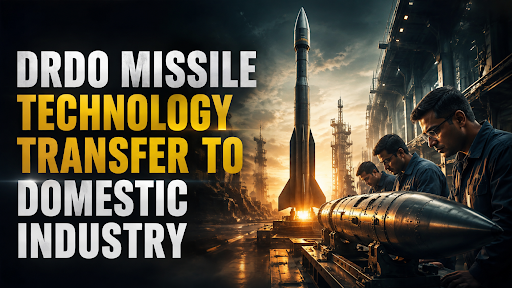
The Union Defence Minister approved the transfer of technology (ToT) for all DRDO-developed conventional missile and precision munition systems to domestic private and public industry to eliminate import reliance and accelerate mass production.
What is Technology Transfer (ToT)?
Technology Transfer (ToT) is the formal, legal, and operational process by which technological knowledge, design blueprints, intellectual property (IP), material specifications, tooling data, and manufacturing processes developed by an R&D agency (like DRDO) are transferred to a production agency for commercial fabrication.
Mechanisms of Defence ToT in India
-
Licensing Agreement for Transfer of Technology (LAToT): A formal non-exclusive agreement granting industry the legal right to manufacture DRDO-developed systems using zero or nominal transfer fees and free access to patented technologies.
-
Development cum Production Partner (DcPP) Model: Involving private industry right from the conceptual design and prototype stage rather than handing over completed designs post-trials.
-
Technology Development Fund (TDF): Financial support of up to ₹50 crore per project provided by DRDO to Indian MSMEs and startups to develop critical defence subsystems.
About DRDO (Defence Research and Development Organisation)
|
Strategic Significance of Missile Tech Transfer
Ending Strategic Import Dependence: India was the world’s leading arms importer between 2019 and 2023, accounting for 9.8% of global arms imports. Indigenising missile production secures supply chains during two-front war contingencies.
Scaling High-Rate Serial Manufacturing: Armed forces require thousands of precision missiles, loitering munitions, and air-defence interceptors. Private production lines scale up capacity far faster than overburdened public ordnance factories.
Driving Defence Exports Target: Accelerates India’s target to achieve ₹50,000 crore in annual defence exports by 2028–29 by offering cost-competitive systems like Akash, Pinaka, and Astra to friendly foreign nations.
MSME & Tier-2/Tier-3 Supply Chain Integration: A single missile system integrates over 1,500 precision components (propulsion motors, thermal batteries, seekers, warheads, control actuators), directly energising hundreds of domestic MSMEs.
Commercialising Public R&D Investments: Ensures that thousands of crores invested in DRDO laboratories translate into operational military inventory and economic growth rather than remaining as lab prototypes.
Operational Readiness & Stockpile Sustainability: Modern high-intensity conflicts (e.g., Russia-Ukraine and West Asia wars) demonstrate that missile stockpiles deplete rapidly; sovereign production prevents foreign embargoes from crippling battlefield operations.
Attracting Long-Term Private Capital: Clear policy signals incentivize major industrial conglomerates to invest in dedicated assembly plants, explosive filling facilities, and private testing ranges.
What are the Major Challenges?
Technology Absorption Deficits in Private Sector: Precision missile manufacturing demands microscopic tolerances, specialized cleanrooms, and explosive handling protocols that many civilian engineering firms lack.
Testing, Range Access, and Certification Bottlenecks: Firing trials require access to specialized military ranges (e.g., Integrated Test Range, Chandipur), where scheduling backlogs delay final military qualification.
Supply Chain Dependencies for Core Components: India remains partially dependent on imported sub-components, such as active electronic scanning array (AESA) radar chips, millimeter-wave radio-frequency seekers, and high-purity carbon fibres.
High Capital Investment and Long Gestation Cycles: Defense manufacturing requires massive upfront capital expenditure without immediate commercial returns, deterring smaller tier-2 suppliers.
Intellectual Property (IP) Protection & Quality Assurance: Balancing wide technological dissemination with strict security protocols to prevent sensitive missile schematics from espionage or quality dilution.
Way Forward
Focus on Pure R&D: DRDO must shed its role in commercial production and minor upgrades, restructuring its laboratories into focused clusters dedicated exclusively to high-end, futuristic deep-tech research, while transferring all production and product development to private industry and DPSUs..
Create a Level Playing Field for Private Strategic Partners: The Ministry of Defence must treat domestic private manufacturers on par with Defence Public Sector Undertakings (DPSUs) by institutionalizing long-term Strategic Partnerships and granting Raksha Udyog Ratna (RUR) status to capable private players..
Assured Minimum Order Commitments for ToT Absorbers: To ensure economic viability and amortize private capital expenditure, the armed forces must guarantee long-term procurement volumes and multi-year order visibility to domestic companies absorbing DRDO technologies.
Open Government-Owned Test Facilities under GOCO Model: Military testing ranges, environmental laboratories, and explosive testing infrastructure must be opened to private defence firms under the Government-Owned Company-Operated (GOCO) model with streamlined standard operating procedures.
Indigenisation of Critical Subsystems via TDF and iDEX: Defence procurement must prioritize the development of indigenous seekers, thermal sensors, and high-energy propellants through enhanced financial grants under Innovations for Defence Excellence (iDEX) and Technology Development Fund (TDF).
Conclusion
Transferring DRDO's conventional missile technology to domestic industry cements India's defence self-reliance, converting public R&D into industrial mass production while insulating national sovereignty from global geopolitical vulnerabilities.
Source: timesofindia
|
PRACTICE QUESTION Q. "Transitioning India from a leading arms importer to a global defence manufacturing and export hub requires bridging the critical gap between laboratory R&D and commercial mass production." Discuss (15 Marks, 250 Words) |