Why In News?
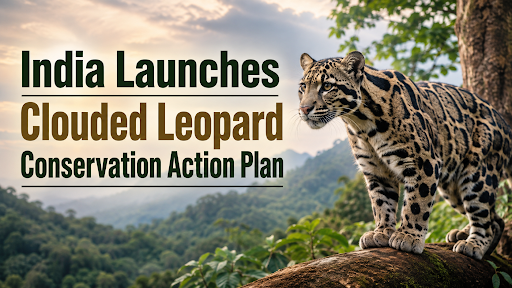
The Government of India launched the first-ever species-specific Clouded Leopard Conservation Action Plan (CAP).
About Clouded Leopard
Scientific name Neofelis nebulosa and is the sister taxon to other big pantherine cats, genetically splitting from them 9.32 to 4.47 million years ago.
Geographical Range: Evergreen forest habitats spanning the foothills of the Himalayas in Nepal and Bhutan, through Northeast India, and down to mainland Southeast Asia and South China.
Habitat Adaptability: Dwells in dense evergreen, semi-evergreen, and subtropical wet forests, showing high adaptability from low elevations of 144 meters in Pakke Tiger Reserve up to high mountain zones at 3,720 meters in Sikkim.
Physical Characteristics: Large, dark, cloud-like dusky spots and irregular stripes on greyish-yellow fur, and possesses long canine teeth measuring 4 cm or longer (the largest relative to body size among all living cats, earning it the title of "modern-day sabre-tooth").
Size: It weighs between 11.5 and 23 kg, measures 68.6 to 108 cm in head-to-body length, and features a 61 to 91 cm tail for balance.
Ecological Role: As a top predator, the cat maintains the ecological balance of forest ecosystems by hunting medium-sized monkeys (such as pig-tailed macaques), wild boars, and hog deer.
Conservation Status
-
IUCN Red List: Vulnerable
-
CITES: Appendix I, which strictly bans international commercial trade of its live body or body parts.
-
Wildlife (Protection) Act, 1972: Highest level of legal protection under Schedule I, which penalizes hunting or poaching with severe imprisonment.
What is the Clouded Leopard Conservation Action Plan?
-
Habitat Protection: Securing and safeguarding forest areas across Northeast range states.
-
Scientific Monitoring: Standardizing population tracking by utilizing camera traps, occupancy surveys, genetic analysis, and environmental DNA (eDNA)
-
Landscape Connectivity: Establishing landscape-level habitat restoration to connect broken forest patches.
-
Community Participation: Encouraging local, indigenous forest-dwelling communities to co-lead conservation while providing sustainable livelihood support to reduce forest pressure.
-
Research and Capacity Building: Training forest guards and using the "M-STrIPES" smart mobile application to patrol and stop wildlife crime.
Source: pib
|
PRACTICE QUESTION Q. Consider the following pairs of Protected Areas and their associated states where Clouded Leopards have been scientifically recorded:
Which of the pairs given above are correctly matched? A. 1 and 2 only B. 2 and 3 only C. 1 and 3 only D. 1, 2, and 3 Answer: D Explanation: All three pairs are correctly matched based on camera-trap and distribution records:
|