Why In News?
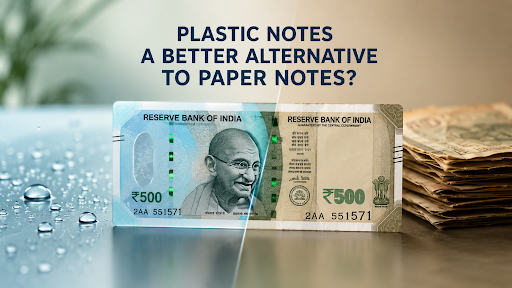
The Reserve Bank of India (RBI) invited global bids to supply special plastic sheets to start a pilot project for printing Rs 10 and Rs 20 polymer banknotes.
What are Polymer (Plastic) Currency Notes?
They are made from a flexible, synthetic plastic material called Biaxially Oriented Polypropylene (BOPP). Unlike traditional Indian notes made from a blend of cotton and linen, these plastic notes feature smooth, non-porous surfaces.
Australia became the first country to invent and use polymer notes in 1988. Today, more than 60 countries, including Canada, the UK, New Zealand, and Romania, use polymer notes.
Recyclable Material: When plastic notes get old, factories shred them into tiny pellets and recycle them to make new plastic items like garden furniture and compost bins.
Integrated Security: The plastic material allows note-makers to build transparent windows directly into the note, which ordinary printers cannot copy.

Why is RBI Considering Polymer Notes?
Longer Lifespan
Polymer notes survive 2.5 to 4 times longer than normal paper notes. They easily survive rough handling by the public.
Better Security
Polymer notes stop criminals from making fake money. They include high-tech security features like 3D holograms and color-changing inks embedded inside the plastic film.
Reduced Currency Replacement Costs
The RBI spends a huge amount of money printing new notes every year. In the financial year 2024-25, the RBI spent Rs 6,372.8 crore just on printing currency. Plastic notes stay in the market longer, which cuts down these high printing bills.
Improved Resistance
Plastic notes do not absorb water, sweat, or oil. If you accidentally wash them in a washing machine, they do not tear or melt.
Record High Cash Demand
Even with UPI digital payments, Indians use a lot of cash. India’s Currency in Circulation (CiC) has more than doubled, surging from ₹17.74 trillion just before the November 2016 demonetisation to an all-time high of ₹42.86 trillion in May 2026.
Too Many Dirty Notes
India destroys billions of dirty and torn notes every year. The RBI threw away 23.8 billion pieces of soiled notes in 2024-25 alone.

What are the Concerns about Polymer Notes?
Higher Initial Production Cost
Producing polymer notes costs 30% to 60% more upfront because it requires complex technology and expensive raw materials.
Infrastructure Upgradation
India has around 2.5 lakh ATMs. Banks must physically change the hardware rollers and update the software in every machine because smooth plastic notes slip more easily than paper notes.
Environmental Concerns
Some people worry about putting more plastic into the world. If India fails to build proper recycling plants, these notes could add to plastic pollution.
Suitability for Indian Conditions
If a user folds a plastic note very sharply, it develops a permanent white crease and breaks. This is a problem in India, where people often fold money tightly.
Static Electricity Issue
In humid Indian weather, plastic notes can create static electricity and stick together inside counting machines and ATMs.
Import Dependence
India currently imports the special BOPP plastic base from a few global companies, raising concerns about supply chain security.
|
Polymer Notes V/S Paper Notes
|
What Measures Can Ensure a Successful Transition?
Conduct Pilot Projects Before Nationwide Rollout
The RBI must first test the Rs 10 and Rs 20 notes in specific cities with extreme weather (like hot Jaipur and humid Kochi) to see how the plastic behaves.
Upgrade Currency Printing and Cash Handling Infrastructure
Banks must calibrate ATM cassettes and sensors so the machines deal smoothly with the slippery texture of plastic notes.
Develop Polymer Note Recycling Facilities
The government needs to build specialized, highly secure factories to melt and pelletize old notes safely, ensuring they do not end up in landfills.
Continuously Upgrade Security Features to Counter Counterfeiting
The RBI must constantly invent secret, new nanotechnology features inside the plastic windows to stay ahead of international criminal networks.
Geopolitical Firewalls
The government must strictly ensure that foreign suppliers do not share printing data or materials with hostile neighboring countries.
Promote Hybrid Ecosystems
The government should balance the use of plastic physical cash with the promotion of the digital e-Rupee (CBDC).
Conclusion
Transitioning to polymer currency will successfully modernize India's financial system by providing the economy with significantly cleaner, safer, and cheaper-to-maintain banknotes.
Source: THEHINDU
|
PRACTICE QUESTION Q. Consider the following statements regarding Polymer Banknotes: 1. Polymer banknotes are completely biodegradable and break down naturally in the environment faster than cotton-based paper notes. 2. The Reserve Bank of India derives its sole authority to issue and determine the material of banknotes from the Banking Regulation Act, 1949. 3. Transparent windows in polymer banknotes serve as a primary 'Level 1' security feature to deter counterfeiting. Which of the statements given above is/are correct? A) 1 and 2 only B) 3 only C) 2 and 3 only D) 1, 2, and 3 Answer: B Explanation: Statement 1 is incorrect: Polymer banknotes are not biodegradable. They are made from synthetic petroleum-based plastics (like biaxially oriented polypropylene or BOPP) which are recyclable but notoriously slow to break down naturally. Statement 2 is incorrect: Under Section 22 of the Reserve Bank of India Act, 1934, the RBI derives its sole right and authority to issue banknotes. However, the authority to determine the material and design of these banknotes lies with the Central Government under Section 25 of the RBI Act, not the Banking Regulation Act, 1949. Statement 3 is correct: Transparent/clear windows are primary 'Level 1' (public-verifiable) security features. They are easily recognizable by the public to deter counterfeiting. |