Why In News?
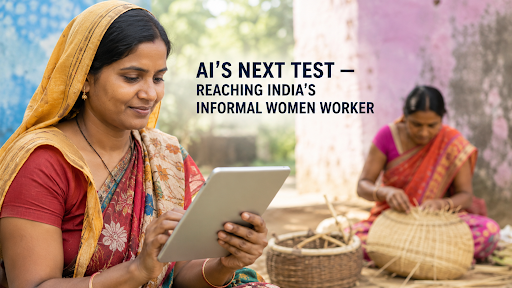
NITI Aayog recently releases report titled "Roadmap on AI for Inclusive Societal Development," shifting the global AI focus from white-collar jobs toward the upliftment of India’s 490 million informal workers
Who are Informal Women Workers?
Informal women workers are women engaged in economic activities without formal employment contracts, regular wages, job security or statutory social protection such as pensions, paid leave, health insurance or maternity benefits.
Key Features
-
Lack of Social Security: No access to provident fund, pension, paid leave, health insurance or other statutory employment benefits.
-
Irregular Employment: Earnings are uncertain, seasonal and highly dependent on market demand.
-
No Written Contracts: Most workers are employed without formal appointment letters or legal job protection.
-
Limited Labour Rights: They often have little bargaining power and face unsafe working conditions.
-
High Economic Vulnerability: Informal workers are disproportionately affected by inflation, pandemics, climate shocks and economic downturns.
Major Occupations
-
Agricultural labourers and cultivators
-
Domestic workers
-
Home-based workers (weaving, embroidery, handicrafts, food processing)
-
Street vendors and hawkers
-
Construction workers
-
Waste pickers and sanitation workers
-
Self-employed workers and micro-entrepreneurs
-
Gig and platform workers (delivery, beauty services, home services)
Status in India
-
Around 82% of working women in India are engaged in informal employment, according to the International Labour Organization (ILO).
-
76.9% of rural working women are employed in agriculture as cultivators or agricultural labourers, according to the Periodic Labour Force Survey (PLFS) 2023–24.
Major Challenges
-
Income instability and low wages
-
Absence of social security and maternity protection
-
Gender wage gap and occupational segregation
-
Unsafe workplaces and exploitation
-
Limited access to institutional credit and digital finance
-
Heavy burden of unpaid care and domestic work
-
Poor access to skill development and formalisation opportunities
Why is AI Important for Informal Women Workers?
Enhances Productivity: AI-powered advisory tools help women improve farm planning, crop management, inventory tracking and daily work efficiency.
-
According to NITI Aayog's AI for Inclusive Societal Development Roadmap, strategic AI adoption could increase labour productivity from US$5 per hour (2025) to US$49 per hour by 2047, raising incomes.
Expands Market Access: AI-enabled e-commerce platforms connect women artisans, farmers and home-based entrepreneurs directly with buyers.
-
Reduces dependence on intermediaries, improves price discovery and enables access to national and global markets.
Improves Financial Inclusion: AI-based credit assessment uses alternative data (mobile transactions, digital payments and business records) to evaluate creditworthiness.
-
Enables women without formal banking histories to access micro-credit, insurance and digital financial services.
Improves Access to Government Services: AI-powered multilingual and voice-enabled assistants simplify access to welfare schemes, pensions, health services and entitlements.
-
Particularly beneficial for women with low literacy or limited digital skills, allowing interaction in local languages.
Strengthens Agricultural Decision-Making: AI provides real-time weather forecasts, pest alerts, market prices and crop recommendations, helping women farmers improve productivity and climate resilience.
Supports Skill Development: AI-powered personalised learning platforms offer digital literacy, vocational training and entrepreneurship education, enabling women to upgrade their skills at their own pace.
Promotes Better Healthcare: AI chatbots and virtual assistants provide maternal health, nutrition, child care and reproductive health information, especially in remote rural areas.
Improves Wage Transparency: AI tools analyse local labour-market data to estimate fair wages, strengthening women's bargaining power in informal and gig work.
Reduces Information Asymmetry: AI delivers timely, localised and verified information on prices, weather, legal rights and employment opportunities, reducing dependence on informal intermediaries.
Builds Climate Resilience: AI-based early warning systems help women prepare for droughts, floods and extreme weather, protecting livelihoods in agriculture and allied sectors.
What are the Major Challenges?
Digital Gender Divide: India's digital gender gap limits women's ability to access AI-enabled services, online markets and digital finance.
-
Only 64.3% of women use the internet compared to 80.5% of men, restricting AI adoption. (Source: NFHS-6))
Low AI and Digital Literacy: Most informal women workers have limited exposure to smartphones, AI tools, digital payments and online business platforms, reducing their ability to benefit from AI-based agriculture, finance and e-commerce services.
Language and Voice Interface Gaps: Many AI applications still perform better in English and a few major Indian languages.
-
Poor support for regional dialects and local accents excludes millions of rural women from AI services.
Algorithmic Bias: AI systems trained on historically biased datasets may discriminate against women in credit scoring, recruitment, insurance and welfare targeting.
-
Women-led micro-enterprises may receive lower AI-generated credit scores despite good repayment potential.
Data Privacy and Online Safety: AI-enabled deepfakes, cyberstalking, identity theft and online harassment discourage women from using digital platforms for entrepreneurship and financial transactions.
-
Fear of Technology-Facilitated Gender-Based Violence (TFGBV) reduces digital participation.
Higher Occupational Exposure to AI: Women are concentrated in clerical, administrative and routine support work—the occupations most exposed to AI-driven automation.
-
Female-dominated occupations have 29% exposure to GenAI compared with 16% for male-dominated occupations. (Source: ILO)
Underrepresentation in AI Ecosystem: Women remain underrepresented in AI research, STEM education and AI leadership, reducing gender-sensitive AI design and limiting access to emerging AI jobs.
Weak AI Governance: Absence of robust AI accountability, explainability and grievance-redress mechanisms makes it difficult for women to challenge discriminatory AI decisions.

Way Forward to Make AI Inclusive for Informal Women Workers
Expand Multilingual & Voice-First AI: Scale up BHASHINI, BharatGen and AI4Bharat to support regional languages, dialects and offline voice interfaces so low-literacy women can access AI services through speech rather than text.
Build AI Literacy as Public Infrastructure: Launch community-based "AI Sakhis" through Self-Help Groups (SHGs), Common Service Centres (CSCs) and Krishi Vigyan Kendras (KVKs) to provide last-mile AI training for women.
-
Integrate AI literacy into Digital Saksharta Abhiyan (DISHA/PMGDISHA) and Skill India programmes.
Mandate Gender-Responsive AI: Require Gender Impact Assessments (GIAs) and Algorithmic Bias Audits before deploying AI systems in recruitment, lending, insurance and welfare delivery.
Strengthen Digital Safety: Implement strong safeguards under the Digital Personal Data Protection (DPDP) Act.
-
Mandate watermarking and labelling of AI-generated content, fast grievance redressal, cybercrime support cells and stricter action against AI-enabled deepfakes and online abuse.
Expand AI-Ready Digital Infrastructure: Upgrade Common Service Centres (CSCs) into AI access hubs equipped with high-speed internet, shared AI devices, edge computing and digital assistance for women.
-
Expand public Wi-Fi and community digital kiosks in underserved regions.
Integrate AI with Social Protection: Link AI platforms with e-Shram, Aadhaar, UPI and DigiLocker for seamless delivery of social security, insurance, pensions and welfare benefits.
-
Use AI to proactively identify eligible beneficiaries and reduce exclusion errors.
Strengthen AI Governance: Establish independent mechanisms for algorithmic audits, explainability, accountability and human oversight in high-risk AI applications.
-
Guarantee the right to appeal AI-assisted decisions affecting employment, credit and welfare.
Establish AI Resource Centres: Set up district-level AI Resource and Innovation Centres offering technical support, mentoring, legal advice and AI tool demonstrations for women-led enterprises.
Conclusion
To achieve the vision of Viksit Bharat 2047, India must intentionally design AI technologies that protect, upskill, and empower its informal women workers, rather than displacing them.
Source: THEHINDU
|
PRACTICE QUESTION Q. "Artificial Intelligence can become a powerful instrument of inclusive development only when it reaches India's informal workforce, particularly women." Discuss. 250 words |