Why In News?
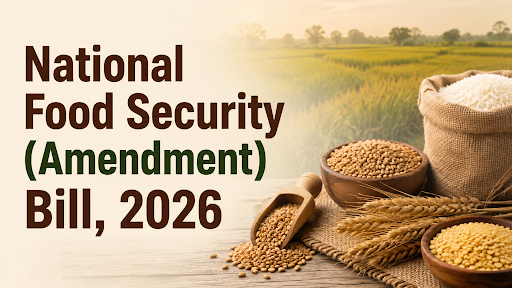
The Department of Food and Public Distribution's draft National Food Security (Amendment) Bill, 2026, proposes changing the Antyodaya entitlement from a flat 35 kg per household to 7 kg per person (capped at 35 kg), raising concerns for large poor families.
What is the National Food Security Act, 2013?
The NFSA establishes a statutory entitlement to subsidised food, connecting Article 21's right to life with dignity to food security via a life-cycle approach that spans from infants to vulnerable households.
Key Provisions
PDS entitlement: Covers up to 75% of the rural and 50% of the urban population, broadly covering about two-thirds of India's population.
Foodgrain entitlement: 5 kg/person/month for Priority Households (PHH) and 35 kg/household/month for Antyodaya Anna Yojana (AAY) households.
Nutritional support: Pregnant women and lactating mothers receive free nutritious meals and a maternity benefit of at least ₹6,000 under the Act.
Children: Children aged 6 months–6 years are entitled to age-appropriate meals through Anganwadis, while children aged 6–14 years are entitled to free mid-day meals in eligible schools.
Food Security Allowance: If entitled foodgrains or meals are not supplied, beneficiaries have a statutory right to a food security allowance.
Women empowerment: The eldest woman aged 18 years or above in an eligible household is treated as the head of household for issuing ration cards.
Accountability: The Act provides for District Grievance Redressal Officers, State Food Commissions, transparency provisions and social-audit mechanisms.
Highlights of the Draft National Food Security (Amendment) Bill, 2026
Shift to Per-Capita Allocation: The draft proposes providing individual Antyodaya Anna Yojana (AAY) beneficiaries with 7 kg of foodgrains per person per month, replacing the legacy system of a flat 35 kg per household.
Maximum Household Cap: Total grain distribution remains strictly capped at 35 kg per household per month. As a result, only AAY families with five or more members will receive the full 35 kg limit.
Government Rationale vs Key Concerns
|
Issue |
Government rationale |
Key concern |
|
Entitlement |
AAY shifts from 35 kg/household → 7 kg/person/month, with a 35 kg household ceiling, creating greater per-capita uniformity. |
A 1-member AAY household would fall from 35 kg to 7 kg/month, while a 6-member household gets only 5.83 kg/person because of the cap. |
|
Small households |
Corrects the anomaly of a single-member household receiving disproportionately high grain entitlement per person. |
Could adversely affect elderly, widowed or disabled single-person households that remain economically vulnerable despite small family size. |
|
Large households |
Households can retain up to 35 kg/month. |
For 6+ members, the proposed 7 kg/person principle is diluted by the 35-kg ceiling. |
|
Equity |
Moves AAY towards person-based allocation, closer to the existing PHH model of 5 kg/person/month.
|
Household size is not a proxy for vulnerability; uniform per-capita allocation may overlook disability, age and dependency burdens. |
Challenges
Coverage–population mismatch: NFSA's 75% rural/50% urban ceiling remains linked to the 2011-era population base, creating a structural coverage gap as population has grown.
AAY design dilemma: The 2026 draft proposes 7 kg/person, capped at 35 kg/household, improving larger-family coverage but reducing protection for smaller AAY households.
Targeting quality: Beneficiary databases require continuous deletion of duplicates/deceased beneficiaries and inclusion of genuine left-outs; otherwise both inclusion and exclusion errors persist.
Digital exclusion: Aadhaar/e-PoS improves traceability, but authentication or connectivity failures can convert a technology safeguard into entitlement denial, requiring reliable fallback mechanisms.
Inter-state implementation gap: NFSA implementation depends heavily on States for beneficiary identification, FPS management and grievance redressal, producing uneven last-mile outcomes.
Cereal–nutrition disconnect: NITI Aayog notes cereals contribute 50–70% of daily energy, while pulses, meat, poultry and fish together contribute only 6–9%, highlighting the gap between foodgrain security and nutrition security.
Climate vulnerability: Rice-wheat-heavy PDS procurement can reinforce water-intensive agriculture; NITI Aayog recommends integrating pulses and millets into PDS to support both dietary and agricultural diversification.
Way Forward
Revisit coverage scientifically: Update NFSA coverage using the latest population and socio-economic data rather than perpetuating the 2011 baseline.
Apply Shanta Kumar's lesson: The Shanta Kumar Committee recommended reducing NFSA coverage to 40% while raising PHH entitlement to 7 kg/person, highlighting the need to balance coverage with adequacy.
Make digitisation exclusion-proof: The Shanta Kumar Committee linked NFSA implementation with end-to-end computerisation, online beneficiary lists and vigilance committees; these should be complemented by offline authentication safeguards.
Strengthen portability: One Nation One Ration Card (ONORC) should be deepened for migrant households so entitlement follows the beneficiary rather than the location of the ration card.
Use grievance data intelligently: Existing nationwide transparency portals, helplines and grievance mechanisms should be converted into real-time exclusion monitoring, rather than merely complaint-registration systems.
Diversify the PDS basket: NITI Aayog recommends linking pulses and millets with PDS, simultaneously improving nutrition, crop diversification and farmer demand.
AI-enabled PDS governance: Integrate AI, ML, NLP and blockchain for monitoring and grievance redressal, offering scope for predictive detection of diversion and exclusion.
Protect entitlement over authentication: The core principle should be “authentication failure ≠ entitlement failure”, with alternative verification and immediate grievance escalation at FPS level.
Conclusion
The proposed NFSA amendment undermines fairness by capping household grain entitlement at 35 kg, which unfairly limits access for larger, vulnerable families despite benefiting smaller households
Source: INDIANEXPRESS
|
PRACTICE QUESTION Q. "Food security is not merely about availability of foodgrains but also about ensuring equitable and reliable access to food for vulnerable households." Discuss. 250 words |