Why In News?
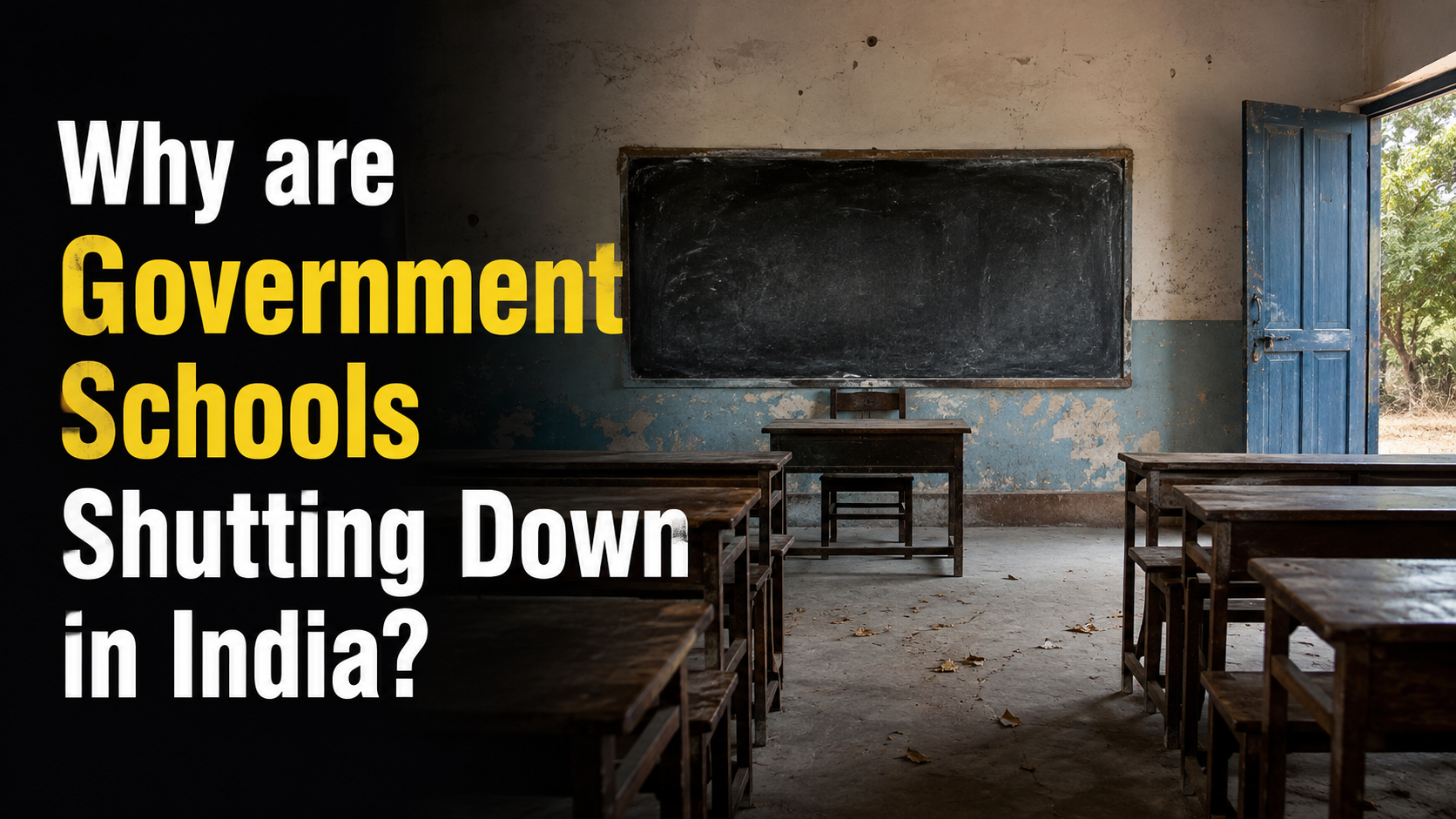
The NITI Aayog 2026 report highlights that government school enrolment has dropped below the 50% mark, currently stagnating at 49.2%.
Why are Government Schools Closing?
Declining Student Enrolment: Government school enrolment has fallen to 49.2% of total enrolment in 2024–25, down from nearly 71% in 2005, reflecting a steady shift towards private schools.
-
NITI Aayog identifies this as a major structural challenge for public education.
State-Level Variations: States such as Uttarakhand and Bihar have witnessed sharp declines in government school enrolment, indicating widening regional disparities.
-
NITI Aayog recommends state-specific strategies rather than a uniform national approach.
School Consolidation & Empty Classrooms: Falling enrollment has resulted in thousands of schools operating with very low student strength, prompting school mergers under consolidation policies.
-
NITI Aayog recommends school complexes/clusters under NEP 2020 to improve resource utilisation without compromising accessibility.
Preference for Private Schools: Parents prefer private schools due to English-medium instruction, perceived better discipline, infrastructure and learning outcomes.
-
ASER 2024 and NITI Aayog note that parental aspirations and perceived quality influence this shift.
Infrastructure & Quality Gaps: Many government schools continue to face shortages of electricity, digital infrastructure, functional toilets and adequate teachers.
-
NITI Aayog reports over 1 lakh single-teacher schools, affecting teaching quality.
Teacher Shortages & Learning Outcomes: Uneven teacher deployment and vacancies reduce classroom effectiveness.
Demographic & Rural Migration: Declining fertility, urbanisation and rising household incomes have accelerated migration from government to private schools, particularly in economically improving states.
-
NITI Aayog highlights demographic changes as a key driver of enrolment shifts.
Weak Public Confidence: Persistent concerns over learning outcomes, governance and accountability have reduced trust in government schools.
-
PARAKH Rashtriya Sarvekshan 2024 and ASER 2024 underline the need to improve foundational learning quality.
What are the Implications of Declining Public Schools?
Reduced Access to Education: School mergers increase travel distance, particularly for young children in rural and tribal areas, undermining the Right to Education (Article 21A).
Hardships for Marginalised Communities: Scheduled Tribes, migrant families, girls and economically weaker sections are disproportionately affected due to poor transport and geographical barriers.
Higher Dropout Risk: Student retention declines sharply beyond elementary education.
Growing Educational Inequality: Dependence on private schooling increases household expenditure and widens socio-economic disparities, conflicting with the Kothari Commission's vision of a Common School System.
Loss of Welfare Benefits: Closure of neighbourhood schools reduces access to PM POSHAN (Mid-Day Meal), free textbooks, uniforms and other student support programmes, particularly for vulnerable children.
Weakening of Public Education: Continuous decline in government school enrolment risks accelerating commercialisation of education.
Threat to NEP 2020 Goals: Declining public-school participation may hinder the achievement of equity, inclusion, universal access and foundational learning envisioned under NEP 2020 and NIPUN Bharat.
What Measures Can Strengthen Government Schools?
Improve Infrastructure: Upgrade schools with science labs, libraries, ICT-enabled classrooms, sports facilities and WASH infrastructure under Samagra Shiksha and PM SHRI Schools, as recommended by NEP 2020.
Fill Teacher Vacancies: Implement time-bound recruitment, transparent transfers and technology-enabled teacher deployment. NEP 2020 recommends merit-based recruitment and continuous professional development.
Strengthen Foundational Learning (FLN): Prioritise FLN through NIPUN Bharat, competency-based teaching and remedial programmes. ASER 2024 and National Curriculum Framework (NCF) 2023 support teaching at the child's learning level.
Empower School Management Committees (SMCs): Strengthen SMCs for monitoring attendance, school development plans and fund utilisation, as envisaged under the RTE Act, 2009.
Bridge the Digital Divide: Expand smart classrooms, broadband connectivity, DIKSHA, PM eVIDYA and digital devices to ensure equitable access to technology-enabled learning.
Modernise Curriculum: Implement NCF 2023 and NEP 2020 through multilingual education, experiential learning, vocational education, AI, coding and digital literacy.
Improve Teacher Capacity: Scale up NISHTHA, mentoring programmes and AI-enabled teacher training to improve classroom pedagogy and assessment.
Enhance Accountability: Operationalise State School Standards Authorities (SSSAs), recommended under NEP 2020, to ensure minimum standards in learning outcomes, governance and infrastructure.
Increase Community & Industry Participation: Encourage Corporate Social Responsibility (CSR) partnerships, alumni networks and local community engagement to improve infrastructure, innovation and vocational exposure.
Performance-Based School Improvement: Use UDISE+, PARAKH and NAS data for evidence-based planning, periodic learning assessments and targeted interventions, as recommended by NEP 2020 and NCF 2023.
Conclusion
To save the public education system, the government must shift its focus from merely consolidating schools to actively filling teacher vacancies, introducing English-medium instruction, and improving foundational learning outcomes to win back the trust of parents.
Source: THEHINDU
|
PRACTICE QUESTION Q. Discuss the factors responsible for the closure of government schools and examine the measures required to strengthen the public education system. 150 words |