Why In News?
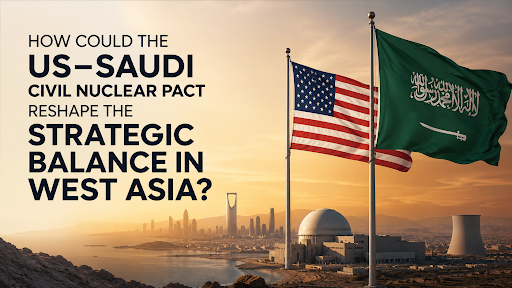
The United States and Saudi Arabia signed a 30-year Civil Nuclear Cooperation ("123") Agreement, allowing US companies to participate in Saudi Arabia's civilian nuclear programme.
What is the US–Saudi Civil Nuclear Pact?
Signed under the US Atomic Energy Act, 1954, which governs US nuclear cooperation with foreign countries and requires Congressional review before transferring sensitive nuclear technology.
Establishes a 30-year framework for transferring US nuclear reactors, technology, fuel-cycle services and equipment for peaceful civilian use.
Includes a bilateral safeguards agreement but does not incorporate the International Atomic Energy Agency ( IAEA ) Additional Protocol, limiting intrusive "snap inspections" at undeclared facilities.
Strategic Significance of the Agreement
Deepened US–Saudi Partnership: Converts the traditional "oil-for-security" relationship into a 30-year multi-billion-dollar technology partnership, creating long-term opportunities for US nuclear firms.
Vision 2030 Support: Supports Saudi Vision 2030 by providing low-carbon electricity for homes, industries and desalination plants, enabling the Kingdom to conserve more crude oil for export.
Regional Power Balance: Strengthens US influence in West Asia while reducing opportunities for China National Nuclear Corporation (CNNC) and Russia's Rosatom to dominate Saudi Arabia's civilian nuclear programme.
US Strategic Footprint: Locks Saudi Arabia into an American nuclear supply chain for three decades, reinforcing US geopolitical influence in the Gulf.
Why is the Pact Important for India?
Energy Security: Over 60% of India's crude oil imports originate from the Gulf region, making stability around the Strait of Hormuz critical for energy security. Any nuclear-related conflict could sharply increase oil prices and inflation.
Strategic Interests: India signed its own India–US 123 Civil Nuclear Agreement in 2008, making regional nuclear stability important for its Think West policy and expanding economic partnerships.
Diaspora Welfare: Around 2.7 million Indians live in Saudi Arabia, the largest expatriate community in the Kingdom. Regional instability could affect their safety and remittance flows.
Source: INDIANEXPRESS
|
PRACTICE QUESTION Q. "Civil nuclear cooperation agreements can simultaneously advance clean energy goals and create strategic security challenges." Discuss . 150 words |