Why In News?
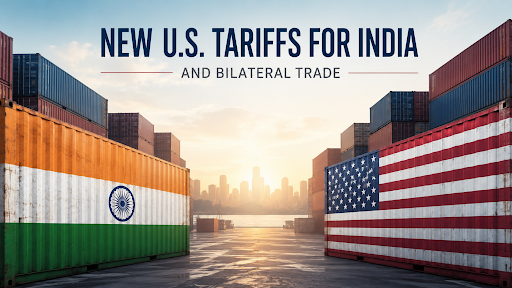
The United States replaced its temporary 150-day import tax under Section 122 with a permanent 10% tariff under Section 301 on July 24, 2026, targeting Indian exports over forced-labor concerns.
What Has the U.S. Announced?
Permanent Tariff Regime: The Office of the United States Trade Representative (USTR) has imposed a permanent 10%–12.5% tariff on imports from 60 economies under Section 301 of the Trade Act, 1974, replacing the temporary 10% emergency tariff.
India's Tariff Rate: India has been placed in the 10% tariff category, lower than the initially proposed 12.5%, after amending its Foreign Trade Policy to prohibit imports made using forced labour.
Forced-Labour Compliance Framework: Countries adopting and enforcing forced-labour import prohibitions received the lower 10% rate, while others face 12.5% tariffs.
Legal Basis: The tariffs have been imposed under Section 301, following a USTR investigation alleging inadequate enforcement of forced-labour restrictions by trading partners.
Why is the 10% Tariff Significant for India?
Relative Competitive Advantage: India remains relatively competitive because major competitors such as Bangladesh, Pakistan, Sri Lanka and the UK also face 10% tariffs, while several economies, including China and Vietnam, face 12.5%.
Lower Compliance Burden: Reduction from 12.5% to 10% protects exporters from steeper cost escalation and preserves price competitiveness.
Positive Policy Signal: The USTR acknowledged India's amendment to its Foreign Trade Policy banning forced-labour imports as a reason for the lower tariff bracket.
Supports Ongoing BTA Talks: The lower tariff indicates that trade negotiations remain active despite disputes, keeping momentum for the proposed India–U.S. Bilateral Trade Agreement (BTA).
Preserves China+1 Opportunity: India continues to remain an attractive destination for firms diversifying supply chains away from China.
Improves Investor Confidence: The policy demonstrates India's willingness to align with global labour and ESG (Environmental, Social, and Governance) standards.
Encourages Supply Chain Reforms: Pushes Indian exporters toward greater traceability and responsible sourcing.
Which Sectors Could Be Affected?
Broad Export Impact: The new 10% tax bracket affects approximately 70% of India's exports to the United States.
Textiles and Apparel: This labor-intensive sector loses tariff-rate quota exemptions planned for other nations, directly threatening local jobs in export hubs like Tirupur.
Engineering Goods: Engineering products, which constitute 27% of India's exports to the U.S., face higher costs for American buyers.
Auto Components: This sector faces compounding pressure as it already suffers under a 25% to 50% tariff under Section 232, which covers 8% of India's total exports.
Chemicals: Chemical exports face the new 10% Section 301 tariff on top of existing standard duties.
Selected Manufacturing Exports: The tariff targets plastics, leather products, furniture, and gems and jewelry, severely denting the growth of the jewelry industry by reducing price competitiveness.
What are the Major Concerns?
Higher Export Costs: The 10% tax applies on top of standard Most-Favored-Nation (MFN) tariffs, creating a double-taxation effect that increases prices for American consumers.
Trade Diversion and Protectionism: The tariff acts as a protectionist wall to shield domestic U.S. businesses, despite the lack of credible factual evidence linking Indian exports to forced labor.
Policy Uncertainty: The U.S. conducts a secondary investigation into "excess capacity" (overproduction and dumping), threatening to trigger additional tariffs in the near future.
Impact on MSMEs: Labour-intensive MSMEs may struggle to absorb additional tariff costs.
Reduced Export Growth: Slower export growth could affect employment in textiles, engineering and leather sectors.
WTO Compatibility: The unilateral use of Section 301 could further weaken the multilateral trading system.
What Opportunities Exist for India?
Accelerated Trade Negotiations: India leverages the ongoing India-US Trade Deal (2026) negotiations to secure lower overall tariffs.
Export Market Diversification: Exporters reduce reliance on the U.S. market—which currently purchases over $100 billion in Indian goods annually—by expanding trade with Africa, Latin America, and Europe.
Strengthened Domestic Manufacturing: The Make in India initiative builds localized supply chains that comply with global labor standards, insulating domestic industries from future foreign audits.
Productivity and Competitiveness Gains: India capitalizes on the shared 10% tariff burden among competitors by boosting production speed and product quality.
Global Value Chain Integration: Strict adherence to robust labor laws attracts multinational corporations executing the "China+1" strategy to relocate manufacturing bases to India.
What Measures Can Minimise the Impact?
Conclude a Comprehensive Bilateral Trade Agreement (BTA): Fast-track the India–U.S. Bilateral Trade Agreement, which is reportedly close to completion, to reduce tariffs, improve market access and provide certainty for exporters.
Diversify Export Markets: Expand exports to the European Union, UK, GCC, Africa, ASEAN, Latin America and BRICS to reduce dependence on the U.S. market.
Reduce Logistics Costs: Accelerate implementation of the National Logistics Policy, PM Gati Shakti, port modernisation and Dedicated Freight Corridors to offset the additional 10% tariff through lower transport costs.
Support MSME Exporters: Provide low-interest working capital, export credit, ECGC insurance, interest equalisation and credit guarantees to MSMEs, especially in textiles, leather, gems & jewellery and engineering sectors.
Promote High-Value Manufacturing: Focus on electronics, pharmaceuticals, medical devices, aerospace and precision engineering, where value addition and innovation reduce tariff sensitivity. India exports nearly US$9.7 billion worth of pharmaceuticals to the U.S. annually.
Strengthen Supply-Chain Compliance: Establish a national supply-chain due diligence and traceability system to prevent forced-labour inputs and ensure compliance with global ESG standards.
Seek Tariff Exemptions: Continue diplomatic engagement with the USTR to secure tariff-rate quotas (TRQs), product-specific exemptions and phased implementation for vulnerable sectors such as textiles and apparel.
Conclusion
India strategically deploys its updated Foreign Trade Policy and accelerates bilateral negotiations to shield vital export sectors from the new U.S. Section 301 tariff walls.
Source: THEHINDU
|
PRACTICE QUESTION Q. "Recent changes in the U.S. tariff regime underscore the growing use of trade policy as a strategic instrument in international relations." Discuss. 150 words |