Why In News?
The Reserve Bank of India (RBI) initiated a pilot trial for ₹10 and ₹20 polymer currency notes to evaluate field trial outcomes to authorize a full-scale rollout of polymer notes by 2027.
What are Polymer Currency Notes?
Material Composition: Polymer currency notes consist of a highly engineered, synthetic plastic material known as Biaxially Oriented Polypropylene (BOPP), which replaces the traditional cotton-fibre paper base to provide a non-absorbent, ultra-strong foundation for advanced security printing.
Global Adoption: Over 50 to 60 countries currently circulate polymer banknotes, including Canada, the United Kingdom, New Zealand, Singapore, and Vietnam.
-
Australia launched the world's first full series of polymer banknotes in 1988.
Why is RBI Exploring Polymer Notes?
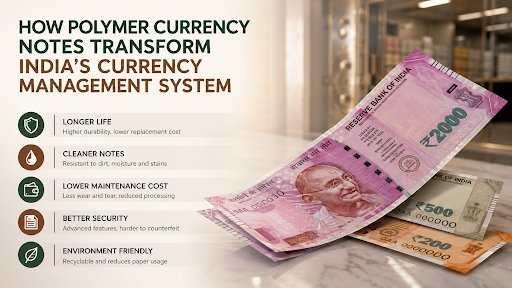
Enhanced Durability: Polymer notes boast a lifespan 2.5 to 4 times longer than conventional cotton-based paper notes, benefiting lower denominations that change hands frequently.
Strengthened Security: The RBI detects a sharp rise in counterfeit currency, intercepting 2.3 lakh fake note pieces recently compared to 2.17 lakh in the previous year; polymer notes resist replication by embedding complex optical effects and transparent windows.
Reduced Currency Management Costs: The RBI spends heavily on cash maintenance, with currency printing costing ₹4,875 crore to manage an active circulation of 17,000 crore individual notes worth ₹41 lakh crore; durable polymer slashes long-term printing and destruction expenses.
Climate Resilience: India's humid and hot climate degrades paper notes, whereas polymer notes do not absorb water, sweat, or dirt, maintaining structural integrity across extreme environments.

Benefits of Polymer Notes
Reduced Counterfeiting: Global case studies prove polymer's efficacy, as Australia achieves and maintains low counterfeiting rates for decades following its transition.
Longer Currency Life: Polymer extends the functional lifespan of low-denomination notes from mere months to several years, cutting down currency turnover.
Lower Long-Term Replacement Costs: Despite higher initial costs—such as Canada spending 25 cents for polymer versus 13 cents for paper—the extended lifespan yields massive net savings, as seen when Australia saves nearly $1 billion in inflation-adjusted terms over 25 years.
Better Hygiene and Cleanliness: The non-absorbent polymer surface wipes clean easily, preventing the buildup of bacteria, oils, and grime.
Improved Public Confidence: Hard-to-counterfeit notes eliminate public fear of accepting fake money, reinforcing trust in the nation's legal tender.
Enhanced Environmental Efficiency: Manufacturing fewer replacement notes directly lowers the environmental footprint by cutting down on transportation, production emissions, and destruction waste.
Source: INDIANEXPRESS
|
PRACTICE QUESTION Q. "Technological innovation in currency management can improve monetary security, operational efficiency and public confidence." Discuss. 150 words |