Why In News?
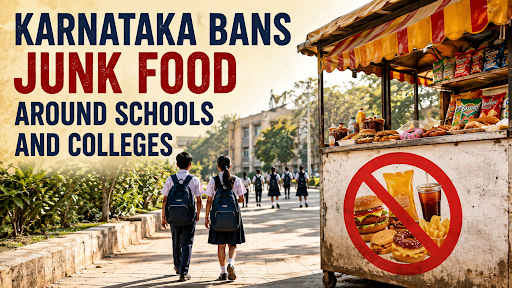
The Karnataka Food Safety and Drug Administration bans the sale, distribution, advertisement, and promotion of High Fat, Sugar, and Salt (HFSS) foods inside school and college campuses and within a 50-metre radius around them.
Karnataka Food Safety Advisory
Nutritious mandate: School and college canteens must provide safe, balanced and nutritious meals, aligning with FSSAI's Guidelines for Making Available Wholesome, Nutritious, Safe and Hygiene Food to School Children, which recommend replacing HFSS foods with healthier alternatives.
Dietary standards: Canteens should ensure 75–80% of menu items comprise whole grains, millets, pulses, fruits, vegetables, milk and eggs to improve dietary diversity and reduce childhood obesity.
Fat restrictions: Reheated cooking oil is prohibited due to the formation of harmful compounds such as trans fats, in line with FSSAI's "Repurpose Used Cooking Oil (RUCO)" initiative.
Healthy food environment: Schools must provide safe drinking water, structured meal timings and nutrition awareness, consistent with the Eat Right India movement promoting healthier food environments.
The advisory reflects the WHO Global Strategy on Diet, Physical Activity and Health, which recommends reducing children's exposure to foods high in fat, sugar and salt to curb non-communicable diseases.
Scope of the Advisory
Institutions covered: The advisory applies to schools and pre-university colleges up to Class XII (II PUC) and has also been extended to hospital canteens, recognising healthy diets as part of preventive healthcare.
50-metre HFSS-free zone: The sale, advertisement and promotion of High Fat, Salt and Sugar (HFSS) foods are prohibited within 50 metres of educational institutions.
Campus warning signs: Institutions must display warning boards discouraging HFSS food consumption and promote informed food choices among students.
Compliance responsibility: School managements are responsible for monitoring compliance by canteens and vendors, strengthening institutional accountability for children's nutrition.
HFSS Foods and Associated Health Risks
The Food Safety and Standards Authority of India (FSSAI) defines HFSS foods as products high in saturated fat, trans-fat, added sugars and sodium, but low in essential nutrients such as dietary fibre, vitamins and minerals, increasing the risk of obesity and non-communicable diseases (NCDs).
-
Common Examples: Refined carbohydrates (white bread, noodles, pasta), sugar-sweetened beverages, packaged snacks, chocolates, pizzas, burgers and deep-fried foods are HFSS products identified by FSSAI for restriction in school environments.
Metabolic Impact: Frequent consumption of HFSS foods causes rapid post-prandial glucose spikes, insulin resistance and poor satiety, impairing children's cognitive performance and increasing long-term metabolic risk.
-
The WHO School Food Environment Guideline (2025/2026) recommends restricting HFSS foods in schools to reduce childhood obesity and diet-related diseases.
Double Burden of Malnutrition: According to the National Family Health Survey (NFHS-5), about 35% of children under five years old in India are stunted (short for their age), and nearly 67% are anaemic (low blood iron).
Aggressive Food Marketing: Children are exposed to HFSS advertisements through digital media, influencer marketing and product placement, shaping unhealthy food preferences from an early age.
-
UNICEF recommends stricter regulation of HFSS marketing targeted at children and mandatory front-of-pack nutrition labelling.
The WHO recommends mandatory nutrition standards for school meals, restrictions on HFSS food sales and marketing in schools, and behavioural "nudges" that make healthy choices the default option.
Framework of Food Safety Regulation in India
Food Safety and Standards Act, 2006: Establishes a unified, science-based food safety regime by repealing multiple fragmented laws, including the Prevention of Food Adulteration Act, 1954, and creates the Food Safety and Standards Authority of India (FSSAI) under the Ministry of Health and Family Welfare.
Risk-based Regulation: The FSSAI adopts a science-based risk analysis framework for setting food standards in line with Codex Alimentarius Commission principles, promoting preventive rather than reactive food safety governance.
Enforcement Powers: Food Safety Officers are empowered to inspect premises, collect samples, seize unsafe food and prosecute offenders, while penalties for sub-standard, misbranded or unsafe food extend up to ₹10 lakh, depending on the nature of the offence.
Food Safety and Standards (Safe Food and Balanced Diets for Children in School) Regulations, 2020: Prohibit the sale, advertisement and free distribution of HFSS (High Fat, Salt and Sugar) foods within school campuses and 50 metres of school gates.
Food Safety and Standards (Labelling and Display) Regulations, 2020: Mandate comprehensive nutrition labelling, ingredient disclosure, allergen declaration and consumer information to promote informed food choices.
Licensing and Registration: Every Food Business Operator (FBO) must obtain an FSSAI licence or registration and comply with Schedule 4 hygiene and sanitary requirements under the Licensing and Registration Regulations, 2011.
Food Recall Mechanism: FSSAI has established a structured recall system requiring Food Business Operators to promptly withdraw unsafe food from the market and inform consumers.
Consumer Participation: The Food Safety Connect portal and mobile application enable consumers to report food safety violations, improving regulatory responsiveness.
Source: thehindu
|
PRACTICE QUESTION Q. Consider the following statements regarding the Food Safety and Standards Authority of India (FSSAI):
Which of the statements given above is/are correct? (a) 1 only (b) 1 and 2 only (c) 2 and 3 only (d) 1, 2 and 3 Answer: (b) Explanation: Statement 1 is Correct. FSSAI is an autonomous statutory body established under the Food Safety and Standards Act, 2006, functioning under the administrative control of the Ministry of Health and Family Welfare. Statement 2 is Correct. The FSS Act of 2006 consolidated multiple fragmented laws and orders—including the Prevention of Food Adulteration Act, 1954, and the Fruit Products Order, 1955—into a single unified umbrella. Statement 3 is Incorrect. FSSAI considers international standards, guidelines, and recommendations such as those established by the Codex Alimentarius Commission when framing science-based food standards for India. |