Why In News?
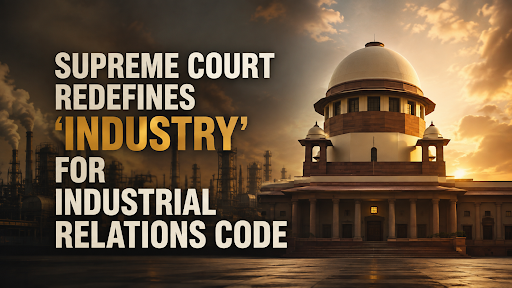
In State of Uttar Pradesh vs Jai Bir Singh, a 9-judge Supreme Court Constitution Bench held that the 1978 Bangalore Water Supply precedent does not govern the definition of "industry" under the Industrial Relations Code, 2020.
Evolution of Industrial Law in India
Colonial Legislation (1855–1947)
Early colonial laws like the Workmen's Compensation Act, 1923, Trade Unions Act, 1926, Payment of Wages Act, 1936, and the Industrial Disputes Act, 1947 focused primarily on maintaining industrial peace for British commercial interests and managing manufacturing disputes.
Post-Independence Legislative Proliferation (1947–2014)
India enacted over 44 Central labour statutes and more than 100 State enactments, creating extreme regulatory fragmentation, conflicting compliance definitions, rigid retrenchment permissions, and an oppressive "Inspector Raj".
The 2nd National Commission on Labour (2002)
Chaired by Ravindra Varma, the Commission recommended rationalizing and amalgamating multiple archaic labour laws into four concise functional codes to ensure worker welfare while providing operational flexibility to enterprises.
Four Labour Codes (2019–2020)
-
The Code on Wages, 2019: Universalizes statutory minimum wages across all employment and eliminates gender pay disparity.
-
The Industrial Relations Code, 2020: Consolidates the Trade Unions Act, 1926, Industrial Employment (Standing Orders) Act, 1946, and Industrial Disputes Act, 1947.
-
The Code on Social Security, 2020: Integrates 9 social security laws and formally extends benefits to unorganized, gig, and platform workers.
-
The Occupational Safety, Health and Working Conditions (OSH) Code, 2020: Consolidates safety and health standards across 13 diverse sectors.

Industrial Regulation in India
Section 2(j) of Industrial Disputes Act, 1947 & the "Triple Test": Defined industry broadly. Under the Bangalore Water Supply (1978) ruling, an activity qualified as an industry if it passed the Triple Test:
-
(1) Systematic activity
-
(2) Organized cooperation between employer and employees, and
-
(3) Production/distribution of goods and services to satisfy human wants and wishes, irrespective of capital or profit motive.
Section 2(p) of the Industrial Relations Code, 2020: Retains the core principle that an industry involves systematic activity carried on by cooperation between an employer and workers for production or distribution of goods/services regardless of profit motive, but introduces Explicit Statutory Carve-Outs:
-
Any institution carrying on entirely charitable, philanthropic, or social services,
-
Any activity pertaining to the sovereign functions of the government (including defence, atomic energy, space, police, and judiciary),
-
Domestic services,
-
Any other activity notified by the Central Government
Key Government Initiatives for Labour Law Reforms
The Four Unified Labour Codes: Rationalized 29 fragmented central labour statutes into 4 modern codes, creating uniform definitions for wages, expanding social security, and standardizing industrial dispute mechanisms.
e-Shram Portal (National Database of Unorganized Workers): A comprehensive national digital database that has registered over 30 crore unorganized and migrant workers, seeded with Aadhaar to deliver targeted welfare, accident insurance (PMMVY), and portable social security.
Pradhan Mantri Shram Yogi Maan-dhan (PM-SYM): A voluntary, contributory pension scheme guaranteeing a monthly pension of ₹3,000 after the age of 60 for unorganized workers with a monthly income of up to ₹15,000.
SAMADHAN Portal for Dispute Resolution: A specialized digital platform (Software Application for Monitoring and Disposal, Handling of Apprehended/Existing Industrial Disputes) enabling online conciliation, automated hearing scheduling, and transparent tracking of industrial disputes.
Shram Suvidha Portal & National Career Service (NCS): Provides a single digital window for online compliance reporting across multiple labour laws, transparent computerized risk-based factory inspections, and an integrated nationwide job-matching portal.
|
Key Reports
|
Challenges in Industrial Relations and Labour Governance
Exclusion of Workers in Non-Profit & Educational Establishments: By excluding charitable hospitals, universities, and philanthropic trusts from Section 2(p) of the IR Code, millions of administrative, sanitation, and support staff lose access to speedy conciliation and Industrial Tribunals.
Higher Thresholds for Retrenchment and Layoffs: The IR Code raises the threshold for requiring prior government permission for closure, lay-off, and retrenchment from 100 workers to 300 workers, sparking trade union concerns regarding job security in medium-sized manufacturing units.
Severe Delays in State-Level Notification of Rules: Although Parliament enacted the 4 Labour Codes in 2019-20, asynchronous rule-making by diverse State Governments under the Concurrent List has delayed full nationwide implementation.
Massive Informalization & Gig Worker Precarity: Over 90% of India's 50+ crore workforce remains in the informal sector, where platform and gig workers lack formal employment contracts, paid leave, minimum wage guarantees, and health insurance.
Stringent Restrictions on the Right to Strike: The IR Code mandates a 14-day advance notice for strikes across all industrial establishments and prohibits strikes during conciliation proceedings, practically eliminating spontaneous union collective action.
Judicial Pendency in Industrial Tribunals: Chronic vacancies of presiding officers in Central Government Industrial Tribunals (CGITs) and State Labour Courts cause commercial dispute adjudication to drag on for years.
Way Forward
Enact Statutory Grievance Redressal Codes for Excluded Sectors: Formulate dedicated, time-bound grievance and arbitration mechanisms under state rules for staff employed in charitable hospitals, NGOs, and universities excluded from the IR Code.
Harmonize Center-State Implementation of the 4 Labour Codes: Convene the Indian Labour Conference (ILC) to establish federal consensus, finalize model state rules, and notify the four codes simultaneously across all States and Union Territories.
Operationalize the Social Security Fund for Gig and Platform Workers: Mandate digital platform aggregators (e-commerce, ride-hailing, food delivery) to contribute 1–2% of annual turnover into the statutory Social Security Fund to provide health, accident, and maternity benefits.
Operationalize the Worker Reskilling Fund: Effectively implement the statutory Worker Reskilling Fund under the IR Code, requiring employers to deposit 15 days of last-drawn wages for retrenched workers to finance vocational upskilling.
Modernize and Digitalize Industrial Tribunals: Integrate Central and State Industrial Tribunals with the National Judicial Data Grid (NJDG) and promote institutional mediation under SAMADHAN to resolve industrial disputes within 90 days.
Strengthen Legitimate Collective Bargaining: Ensure transparent democratic secret-ballot recognition of Negotiating Unions / Negotiating Councils (requiring 51% worker support) to foster genuine enterprise-level bipartite dialogue.
Expand Female Labour Force Participation (FLFP): Implement the OSH Code provisions allowing women to work night shifts across all sectors subject to mandatory employer-provided safety, lighting, and dedicated transport infrastructure.
Conclusion
The Supreme Court's 2026 ruling protects historic worker rights under the 1947 Act while enabling Parliament to establish a modern industrial framework under the Industrial Relations Code, 2020.
Source: THEHINDU
|
PRACTICE QUESTION Q. Discuss the key reforms introduced by the four Labour Codes in India. (10 Marks, 150 Words) |