Why In News?
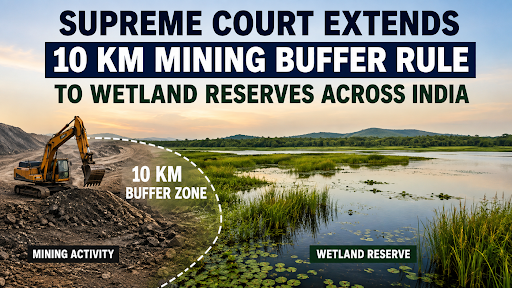
The Supreme Court mandates a 10-km mining buffer zone for all notified wetland conservation reserves across the country.
What are Wetlands?
The Wetlands (Conservation and Management) Rules, 2017 define wetlands as marshes, fens, peatlands and natural or artificial water bodies, excluding river channels, paddy fields, coastal CRZ areas and man-made water bodies.
Wetlands support rich biodiversity. Asan Conservation Reserve hosts 330+ bird species and 49 fish species, while Tsomoriri Lake is India's only breeding habitat for the Black-necked Crane.
Wetlands regulate floods, recharge groundwater, sequester carbon and improve water quality. East Kolkata Wetlands naturally treat nearly one-third of Kolkata's wastewater, illustrating nature-based urban sanitation.
The IPCC Sixth Assessment Report identifies wetlands as among the most cost-effective nature-based solutions for climate adaptation and disaster risk reduction.
Framework for Wetlands Conservation
Wetlands (Conservation and Management) Rules, 2017: Establish State Wetland Authorities, promote wise use, prohibit reclamation, permanent construction and untreated waste disposal in notified wetlands.
Environment (Protection) Act, 1986: Section 3 empowers the Central Government to notify Eco-Sensitive Zones, while Section 5 enables binding environmental directions.
Ramsar Convention: As of August 2026, India has 101 Ramsar Sites, the highest in Asia and third globally; Glaw Lake (Arunachal Pradesh) became the 101st Ramsar Site.
-
Sundarban Wetland (4.23 lakh ha) is India's largest Ramsar Site, while Renuka Lake and Vembannur Wetland Complex (20 ha each) are the smallest.
The National Wildlife Action Plan (2017–2031) recommends a landscape-based conservation approach, improved wetland restoration and stronger community participation.
International recommendation: The Ramsar Convention's Wise Use Principle urges integrating wetland conservation into national land-use planning and development decisions to ensure long-term ecological sustainability.
Impact of Mining on Wetlands
Water contamination: Mining releases toxic slurry, heavy metals and suspended solids, degrading wetland water quality and threatening public health.
-
Case Study: In Shivpuri (Madhya Pradesh), abandoned stone-mining pits have contaminated local water sources, forcing nearby communities to depend on polluted water.
Habitat fragmentation: Blasting, quarrying and haul roads disrupt migratory bird habitats and wildlife corridors, reducing the ecological connectivity of wetlands.
Biodiversity loss: Mining destroys native vegetation and wetland-dependent ecosystems.
-
Case Study: Stone mining around Madhav National Park, Shivpuri, has degraded parts of the endemic Kardhai forest ecosystem, affecting habitat quality for wildlife.
Hydrological disruption: Excavation alters drainage, lowers groundwater tables and weakens the natural filtration functions of wetlands.
-
Case Study: Degradation of Sasthamkotta Lake (Kerala) has been linked to catchment disturbances, threatening the state's largest freshwater lake.
Climate implications: Degradation of wetlands reduces carbon sequestration and weakens flood buffering and drought resilience.
Challenges In Wetland Conservation
Enforcement deficit: Weak monitoring capacity of State Wetland Authorities and inadequate field staff limit enforcement in remote mining areas.
-
The MoEFCC Wetlands Rules, 2017 Implementation Guidelines recommend strengthening State Wetland Authorities through integrated management plans and regular monitoring.
Illegal mining: Organised illegal quarrying continues in ecologically sensitive zones despite statutory restrictions, often exploiting vulnerable tribal communities.
Livelihood dependence: Blanket mining bans may affect Scheduled Tribes (STs) and Scheduled Castes (SCs) unless accompanied by sustainable livelihood alternatives.
Monitoring complexity: Seasonal wetland dynamics and extensive buffer zones make compliance monitoring difficult using conventional inspections alone.
Institutional overlap: Fragmented responsibilities among Forest, Mining, Revenue and Pollution Control authorities weaken coordinated action.
-
The MoEFCC Guidelines recommend integrated wetland management through inter-departmental coordination.
Way Forward
Scientific delineation: Use GIS, IRS LISS-III, remote sensing and drone surveys to demarcate wetlands and their zones of influence.
-
The MoEFCC Wetlands Rules, 2017 Guidelines recommend scientific inventory, delineation and integrated management plans.
Technology-enabled compliance: Deploy real-time air and water quality monitoring, satellite surveillance and AI-assisted detection of illegal mining.
Community-led conservation: Scale up participatory models such as the East Kolkata Wetlands management approach and Pong Dam Lake ecotourism to align conservation with livelihoods.
Ecological restoration: Enforce Wetlands (Conservation and Management) Rules, 2017, mandate mine closure plans, native species restoration and compensatory ecological rehabilitation.
-
The NGT (Shivpuri case) recommended bioremediation, lake restoration, fencing, scientific weed removal and strict compliance with Wetlands Rules, 2017.
Adopt the "wise use" principle: Integrate mining regulation with watershed planning, wetland inventories and ecological carrying capacity, consistent with the Ramsar Convention's Wise Use Framework and the National Wetland Committee's advisory approach.
Source: thehindu
PRACTICE QUESTIONQ. With reference to the Ramsar Convention and wetlands in India, consider the following statements:
Which of the statements given above are correct? (a) 1 and 2 only (b) 2 and 3 only (c) 1 and 3 only (d) 1, 2 and 3 Answer: (d) 1, 2 and 3 Explanation: Statement 1 is correct: India signed the Ramsar Convention on February 1, 1982. Statement 2 is correct: The Sunderban Wetland is the largest site (423,000 hectares), and Renuka Lake is one of the smallest (20 hectares). Statement 3 is correct: Glaw Lake in Arunachal Pradesh was designated as the nation's 101st Ramsar site on August 3, 2026. |