Why In News?
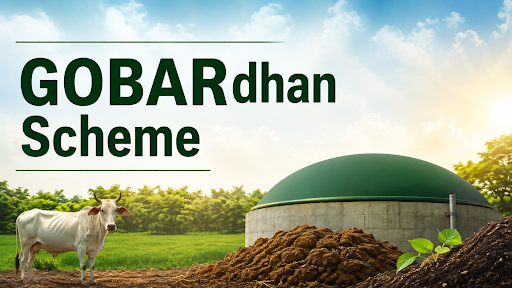
The Union Cabinet approved the GOBARdhan National Circular Bioenergy Scheme with an outlay of Rs 23,731 crore to boost compressed biogas (CBG) production.
What is the GOBARdhan (Galvanizing Organic Bio-Agro Resources Dhan) Scheme?
It is India's National Circular Bioenergy Scheme, which converts cattle dung, crop residue, municipal solid waste and other biodegradable waste into Compressed Biogas (CBG), bio-manure and organic fertilisers, transforming waste into economic assets.
Objectives: Build a complete CBG ecosystem by addressing pricing uncertainty, assured offtake, financing gaps, feedstock aggregation and pipeline connectivity.
The scheme provides capital assistance of up to ₹2 crore per tonne per day (TPD) for eligible greenfield CBG plants, with support also extended to eligible brownfield expansion projects.
-
CBG is produced from cattle dung, crop residues, press mud, municipal solid waste and other biomass and has properties comparable to CNG, enabling its use in transport, industries and City Gas Distribution (CGD) networks.
GOBARdhan operationalises the "Waste-to-Wealth" model by converting organic waste into clean fuel, fermented organic manure (FOM), liquid fermented organic manure (LFOM) and additional rural income, supporting Mission LiFE, Swachh Bharat Mission and India's Net Zero 2070 pathway.

What are the Benefits of Compressed Biogas (CBG)?
Accelerates India's Clean Energy Transition: CBG is a carbon-neutral, renewable gas made from cattle dung, crop residue, and organic waste, replacing fossil CNG/LNG. It supports India's Net Zero 2070 and Panchamrit goals.
Mitigates Greenhouse Gas Emissions: Anaerobic digestion captures methane, preventing its atmospheric release. Because methane possesses a greater short-term warming impact than carbon dioxide, CBG projects provide climate mitigation while minimizing stubble burning and open dumping.
Improves Soil Health through Bio-Manure: CBG plants generate Fermented Organic Manure (FOM) and bio-slurry, reducing dependence on chemical fertilisers, improving soil organic carbon and supporting sustainable agriculture.
-
The Department of Fertilizers also provides Market Development Assistance to promote organic manure utilisation.
Strengthens Energy Security: Domestic CBG production expands India's gas mix, decreasing reliance on LNG imports and enhancing protection against international energy price shocks. Its network integration boosts local gas availability.
Supports Circular Bioeconomy: By converting agricultural residue and animal waste into fuel, organic manure and rural income, CBG operationalises the waste-to-wealth approach under the circular economy.
What are the Challenges?
Feedstock Aggregation Bottlenecks: Scattered livestock ownership, seasonal crop residues and weak village-level aggregation increase logistics costs and reduce plant utilisation, affecting commercial viability.
Capital and Financing Constraints: Although the scheme provides capital assistance up to ₹2 crore per TPD, high upfront investment, long gestation periods and limited access to affordable finance remain major barriers for MSMEs and FPOs
Technology and Skilled Manpower Gap: Efficient operation requires expertise in anaerobic digestion, gas purification, compression and digestate management, capacities that remain limited at district and panchayat levels.
Weak Market and Logistics Ecosystem: Poor connectivity, pipeline infrastructure and offtake arrangements limit commercial expansion despite rising production capacity.
Behavioural and Institutional Challenges: Limited farmer awareness regarding feedstock monetisation, bio-manure markets and long-term contractual arrangements reduces participation in the CBG value chain.
Way Forward
Develop Decentralised Bioenergy Clusters: Establish panchayat-level CBG and community biogas plants linked with FPOs and dairy cooperatives.
-
Under SBM (Grameen) Phase II, assistance of up to ₹50 lakh per district is available for community and cluster-based biogas plants.
Build an Integrated Feedstock Value Chain: Scale digital feedstock mapping, aggregation centres and long-term procurement contracts.
-
The 2026 Model State CBG Policy encourages states to create enabling ecosystems for feedstock security and project viability.
Deepen Private Investment: Stable administered pricing, credit guarantees, assured offtake and long-term policy certainty can improve bankability of greenfield and brownfield CBG projects.
-
Case Study: The National GOBARdhan Scheme (2026) provides a 10-year implementation horizon with a total outlay of ₹23,731 crore to encourage sustained private investment.
Strengthen Institutional Convergence: Integrate GOBARdhan with the National Bioenergy Programme, SBM (G), Animal Husbandry Infrastructure Development Fund and Agriculture Infrastructure Fund to create a circular bioeconomy ecosystem.
Conclusion
The GOBARdhan Scheme turns India's farm and cattle waste into a decade-long engine for clean fuel, farmer income, and energy security.
Source: NEWINDIANEXPRESS
PRACTICE QUESTIONQ. Discuss the significance of the GOBARdhan Scheme for India's circular bioeconomy and energy security. What challenges may hinder its implementation? (150 words) |