Why In News?
The Union Cabinet approved the ₹5,659.22 crore "Mission for Cotton Productivity" (2026–31) to reverse declining crop yields, enhance quality, and align with the government's 5F vision (Farm to Fibre to Factory to Fashion to Foreign) to make India self-reliant and globally competitive by 2031.
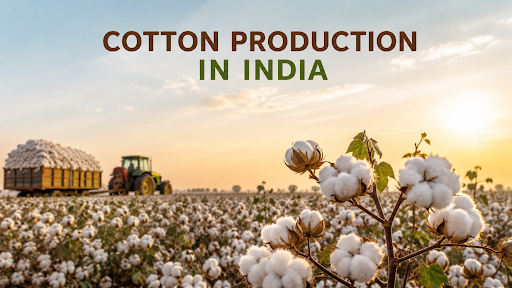
Cotton Production in India
White Gold Status: Industry experts term cotton as "White Gold" due to its immense economic value and contribution to the agricultural GDP.
Climatic Requirements: The crop grows as a semi-xerophyte in tropical and subtropical climates, requiring moderate rainfall.
Soil Distribution: Cultivators plant cotton in deep alluvial soil in the Northern zone, black regur soil in the Central zone, and red-black mixed soils in the Southern zone.
Species Diversity: India stands as the only country globally that cultivates all four recognized cotton species: Gossypium Arboreum, G. Herbaceum, G. Barbadense, and G. Hirsutum.
Dominant Variety: American Upland cotton (G. Hirsutum) dominates domestic fields, accounting for nearly 90% of India's hybrid cotton production.
Cultivation Zones: Farmers cultivate cotton across three distinct zones: the Northern Zone (Punjab, Haryana, Rajasthan), the Central Zone (Gujarat, Maharashtra, Madhya Pradesh), and the Southern Zone (Telangana, Andhra Pradesh, Karnataka).

Why is Cotton Important for the Indian Economy?
Farmer Livelihoods: The cotton sector directly supports the livelihoods of approximately 6 million farmers across India.
Industrial Backbone: Domestic mills consume massive volumes of raw cotton, recording a consumption of 328 lakh bales in 2025-26 to feed spinning, weaving, and garment-making factories.
Massive Employment Generation: Processing and trade activities sustain employment for 40 to 50 million people, making the textile sector the second-largest employer in India after agriculture.
Export Earnings: Cotton exports of fiber, yarn, and garments generate crucial foreign exchange, earning US$ 11.49 billion in FY25, with the United States purchasing 26.35% as the largest buyer.
Circular Economy Integration: Factories crush cotton seeds to extract healthy "heart oil" containing 50% polyunsaturated fatty acids, minimizing agricultural waste.
Livestock Feed Support: Farmers utilize nutrient-rich leftover deoiled cake to feed cattle, poultry, and fish.
Medical Applications: Healthcare facilities utilize short-staple cotton fibers to manufacture pure, highly absorbent surgical cotton.
Key Features of Indian Cotton Ecosystem
Global Cultivation Leadership: India dedicates 114.84 lakh hectares of land to cotton, representing approximately 38% of the global cotton cultivation area. India ranks as the second-largest cotton producer in the world, following China.
Integrated Value Chain: India maintains a complete domestic supply chain, transforming raw farm cotton into finished fashion garments locally.
Modernization and Mechanization: The government targets the upgrade of 2,000 ginning and processing factories and promotes High-Density Planting Systems (HDPS) to prepare crops for mechanical harvesting.
Sustainability Focus: The ecosystem actively promotes cotton waste recycling and circular economy practices to minimize environmental impact.
Technical Textiles Expansion: The National Technical Textiles Mission (NTTM) deploys ₹1,480 crore to develop specialized textiles for healthcare, infrastructure, and defense.
Traceability and Quality Assurance: The Kasturi Cotton Bharat program implements blockchain technology and QR codes to track cotton from the farm to the final buyer.
Digital Farmer Integration: Over 41 lakh farmers utilize the Kapas Kisan app to book sales slots and receive transparent, Aadhaar-linked payments.
Fibre Diversification: The mission explores complementary natural fibers like bamboo, banana, and flax to diversify and support the primary cotton ecosystem.
Major Challenges in Indian Cotton Sector
Low Agricultural Yield: India's cotton yield stands at a low 477 kg per hectare, contrasting sharply with China's yield of over 2,000 kg per hectare.
Climate Vulnerability: Approximately 62% of India's cotton cultivation occurs in rain-fed areas, leaving crops highly vulnerable to erratic rainfall and droughts.
Pest Infestations: The destructive Pink Bollworm pest has evolved resistance to the toxic proteins in genetically modified Bt cotton (Cry1Ac and Cry2Ab genes).
Price Volatility: Global market crashes frequently push cotton prices below the government-mandated support prices, causing severe financial distress to farmers.
Contamination and Trash Content: Manual hand-picking leaves 8% to 14% trash (leaves and twigs) in cotton bales, leading to export rejections or heavy discounts.
Synthetic Competition: Cheaper synthetic and man-made fibers aggressively compete with natural cotton, threatening its global market share.
Labor Shortages and High Costs: Manual picking consumes immense time and drives harvesting costs to 35% of total production expenses due to acute labor shortages.
Mechanization Barriers: Tall and bushy Indian hybrid cotton varieties restrict the effective use of standard mechanical harvesters.
Government Initiatives Supporting the Cotton Sector
Kasturi Cotton Bharat Initiative: The Ministry partners with industry bodies to brand premium cotton, certifying 3,29,550 bales for supreme quality and 100% traceability.
Cotton Corporation of India (CCI) Interventions: The CCI provides a robust safety net by purchasing 105.09 lakh bales of cotton in 2025-26, transferring ₹41,530 crore directly to farmer bank accounts.
Minimum Support Price (MSP) Guarantees: The government increases the MSP for medium staple cotton to ₹8,267 per quintal for the 2026-27 season to protect farmer margins.
PM MITRA Parks: The government invests ₹4,445 crore to establish 7 Mega Integrated Textile Region and Apparel (PM MITRA) Parks across states like Tamil Nadu, Gujarat, and Madhya Pradesh.
National Technical Textiles Mission (NTTM): The Ministry funds 168 R&D projects and 24 startups under the ₹1,480 crore NTTM scheme to drive high-tech fabric innovation.
Production Linked Incentive (PLI) Scheme: A ₹10,683 crore PLI scheme rewards manufacturers producing high volumes of man-made fabrics and technical textiles.
Special Project on Cotton (NFSM): The government demonstrates advanced planting techniques across 14,740 hectares of farmer fields to showcase yield improvements.
GST Rationalisation: The government reduces the GST on man-made fibers and yarns from 12%–18% down to 5% to support textile factory growth
Way Forward
Adopt High-Density Planting Systems (HDPS): Farmers must adopt closer seed spacing; for instance, Shri Vinodbhai Vadodriya from Rajkot, Gujarat, boosted his yield by 30-35% and avoided pest cycles through early harvesting using HDPS.
Accelerate Next-Generation Seed Research: Scientists must fast-track the development of high-yielding, pest-resistant seed varieties.
Promote Climate-Resilient Cultivation: Cultivators should transition back to native Desi Cotton (Gossypium Arboreum), which naturally tolerates extreme droughts and resists the cotton leaf curl virus.
Enhance Fibre Quality and Certification: Processing units must install automated pre-cleaning equipment to eliminate trash and strictly adhere to Kasturi certification standards.
Expand Modern Ginning Infrastructure: The government must subsidize fully automated ginning mills to process high volumes cleanly and eliminate manual contamination.
Empower Farmer Producer Organisations (FPOs): Farmers must leverage FPOs to collectively purchase and share expensive mechanical cotton pickers.
Strengthen Global Branding and Value Addition: India showcases its textile capabilities to global executives through mega-events like Bharat Tex, which attracts over 1,20,000 visitors from 100+ countries.
Fast-Track Seed Regulations: Regulatory bodies must expedite approvals for advanced biotech seeds, including Pink Bollworm-resistant Bt varieties and Herbicide Tolerant (HTBt) cotton, to combat pests effectively.
Conclusion
Integrating modern high-density farming methods with robust digital branding and quick regulatory seed approvals will transform the Indian cotton sector into a dominant, sustainable global force.
Source: PIB
|
PRACTICE QUESTION Q. "India's competitiveness in the global textile industry depends as much on cotton quality and value addition as on production volumes." Discuss. 150 words |