Why In News?
India signed a 10-year contract with Iran in May 2024 to equip and operate the Chabahar Port, fulfilling its $120 million financial commitment for port equipment.
About Chabahar Port
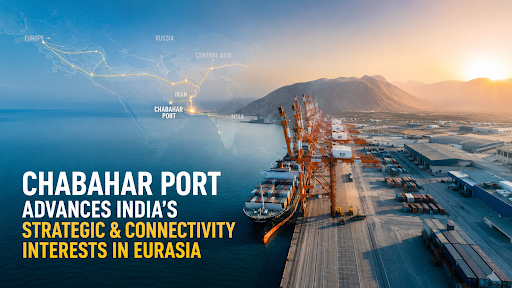
Geographic Location: Iran's only deep-sea oceanic port sits in the Sistan and Baluchestan province on the Gulf of Oman, opening directly into the Indian Ocean.
Dual-Terminal Structure: The port comprises two main terminals, namely Shahid Kalantari and Shahid Beheshti.
Indian Management: India exclusively manages and operates the Shahid Beheshti terminal.
Maritime Proximity: The port lies just 550 nautical miles from the Kandla Port in Gujarat, India, ensuring rapid sea access.

Why is Chabahar Strategically Important for India?
Direct Eurasian Access: The port establishes a direct land-sea route to Afghanistan and Central Asia, bypassing Pakistan's land border restrictions.
INSTC Integration: Chabahar serves as the southern entry point for the 7,200 km International North-South Transport Corridor (INSTC), which slashes transit times by 40% and freight costs by 30%.
Geopolitical Counterweight: The facility counters China's growing naval and trade footprint in the Arabian Sea, sitting just 170 kilometers from the Chinese-operated Gwadar Port in Pakistan.
Energy and Trade Security: The route allows landlocked, resource-rich Central Asian nations like Kazakhstan (which provides 80% of India's uranium needs) to export natural gas and minerals directly to India.
Chokepoint Avoidance: India utilizes this route to bypass the highly congested and volatile Strait of Hormuz.
Strategic Alliance: The project cements a robust military and diplomatic partnership with Iran, securing Indian interests in the Persian Gulf.
What are the Key Features of India's Chabahar Project?
IPGL Management: India Ports Global Limited (IPGL) equips and manages the daily logistics of the Shahid Beheshti terminal, deploying heavy machinery including six high-capacity mobile harbor cranes.
Long-Term Agreement: India and Iran sign a 10-year contract in May 2024, committing $120 million for port equipment alongside a $250 million credit line for infrastructure development.
Rail Connectivity: The 628-km Chabahar-Zahedan railway line reaches 89% completion, seamlessly linking maritime cargo to the national Iranian rail network.
Humanitarian Gateway: India successfully ships 2.5 million tonnes of wheat and 2,000 tonnes of pulses through this route to provide aid to Afghanistan.
Eurasian Market Access: Integration with the INSTC connects Mumbai directly to Moscow, unlocking a Eurasian trade market valued at over $170 billion.
Exponential Traffic Growth: Cargo traffic surges to 60,088 TEUs of containers in 2023-24, representing a massive 558% increase year-on-year.
Dispute Resolution: Both nations agree to resolve legal disputes under the United Nations Commission on International Trade Law (UNCITRAL) framework.
What Challenges Affect the Chabahar Project?
West Asian Instability: Ongoing conflicts involving the US, Israel, and Iran create an unstable investment environment, highlighted by recent regional military strikes.
Sanctions Regime: The United States maintains "maximum pressure" sanctions on Iran, leaving India dependent on a temporary waiver.
Infrastructure Delays: The Chabahar-Zahedan railway faces prolonged delays after India withdrew from direct construction due to sanction fears.
Sino-Pakistani Competition: China's $1.6 billion investment in Pakistan's Gwadar Port under the China-Pakistan Economic Corridor (CPEC) creates intense regional competition.
Financial Risk Aversion: International banks and shipping lines avoid the port to prevent violating secondary US financial sanctions.
Budgetary Reductions: The Indian government slashes direct budget allocations for the port to zero in the 2026-27 Union Budget to mitigate direct sanction risks.
What Measures Can Strengthen India's Chabahar Strategy?
Accelerate Rail Infrastructure: India must expedite the remaining links of the Chabahar-Zahedan railway to accelerate cargo transit to Central Asia.
Proactive Diplomacy: Indian diplomats must negotiate with the US government to secure a permanent, connectivity-linked sanctions exemption.
Expand Port Capacity: India must supply additional heavy machinery, including reach stackers and forklifts, to scale port capacity from 8 million tonnes to 18 million tonnes.
Domestic Port Integration: Shipping authorities must link Chabahar directly to domestic hubs like Kandla and Mumbai via dedicated shipping lines.
Alternative Financial Channels: India and Iran must operationalize a robust Rupee-Rial trade system to bypass US-dollar-denominated transactions.
Private Sector Mobilization: Policymakers must establish non-US-exposed trade entities to encourage private investment in the Chabahar Free Trade Zone without sanction risks.
Conclusion
The Chabahar Port remains India's most critical strategic asset for bypassing Pakistan, accessing resource-rich Eurasia, and countering China's regional dominance, provided it can successfully navigate US sanctions.
Source: INDIANEXPRESS
|
PRACTICE QUESTION Q. "Chabahar Port is more than a connectivity project; it is a strategic instrument of India's foreign policy in Eurasia." Discuss. 150 words |