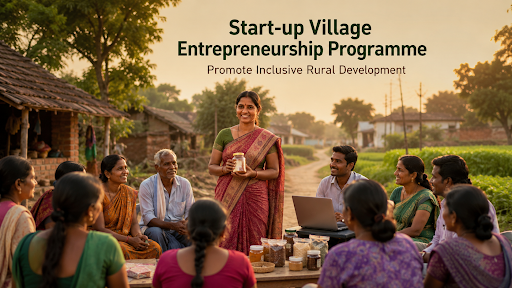
Why In News?
The Ministry of Rural Development reports that the Start-up Village Entrepreneurship Programme (SVEP) supports over 4.32 lakh rural enterprises by June 2026.
What is the Start-up Village Entrepreneurship Programme (SVEP)?
SVEP, launched in 2026, is a sub-scheme of the Deendayal Antyodaya Yojana–National Rural Livelihoods Mission (DAY-NRLM) under the Ministry of Rural Development (MoRD).
It aims to promote rural entrepreneurship by helping Self-Help Group (SHG) members and their family members establish and sustain non-farm micro-enterprises, thereby creating sustainable livelihoods and reducing rural poverty.
Objectives
-
Promote self-employment and non-farm livelihoods in rural areas.
-
Support first-generation entrepreneurs from poor rural households.
-
Generate local employment and reduce migration.
-
Strengthen the rural economy through micro and nano enterprises.
-
Democratise entrepreneurship through community-led institutions.
Key Features of SVEP
Community Enterprise Promotion: The program utilizes local talent by creating a dedicated cadre of Community Resource Persons-Enterprise Promotion (CRP-EP).
Empowered Mentors: Local SHG women comprise the majority of CRP-EPs, undergoing 56 days of training to mentor up to 50 local enterprises each, assist in writing business plans, and resolve daily operational issues.
Financial Support: The scheme establishes a Community Enterprise Fund (CEF) to provide flexible start-up capital directly controlled by SHGs.
Affordable Investment: The average financial investment per village enterprise stands at a highly affordable ₹27,083.
Capacity Building: The National Institute of Entrepreneurship and Small Business Development (NIESBUD) acts as the National Resource Organisation (NRO) to train rural entrepreneurs and CRP-EPs in market linkages, banking, and basic accounting.
Social Inclusion: The program targets marginalized groups, with 86% of beneficiaries hailing from SC, ST, OBC, or Minority backgrounds.
Gender Mandate: The policy officially mandates that women must constitute at least 60% of the total beneficiaries.
Major Challenges of the Start-up Village Entrepreneurship Programme (SVEP)
Limited Access to Institutional Credit: Many first-generation rural entrepreneurs struggle to obtain timely bank loans due to inadequate collateral, low credit history and procedural delays, despite convergence with schemes like PM Mudra Yojana.
Low Enterprise Survival Rate: A significant number of micro-enterprises face challenges in scaling up because of weak business planning, limited mentoring and inadequate market access.
Market Linkage Constraints: Rural entrepreneurs often depend on local markets, resulting in low profitability, weak branding and limited access to e-commerce platforms.
Digital and Financial Literacy Gaps: Many beneficiaries, particularly women and first-time entrepreneurs, lack digital, accounting and financial management skills, affecting business sustainability.
Regional Disparities: SVEP implementation remains uneven across States, with stronger performance in Assam, Bihar, Jharkhand, West Bengal and Madhya Pradesh, while several regions require greater outreach.
Infrastructure Deficits: Poor rural roads, storage facilities, electricity and internet connectivity increase production and transaction costs.
Capacity Constraints of Community Institutions: Variations in the quality of Community Resource Persons–Enterprise Promotion (CRP-EPs) and Block Resource Centres (BRC-EPs) affect enterprise handholding and monitoring.
Limited Value Addition: Most enterprises remain concentrated in low-value retail and traditional activities, limiting income growth and competitiveness.
Climate and Economic Vulnerability: Rural micro-enterprises are highly vulnerable to inflation, natural disasters and fluctuations in local demand
Way Forward
Improve Credit Flow: Simplify bank lending procedures, strengthen credit guarantees and deepen convergence with PM Mudra Yojana, Stand-Up India and other financial inclusion initiatives.
Strengthen Market Linkages: Connect SVEP enterprises with ONDC, Government e-Marketplace (GeM), e-commerce platforms and ODOP initiatives to expand market access.
Promote Digital Entrepreneurship: Provide training in digital payments, bookkeeping, GST compliance, social media marketing and e-commerce.
Develop Rural Enterprise Clusters: Create cluster-based ecosystems for food processing, handicrafts, agro-processing and rural services to improve economies of scale.
Expand Skill Development: Integrate SVEP with PM Vishwakarma, Skill India Mission and entrepreneurship development programmes to improve productivity.
Strengthen Value Chains: Invest in branding, packaging, quality certification, warehousing and cold-chain infrastructure to increase value addition.
Leverage Technology: Use AI-enabled monitoring, digital dashboards and mobile applications for real-time enterprise tracking and mentoring.
Promote Women-Led Enterprises: Provide targeted incentives, mentoring and leadership support for women entrepreneurs through SHGs.
Enhance Monitoring & Impact Evaluation: Use outcome-based performance indicators focusing on enterprise survival, employment generation and income enhancement.
Strengthen Convergence: Integrate SVEP with DAY-NRLM, PM Formalisation of Micro Food Processing Enterprises (PMFME), MSME schemes, Agriculture Infrastructure Fund (AIF) and State livelihood missions for holistic rural enterprise development.
Conclusion
By empowering rural youth and women to transition from desperate job-seekers to successful job-creators, the Start-up Village Entrepreneurship Programme (SVEP) curbs distress migration and builds the true foundation for an Atmanirbhar Bharat.
Source: PIB
|
PRACTICE QUESTION Q. “Decentralized micro-entrepreneurship is key to addressing India's twin challenges of rural poverty and distress migration.” Discuss. 250 words |