Why In News?
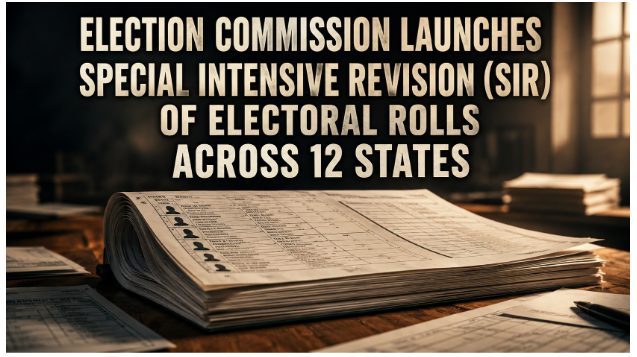
The Election Commission of India (ECI) launched the second phase of the Special Intensive Revision (SIR) of electoral rolls across 12 States and Union Territories.
What is Special Intensive Revision (SIR)?
It is an exercise undertaken by the Election Commission of India to verify and revise electoral rolls through house-to-house enumeration, pre-filled forms, and verification of old voter data.

Statutory Basis under RPA 1950
Empowered by Article 324 of the Constitution read with Section 21(3) of the Representation of the People Act, 1950 (RPA 1950), the ECI orders a Special Intensive Revision to conduct a complete physical overhaul of electoral rolls for reasons recorded in writing.
100% Door-to-Door Verification
Unlike routine annual summary revisions where voters apply individually, SIR mandates Booth Level Officers (BLOs) to visit every household, issue customized enumeration slips, and verify physical residency.
Historical Roll Cross-Matching
Electors are cross-referenced with historic computerized rolls (2002–2004 base data); electors listed in historical rolls require no fresh documentation, whereas unlisted names must furnish proof of age, citizenship, and ordinary residence.
Evolution of Electoral Roll Revision in India
Annual Intensive Revisions (1950s–1970s): In post-independence India, the ECI conducted universal door-to-door physical enumeration every single year under the Registration of Electors Rules, 1960.
Shift to Summary Revisions (1980s–2000s): Escalating demographic growth made annual physical enumeration logistically unsustainable; the ECI adopted annual Summary Revisions with periodic Intensive Revisions ordered every 10–15 years (last nationwide intensive revisions occurred in 2002–2004).
Digitization & ERONet 2.0 Deployment: Centralized national electoral roll database via ERONet 2.0, introducing automated algorithmic detection for Demographically Similar Entries (DSEs) and Photo Similar Entries (PSEs) across state borders.
Statutory Qualifying Dates (2021 Amendment): The Election Laws (Amendment) Act, 2021 amended Section 14(b) of RPA 1950 to establish four qualifying dates per year (January 1, April 1, July 1, October 1), ending the single January 1 cutoff for young electors.
Significance of Electoral Roll Purification
Safeguarding Universal Adult Suffrage: Fulfills the constitutional mandate of Article 326, ensuring every eligible citizen aged 18 and above is registered without arbitrary exclusion.
Elimination of Ghost & Duplicate Electors: Field audits in intensive revisions removed over 5.18 crore duplicate, shifted, and deceased voter entries across 12 states, preventing electoral manipulation.
Enfranchising Marginalized Communities: Deploys dedicated tracking to enroll Particularly Vulnerable Tribal Groups (PVTGs), Persons with Disabilities (PwDs), homeless citizens, and transgender persons via mobile enrollment camps.
Restoring Political Trust & Inter-Party Transparency: Freezing rolls and publishing draft lists for open public claims and objections (Forms 6, 7, 8) builds multi-party confidence in electoral integrity.
Key Supreme Court Directives
Inderjit Barua vs Election Commission of India (1985): The Supreme Court held that conducting elections on unrevised or flawed electoral rolls when an intensive revision is possible violates the constitutional sanctity of free and fair elections.
Association for Democratic Reforms (ADR) vs Union of India (2002): Affirmed that voter awareness and access to transparent, accurate electoral rolls are intrinsic to the fundamental freedom of expression under Article 19(1)(a).
Supreme Court Judgment on Section 21(3) RPA 1950 (May 2026): The Apex Court upheld the ECI's constitutional authority under Article 324 read with Section 21(3) to order Special Intensive Revisions, while mandating strict adherence to statutory notice procedures before deleting any name.
Voluntary Aadhaar-Voter ID Linkage (2023–2024): Clarified that submitting Form 6B for Aadhaar linking under the 2021 amendment is strictly voluntary; no voter's name can be struck off for non-submission of Aadhaar.
Challenges in Electoral Roll Management
Risk of Arbitrary Deletions Without Due Notice: Deletions executed without strictly issuing individual show-cause notices under Rule 21A of the Registration of Electors Rules, 1960 disenfranchise genuine marginalized citizens.
Overburdened Booth Level Officers (BLOs): Primary school teachers and Anganwadi workers perform BLO duties in addition to routine classroom responsibilities, causing hurried or incomplete physical field verifications.
Rapid Urban Migration & High Voter Apathy: Frequent residential shifts among urban renters and inter-state migrant labourers result in outdated addresses and duplicate EPIC entries across constituencies.
Subdued Registration in the 18–19 Youth Cohort: Despite four annual qualifying dates, youth registration rates remain below 40% of eligible first-time electors due to lack of campus-level voter awareness.
Algorithmic False-Positives in De-duplication: Automated Photo Similar Entry (PSE) algorithms frequently flag identical twins or common demographic names as bogus voters, generating wrongful deletion notices.
Cross-Border Infiltration & Document Friction: Border districts in eastern states (e.g. Manipur) witness intense political disputes over documentation requirements demanded from electors not found on historical 2002 rolls.
Way Forward
Mandate Digital Geotagging on the BLO Mobile App: Enforce mandatory GPS-stamped verification for every household visit on the BLO app to eliminate desk-bound entries.
Integrate with Civil Registration System (CRS) for Auto-Deletions: Link ECI's ERONet platform directly with the Registrar General of India's birth and death registry (CRS) to automatically strike off deceased electors in real time.
Enforce Mandatory Physical Hearings Before Deletions: Strictly comply with Rule 21A by requiring written notices, public display at Gram Panchayat offices, and personal hearings before executing any Form 7 deletion.
Establish a Dedicated Full-Time Electoral Cadre: Create permanent, trained block-level electoral assistance officers to replace overburdened primary school teachers and Anganwadi workers.
Universalize Campus-Based Voter Enrollment Drives: Institutionalize mandatory voter registration desks during university admissions across all four statutory qualifying dates (Jan 1, Apr 1, Jul 1, Oct 1).
Deploy Advanced Non-Intrusive Biometric De-duplication: Upgrade ERONet with AI algorithms capable of cross-matching multi-modal facial biometric vectors without relying on third-party identification databases.
Implement Secure Domestic Migrant Remote Voting (RVM): Operationalize prototype Remote Voting Machines (RVM) to allow domestic migrant workers to vote for their home constituencies without travelling.
Conclusion
The Special Intensive Revision of electoral rolls upholds the constitutional promise of universal adult franchise, transforming voter lists into an error-free, inclusive, and transparent foundation for Indian democracy.
Source: NEWSONAIR
|
PRACTICE QUESTION Q1. "A pure and transparent electoral roll is the indispensable cornerstone of free and fair elections." Discuss. (10 Marks, 150 Words) |