Why In News?
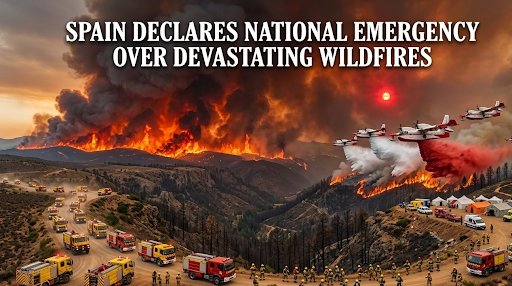
Spain declares a national emergency in the Madrid and Ávila regions as unprecedented wildfires force the evacuation or confinement of over 60,000 people.
What is Wildfires?
Wildfires include surface fires, ground (peat) fires, and crown fires, with crown fires spreading fastest and causing maximum ecological damage.
Fire Triangle: Wildfires require heat, oxygen and fuel; prolonged drought and dry biomass significantly increase fire intensity.
Fire Weather Index (FWI): Many countries use the Canadian Fire Weather Index (FWI) to forecast wildfire danger based on temperature, humidity, wind speed and rainfall.
Pyrocumulonimbus (PyroCb) Clouds: Extremely intense fires can generate fire-induced thunderstorms, producing lightning and erratic winds that create new fire outbreaks.
Drivers of Increased Wildfire
Climate Change: Rising global temperatures increase heatwaves, flash droughts and fuel aridity, making forests highly flammable even after wetter-than-normal spring seasons.
Extreme Heatwaves: Temperatures exceeding 40°C, combined with low humidity, rapidly dry vegetation and increased ignition probability.
Strong Winds: High winds accelerate flame spread, transport burning embers over long distances, and make suppression operations extremely difficult.
Heavy Spring Rain Followed by Summer Drought: Above-normal rainfall promotes abundant vegetation growth, which later dries during summer, creating large fuel loads that intensify wildfires.
Land-Use Change & Rural Abandonment: Declining traditional farming, grazing and forest management allow combustible biomass to accumulate, increasing fire intensity.
Expansion of the Wildland–Urban Interface (WUI): Rapid urbanisation near forests exposes more people, homes and infrastructure to wildfire risks.
Highly Flammable Vegetation: Large-scale plantations of pine and eucalyptus increase fire intensity because of their high resin and oil content.
Lightning & Dry Thunderstorms: Climate change is increasing dry thunderstorms, resulting in more natural ignitions.
Human Activities: Negligence, agricultural burning, discarded cigarettes, campfires, power-line failures and arson remain major ignition sources.
Climate-Induced Longer Fire Seasons: Europe now experiences wildfire seasons lasting several months longer than historical averages due to warmer springs and delayed autumn rainfall.

Lessons for India from the Spanish Wildfires
Strengthen Early Warning Systems: Expand the Forest Survey of India (FSI) Fire Danger Rating System, to predict high-risk zones using temperature, humidity, wind, fuel moisture and terrain conditions.
Enhance Forest Fire Monitoring: Integrate MODIS, VIIRS, Sentinel, INSAT and drone-based thermal imaging with AI analytics to provide real-time hotspot detection, Fire Radiative Power (FRP) estimation and rapid response.
Promote Community-Based Forest Management: Strengthen Joint Forest Management Committees (JFMCs), Van Panchayats and tribal communities to undertake fuel-load reduction, fire-line maintenance and community surveillance.
Climate-Resilient Disaster Planning: Integrate wildfire risk into State Disaster Management Plans, especially in the Wildland–Urban Interface (WUI), with fire-resistant building standards and evacuation planning.
Strengthen Firefighting Capacity: Develop specialised Forest Fire Response Units with helicopters, water bombers, drones, thermal cameras and rapid-response teams on the lines of Spain's Military Emergency Unit (UME).
Use AI & Decision Support Systems: Deploy AI, machine learning, GIS and UAVs for predictive wildfire modelling, resource allocation and evacuation planning.
Strengthen Climate Adaptation: Integrate wildfire management with Green India Mission, CAMPA, National Action Plan on Climate Change (NAPCC) and landscape restoration programmes.
Improve Fire Risk Mapping: Prepare district-level wildfire vulnerability maps using historical fire hotspots and vegetation data for resource prioritisation. FSI has already identified fire-prone forest areas using long-term GIS analysis.
Promote Indigenous Knowledge: Incorporate traditional fire management practices of forest-dependent communities into scientific forest management.
Measures to Reduce Wildfire Risks
Scientific Forest Management: Adopt prescribed burning, controlled grazing, thinning and fuel-load reduction to minimise combustible biomass.
Landscape-Level Fire Prevention: Create fire lines, firebreaks, water reservoirs, hydrants and buffer zones in high-risk landscapes
Strengthen International Cooperation: Collaborate with FAO, Global Fire Management Hub, Global Fire Monitoring Center (GFMC) and regional mechanisms for technology sharing, training and emergency assistance.
Develop Dedicated Wildfire Command Centres: Establish state-level command-and-control centres integrating satellite imagery, weather forecasts and AI-based decision support.
Strengthen Drone-Based Firefighting: Deploy UAVs for thermal mapping, hotspot identification, firefighter safety and post-fire damage assessment.
Improve Water Infrastructure: Construct forest ponds, check dams and emergency water storage in fire-prone forests to support firefighting operations.
Strengthen Inter-Agency Coordination: Improve coordination among MoEFCC, FSI, NDMA, NDRF, SDRF, IMD and State Forest Departments through unified incident command systems.
Adopt Nature-Based Solutions: Restore wetlands, grasslands and ecological buffers that naturally reduce fire spread.
Increase Research & Innovation: Invest in wildfire behaviour modelling, fire-resistant species, climate-risk assessment and indigenous firefighting technologies.
Conclusion
The devastating wildfires in Spain underscore the urgent need to transition from reactive firefighting to comprehensive, climate-resilient landscape management and robust international cooperation.
Source: THEHINDU
|
PRACTICE QUESTION Q. "The increasing frequency and intensity of wildfires underscore the growing challenge of climate-induced disasters." Discuss. 150 words |