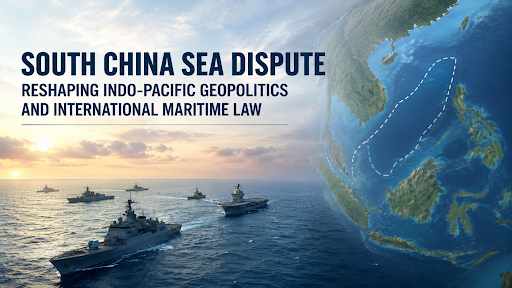
Why In News?
A coalition of 14 nations (including the US, Japan, Australia, Germany, and the UK) and the European Union (EU) released a joint statement rejecting China's expansive claims in the South China Sea, declaring they have no legal basis under international law.
What is the South China Sea Dispute?
The South China Sea is a highly contested marginal sea of the Western Pacific Ocean, located strategically between southern China, Taiwan, the Philippines, Indonesia, Vietnam, Thailand, Cambodia, and Malaysia.
Primary Claimants: Six primary claimants—China, Taiwan, the Philippines, Vietnam, Malaysia, and Brunei—assert competing sovereign rights over islands, reefs, and maritime zones.
Historical Claims: Post-World War II, geopolitical conflict intensifies as China stakes its claim using a 1947 U-shaped "nine-dash line" map to justify historic rights over the sea.
Legal Escalation: Following a prolonged maritime standoff at the Scarborough Shoal, the Philippines formally initiated arbitral proceedings against China under the United Nations Convention on the Law of the Sea (UNCLOS).
The 2016 Permanent Court of Arbitration (PCA) ruled in favor of the Philippines, declaring that China has no legal basis to claim "historic rights" over the maritime resources within its expansive "nine-dash line".
China protests the joint statement, summons the Japanese envoy in Beijing, dismisses the international ruling as an "illegal piece of waste paper", and conducts live-fire military exercises in the region.
 V
V
Why is the South China Sea Important for Global Geopolitics?
Maritime Trade Route: The sea operates one-third of global maritime trade annually according to the United Nations Conference on Trade and Development (UNCTAD).
Resource Wealth: The seabed contains tremendous untapped reserves of oil and natural gas, alongside highly lucrative fishing grounds that sustain regional food security and economic life.
Militarization and Reclamation: China asserts its dominance by constructing Artificial Military Islands (AMIs) using advanced land reclamation techniques, outfitting them with runways, deep-water naval harbors, radar systems, and missile installations.
Supply Chain Junction: Acting as the maritime junction connecting the Pacific and Indian Oceans, the sea ensures the swift transit of energy imports and manufactured goods critical to global economies.
Security Architecture: The region forms the geopolitical core of the Indo-Pacific, where the dispute fuels defense convergence among like-minded democracies (such as the Quad) to balance China's expanding footprint and enforce a rules-based order.
Implications of the South China Sea Dispute for India
Trade Vulnerability: Over 55% of India's trade traverses the South China Sea and the Malacca Strait, intrinsically linking regional stability to India's economic prosperity according to the Ministry of External Affairs (MEA).
Legal Advocacy: India supports freedom of navigation and overflight, officially advocating for all parties to respect UNCLOS in joint diplomatic communiqués.
Act East Policy: Under the Act East Policy, India shifts from a cautious, neutral stance to robust articulation, viewing the South China Sea as central to its strategic security calculus and establishing itself as a credible maritime partner.
Defense Convergence: India leverages the threat of China's expanding maritime footprint to deepen defense ties with ASEAN, Japan, and Quad countries, conducting the AUSINDEX and Malabar naval exercises, and signing the Mutual Logistics Support Arrangement (MLSA) with Australia and other Quad members.
Energy Stakes: India maintains energy stakes in the region as state-owned enterprises like ONGC Videsh operate oil exploration blocks in Vietnamese-claimed waters, directly confronting China's territorial ambitions.
What are the Major Concerns Associated with the South China Sea Dispute?
Gray Zone Tactics: China employs gray zone tactics, utilizing its Coast Guard and maritime militia to deploy powerful water cannons and blinding lasers against Philippine supply runs to the BRP Sierra Madre grounded at the Second Thomas Shoal.
Livelihood Threats: China unlawfully prevents Filipino and Vietnamese fishermen from engaging in traditional fishing within their own recognized EEZs, threatening local livelihoods and maritime rights.
Global Militarization: The dispute drives global militarization; for example, Japan deploys a Type 88 surface-to-ship missile system using live rounds outside its territory for the first time during the Balikatan joint military exercises with the US and the Philippines.
Accidental Collisions: Continual harassment below the threshold of open warfare artificially inflates regional tensions, drastically increasing the likelihood of accidental military collisions in a pivotal global trade corridor.
Undermining Global Order: By refusing to participate in the arbitration and openly disregarding the legally binding 2016 PCA Award, China sets a dangerous precedent that undermines UNCLOS and the global rules-based order.
Measures to Resolve the South China Sea Dispute
Legal Alignment: All claimant nations must synchronize their domestic maritime laws with UNCLOS parameters, ceasing to assert historic rights that exceed their geographic maritime entitlements.
Arbitration Over Coercion: Parties must utilize third-party arbitration and international tribunals (like PCA) over unilateral coercion, intimidation, and gray-zone warfare.
Unified Diplomacy: ASEAN must act as a unified, central diplomatic bloc to collectively negotiate with China, rejecting external divide-and-conquer tactics to forge a stable regional consensus.
Collision Prevention: Militaries operating in the region must strictly adhere to the International Regulations for Preventing Collisions at Sea (COLREGS) to mitigate the severe risk of vessel collisions and unintended escalation.
Binding Agreement: China and ASEAN must finalize a robust, legally binding Code of Conduct (COC) that bans the further militarization of maritime features and artificial island construction.
Source: TIMESOFINDIA
|
PRACTICE QUESTION Q. The South China Sea dispute is not merely a territorial conflict but a test case for the future of international maritime order. Discuss. (250 Words, 15 Marks) |