Why In News?
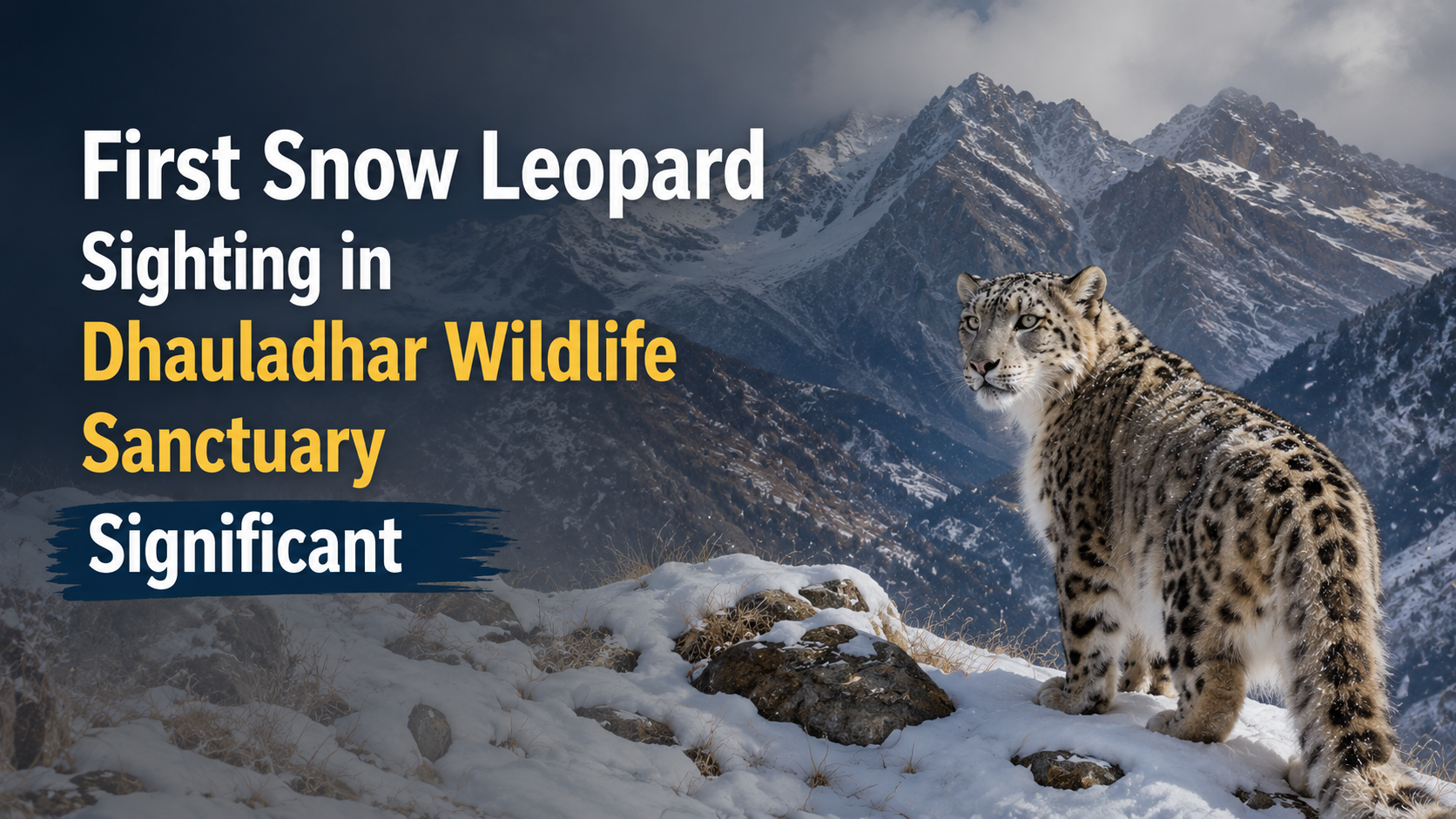
The Dhauladhar Wildlife Sanctuary recorded its first-ever confirmed photographic evidence of a snow leopard.
About Dhauladhar Wildlife Sanctuary
Location: Situated in Kangra district, Himachal Pradesh, along the Dhauladhar range of the Lesser Himalayas.
Established: 1994 to conserve the rich Himalayan biodiversity.
Area: Covers 982.86 km², with an altitude ranging from 2,000 m to 6,069 m, supporting temperate, sub-alpine and alpine ecosystems.
Flora: Dominated by Deodar, Oak, Fir, Spruce, Rhododendron and alpine meadows.
Fauna: Home to Snow Leopard, Himalayan Brown Bear, Himalayan Tahr, Goral, Musk Deer, Himalayan Black Bear, Leopard and several pheasant species including the Western Tragopan.
Ecological Importance: Forms an important wildlife corridor connected with Kugti, Tundah, Nargu and Manali Wildlife Sanctuaries, enhancing landscape-level conservation.
About Snow Leopard
It naturally ranges across 12 countries in Central and South Asia: Afghanistan, Bhutan, China, India, Kazakhstan, Kyrgyzstan, Mongolia, Nepal, Pakistan, Russia, Tajikistan, and Uzbekistan.
Conservation Status: Vulnerable (IUCN Red List); listed in CITES Appendix I and Schedule I of the Wildlife (Protection) Act, 1972, providing the highest level of legal protection.
Distribution: Found in the Trans-Himalayan region of Ladakh, Jammu & Kashmir, Himachal Pradesh, Uttarakhand, Sikkim and Arunachal Pradesh.
Population: India's first Snow Leopard Population Assessment in India (SPAI) 2024 estimated 718 snow leopards, with Ladakh (477) having the largest population, followed by Uttarakhand (124) and Himachal Pradesh (51).
Habitat: High-altitude alpine and sub-alpine ecosystems between 3,000–5,500 m, often called the "Ghost of the Mountains" due to its elusive nature and exceptional camouflage.
Threats: Habitat fragmentation, decline of wild prey, retaliatory killings due to livestock depredation, climate change and infrastructure development.
Conservation Initiatives: Protected under Project Snow Leopard (2009), SECURE Himalaya Project (UNDP-GEF) and monitored through the Snow Leopard Population Assessment in India (SPAI) using camera traps and occupancy-based surveys.
Recent Development: Scientists fitted GPS collars on snow leopards in the Himalayas to better understand movement patterns and strengthen conservation planning.
Source: MID-DAY
|
PRACTICE QUESTION Q. Consider the following statements regarding the Snow Leopard (Panthera uncia):
Which of the statements given above is/are correct? A) 1 only B) 2 only C) Both 1 and 2 D) Neither 1 nor 2 Answer: A Explanation: Statement 1 is correct: The Snow Leopard (Panthera uncia) is the officially recognized state animal of Himachal Pradesh. It replaced the musk deer to claim this title.Statement 2 is incorrect: The Snow Leopard is classified as 'Vulnerable' on the IUCN Red List of Threatened Species. |