Why In News?
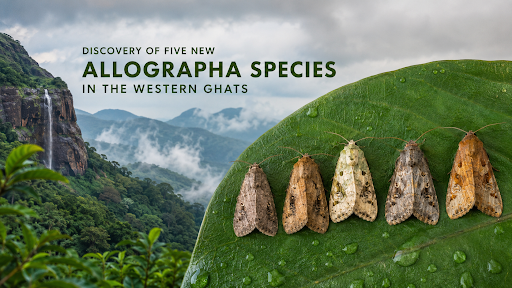
Scientists from the MACS Agharkar Research Institute (ARI), Pune have discovered five new species of lichen-forming fungi belonging to the genus Allographa in the biodiversity-rich Western Ghats.
What is Allographa?
Allographa is a genus of script lichens, meaning it is a composite organism formed by a fungus pairing with algae or cyanobacteria to create a lichen.
The genus belongs to the family Graphidaceae and consists of more than 200 globally recognized species.
Characteristics
-
It exhibits robust and prominent elongated fruiting bodies known as lirellae.
-
The species has a completely carbonized excipulum, giving the fruiting bodies a distinctly dark, massive structure.
-
They feature large, colourless (hyaline) ascospores that turn a violet-blue color when exposed to iodine.
Which New Species Were Discovered?
-
Allographa keralensis: Named geographically after the state of Kerala.
-
Allographa nayakae: Named to honor the renowned Indian lichenologist Dr. Sanjeeva Nayaka.
-
Allographa paraconsanguinea.
-
Allographa persistinspersa.
-
Allographa semicarbonisata.
What are Lichens?
Composite Organism: Lichens are not a single organism. They are a symbiotic, mutualistic partnership between two distinct organisms.
The Partners:
-
Mycobiont (Fungi): Forms the dominant structural body (thallus). It provides protection, secures anchorage, and absorbs water and mineral nutrients from the environment. It belongs mostly to Ascomycota or Basidiomycota.
-
Photobiont (Algae/Cyanobacteria): The photosynthetic component. It contains chlorophyll to synthesize food (carbohydrates) for the association.
Ecological Significance & Functions
-
Pioneer Species: Lichens are primary colonizers of bare rocks. They secrete organic acids (like oxalic acid) that chemically weather rocks into soil particles, initiating primary ecological succession.
-
Bioindicators of Air Pollution:
-
They lack a protective cuticle or roots, absorbing water and gases directly from the atmosphere.
-
They are highly sensitive to Sulfur Dioxide (SO₂) and heavy metals.
-
Their absence or decline in an area indicates high levels of air pollution.
-
Climate & Forest Health Indicators: Recent discoveries (like the Allographa species in the Western Ghats) use molecular data to show that lichens act as highly sensitive indicators of micro-climatic shifts and forest degradation.
-
Nitrogen Fixation: Lichens containing cyanobacteria (blue-green algae) can fix atmospheric nitrogen, contributing directly to soil fertility in nutrient-poor ecosystems.
Economic and Practical Uses
-
Litmus Paper: The chemical indicator dye litmus, used to test acidity (pH), is extracted from lichens like Roccella tinctoria.
-
Food and Fodder: "Reindeer moss" serves as crucial winter food for arctic animals. In India, Parmelia perlata (known as Kalpasi or Dagad Phool) is widely used as a spice in traditional cooking.
-
Perfumes and Medicines: Used as fixatives in the perfume industry and traditionally used to extract antibiotic compounds (like usnic acid) for wound healing.
Source: PIB
|
PRACTICE QUESTION Q. Consider the following statements regarding the recently discovered Allographa species:
Which of the statements given above is/are correct? A) 1 only B) 2 and 3 only C) 1 and 3 only D) 1, 2, and 3 Answer: B Explanation: Statement 1 is incorrect: Allographa species are not parasitic plants. Instead, they belong to a diverse group of lichen-forming fungi. Statement 2 is correct: Members of the genus Allographa are script lichens (lichen-forming fungi) that form a mutually beneficial symbiotic relationship with photosynthetic partners like algae (e.g., Trentepohlia) or cyanobacteria. Statement 3 is correct: Like many lichens, Allographa species are highly sensitive to air pollution, climate shifts, and habitat degradation, making them excellent bioindicators for assessing forest health and environmental quality. |