Why In News?
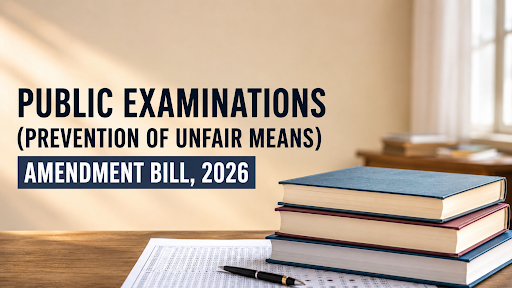
The Union Cabinet approves the Public Examinations (Prevention of Unfair Means) Amendment Bill, 2026 to impose stricter penalties on organized examination fraud.
What is the Public Examinations (Prevention of Unfair Means) Act, 2024?
It is India's first dedicated central law to prevent paper leaks, organised cheating and unfair practices in public examinations. It came into force in June 2024.
Objective
-
Ensure transparency, fairness and credibility in public examinations.
-
Deter organised examination mafias and commercial cheating networks.
-
Protect the interests of genuine candidates and uphold merit-based recruitment.
Coverage
The Act applies to examinations conducted by:
-
UPSC
-
SSC
-
Railway Recruitment Boards (RRBs)
-
National Testing Agency (NTA)
-
IBPS
-
Central Government Ministries/Departments and notified recruitment agencies.
Major Features
-
Defines 15+ unfair means, including paper leaks, question paper theft, impersonation, hacking, tampering with answer sheets, and conspiracy.
-
All offences are cognizable, non-bailable and non-compoundable.
-
Provides punishment for organised crime, service providers and institutions involved in malpractice.
-
Enables attachment of property under the Criminal Law (Amendment) Ordinance, 1944 in organised exam fraud cases.
Key Provisions of the Public Examinations (Prevention of Unfair Means) Amendment Bill, 2026
Stricter Punishment: Increases punishment for individuals involved in unfair means to 5–10 years' imprisonment and a fine up to ₹50 lakh.
Organised Examination Fraud: Raises the minimum punishment for organised paper leak rackets to 7 years' imprisonment, with fines starting from ₹10 crore.
Time-Bound Investigation: Makes it mandatory to complete investigations within two months to ensure speedy prosecution.
Fast-Track Courts: Requires States to establish special fast-track courts for day-to-day hearings, with trials targeted for completion within three months of filing the chargesheet.
Institutional Accountability: Imposes fines up to ₹5 crore and 8-year debarment on examination centres, service providers or institutions found complicit in paper leaks. The Government may also recover the entire examination cost from guilty entities.
Special Investigation Mechanism: Empowers the Centre to constitute specialised investigation teams for complex inter-state paper leak cases.
Enhanced Cybersecurity Oversight: Strengthens accountability for computer-based testing platforms and digital examination infrastructure to tackle cyber-enabled exam fraud.
Protection of Meritocracy: Seeks to dismantle organised examination mafias and restore public confidence in recruitment and entrance examinations.
Major Challenges in Implementation
Cross-State Criminal Networks: Paper-leak syndicates operate across multiple States, requiring coordinated action by the CBI, State Police and cyber agencies.
Cybersecurity Threats: Many examination systems depend on third-party vendors with uneven cybersecurity standards, exposing question banks and candidate databases to cyberattacks.
-
Strengthening data-security protocols was a key mandate of the K. Radhakrishnan High-Level Committee.
Insider Collusion: Leaks can occur through printing presses, logistics providers, examination centres or officials, highlighting weaknesses in the chain of custody.
Institutional Capacity Constraints: The NTA conducts several national examinations involving millions of candidates every year, requiring a stronger permanent organisational structure.
-
The government has begun creating 16 additional senior posts and institutional linkages with States to strengthen capacity.
Delays in Investigation: Multi-state investigations, digital evidence collection and prosecution often delay convictions, reducing deterrence.
Dependence on Private Vendors: Outsourcing printing, logistics and CBT centres increases security risks and requires stronger oversight.
Digital Divide: Expanding Computer-Based Tests (CBTs) must address disparities in internet connectivity, digital literacy and infrastructure in rural areas.
Inconsistent Test Centre Standards: Variation in surveillance, biometric verification and infrastructure across centres creates vulnerabilities.
Weak Grievance Redressal: Delayed complaint handling reduces transparency and public trust. The High-Level Committee recommended an AI/ML-enabled grievance redressal system.
Restoring Public Confidence: Repeated examination irregularities have eroded trust among students, making credibility restoration a major governance challenge.
Way Forward
Expand Computer-Based Testing (CBT): Increase secure CBT with encrypted delivery, randomisation and secure browser technology. The Radhakrishnan Committee recommended expanding online examinations where feasible.
Strengthen Cybersecurity Infrastructure: Conduct regular penetration testing, zero-trust security, Security Operations Centres (SOC) and third-party cybersecurity audits.
Rigorous Background Verification: Mandatory police verification and periodic audits for personnel involved in printing, transport, IT and invigilation.
AI-Based Examination Monitoring: Deploy AI-enabled CCTV analytics, facial recognition (subject to legal safeguards), behaviour analytics and biometric authentication to detect impersonation and malpractice.
Independent Security Audits: Conduct mandatory third-party audits of question-paper handling, logistics, testing centres and IT systems before every examination cycle.
Strengthen Government Infrastructure: Increase use of government schools, universities, IITs, NITs and other public institutions instead of relying heavily on private centres.
Permanent Professional Cadre: Build a dedicated cadre in NTA comprising cybersecurity experts, psychometricians, forensic specialists and examination managers instead of ad hoc staffing.
Standardised SOPs: Implement uniform national SOPs covering paper setting, printing, transport, storage, centre operations and post-exam evaluation.
Blockchain-Based Audit Trails: Maintain tamper-proof digital logs for question papers and examination records to improve traceability.
Strict Enforcement of the Public Examinations (Prevention of Unfair Means) Act, 2024: Ensure swift investigation, prosecution and exemplary penalties to deter organised exam fraud.
Conclusion
The Anti-Paper Leak Amendment Bill, 2026 establishes a powerful legal deterrent against examination fraud. However, securing the future of competitive exams ultimately requires a combination of institutional integrity, modern technology, and continuous independent security audits.
Source: DDNEWS
|
PRACTICE QUESTION Q. "Ensuring the integrity of public examinations is fundamental to merit-based governance and social justice." Examine. 150 words |