Why In News?
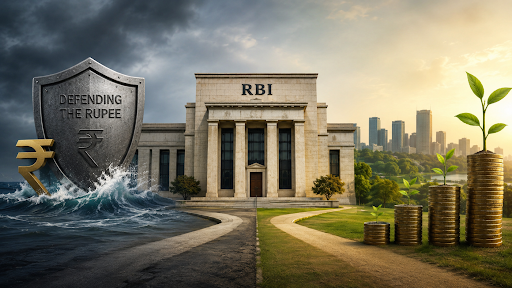
The Reserve Bank of India should prioritize structural reforms and long-term capital account openness over the direct, short-term intervention of defending the rupee against volatility.
What is the RBI's Role in the Foreign Exchange Market?
Managed Float Exchange Rate: India operates a market-determined exchange rate framework known as a managed float, where the RBI allows market forces of supply and demand to determine the rupee's value without targeting a rigid, specific exchange rate.
Volatility Control: The RBI curbs excessive volatility and maintains orderly market conditions to prevent sudden, speculative attacks on the currency by selling dollars from its reserves or conducting forex swap auctions.
Why the RBI Must Look Beyond Defending the Rupee?
Economic Fundamentals: A depreciating rupee reflects relative domestic economic weakness and acts as a natural macroeconomic shock absorber to automatically correct external trade imbalances by making imports costlier and exports cheaper.
Liquidity Drain: Continuous dollar sales drain domestic liquidity, spike interbank call rates to 6.9%, and slow economic growth, while artificial stabilization subsidizes imports and hurts export competitiveness.
Reserve Depletion: Aggressive currency defense rapidly exhausts foreign exchange reserves, which currently stand at USD 701.4 billion (covering roughly 11 months of imports), depleting the ultimate buffer needed for severe global financial crises.
What Determines the Value of the Rupee?
Inflation Differentials: High domestic inflation reduces the purchasing power of the rupee and weakens its Real Effective Exchange Rate (REER) against trading partners with lower inflation.
Current Account Balance: Massive trade deficits and record gold imports reaching $71.98 billion in FY26 weaken the currency by generating massive dollar demand.
Capital Outflows: Foreign Institutional Investors (FIIs) withdraw capital, pulling out approximately $11 billion from Indian equities in March 2026 alone, which directly depreciates the rupee.
Global Commodity Prices: India imports 85% to 90% of its crude oil, meaning rising Brent crude prices above $110 per barrel widen the trade deficit and spike demand for the US dollar.
Monetary Policy Divergence: Hawkish interest rates from the US Federal Reserve strengthen the US Dollar and pull capital away from emerging markets back to the United States.
The Necessity of a Broader Macroeconomic Strategy
Export Competitiveness: Imported raw materials constitute up to 40% of Indian exports, which cancels out the benefits of a weaker rupee and necessitates structural logistics and manufacturing quality reforms.
Import Dependence: Heavy reliance on imports of crude oil, gold, electronics, and fertilizers requires a shift toward domestic production to permanently reduce dollar demand.
Productivity Enhancement: The government shifts focus toward building robust domestic manufacturing in semiconductors, defense, and solar equipment to build a truly resilient economy.
Price Stability: A severely depreciated rupee triggers imported inflation by raising the cost of fuel and food imports, which directly hurts domestic consumers.
Major Challenges in Currency Management
Global Financial Volatility: Investors pull capital from emerging markets during global crises, rushing to safe-haven US assets and destabilizing the rupee.
Energy Import Bills: Geopolitical conflicts continuously inflate crude oil prices, forcing India to spend massive forex reserves on energy.
Geopolitical Uncertainty: Wars and supply chain disruptions create unpredictable shocks in the foreign exchange market.
Capital Flow Swings: Volatile "hot money" portfolio investments enter and exit rapidly, disrupting exchange rate stability.
The Impossible Trinity: The economic trilemma dictates that a country cannot simultaneously maintain a fixed exchange rate, free capital movement, and an independent monetary policy without triggering a financial crisis.
Measures to Strengthen Long-Term Currency Stability
Inflation Control: Maintain low and stable inflation to preserve the Real Effective Exchange Rate (REER) and strengthen macroeconomic stability through inflation targeting.
Export-Led Growth: Expand Production Linked Incentive (PLI) schemes, improve product quality and diversify export markets to increase foreign exchange earnings.
Financial Market Deepening: Develop domestic forex derivatives, corporate bond and currency hedging markets to reduce excessive dependence on RBI intervention.
Energy Transition: Accelerate renewable energy, green hydrogen, ethanol blending and electric mobility to reduce crude oil imports and dollar demand.
Stable Capital Inflows: Attract long-term FDI, expand sovereign green bond financing and deepen India's debt markets.
Calibrated RBI Intervention: Use an Integrated Policy Framework (IPF) combining monetary policy, macroprudential measures and capital flow management instead of relying solely on forex reserve depletion.
Domestic Gold Mobilisation: Revitalise the Gold Monetisation Scheme (GMS) to reduce physical gold imports and improve productive utilisation of idle household gold.
Strategic Currency Swaps: Expand bilateral currency swap arrangements with partner central banks to provide emergency foreign currency liquidity.
Promote Rupee Internationalisation: Expand local currency trade settlements, Special Rupee Vostro Accounts (SRVAs) and cross-border use of the Indian rupee.
Reduce Current Account Deficit (CAD): Promote import substitution in electronics, defence, semiconductors and fertilisers while boosting high-value exports.
Conclusion
To secure long-term macroeconomic stability, India must transition away from costly, short-term rupee defense tactics toward comprehensive structural reforms that boost export competitiveness, attract stable foreign direct investment, and achieve energy independence.
Source: INDIANEXPRESS
|
PRACTICE QUESTION Q. "A stable currency is ultimately a reflection of strong macroeconomic fundamentals rather than sustained central bank intervention." Discuss. 150 words |