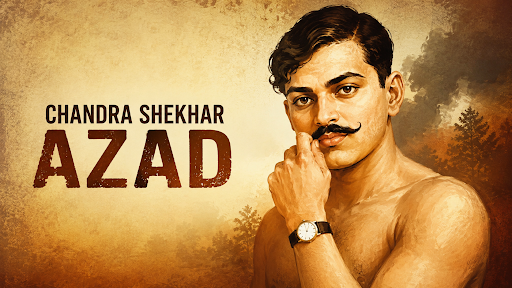
Why In News?
Prime Minister Narendra Modi paid homage to the brave Chandra Shekhar Azad on his birth anniversary on July 23, 2026.
Who Was Chandra Shekhar Azad?
Early Life
-
He was born as Chandra Shekhar Tiwari on July 23, 1906, in Bhavra village (present-day Madhya Pradesh).
-
His parents were Sitaram Tiwari and Jagrani Devi.
-
His mother wanted him to be a great Sanskrit scholar, so he studied at Kashi Vidyapeeth in Benares.
Why Was He Called "Azad"?
-
In 1921, as a 15-year-old student, he joined Mahatma Gandhi's Non-Cooperation Movement.
-
The British police arrested him for his participation. When presented before a district magistrate, he declared his name as "Azad" (The Free), his father’s name as "Swatantrata" (Independence), and his home address as "Jail".
-
The magistrate punished him with 15 lashes, but from that day on, the name "Azad" stuck with him forever.
What Was His Contribution to Indian Freedom Struggle?
Fearless Patriotism
-
He lived by the powerful slogans, "We will face bullets but will not bow" and "I will never be captured alive".
-
He completely shifted from Gandhi's non-violence to armed rebellion after the Chauri Chaura incident in 1922 caused Gandhi to stop the movement.
Leader of the Hindustan Socialist Republican Association (HSRA)
-
Azad joined the Hindustan Republican Association (HRA) under the guidance of Ram Prasad Bismil.
-
After the British hanged Bismil and other leaders, Azad teamed up with Bhagat Singh to rebuild the group. In 1928, they changed its name to the Hindustan Socialist Republican Association (HSRA) to fight for a socialist republic.
-
He served as the commander-in-chief of the HSRA and used the secret name "Balraj" when signing important party posters and pamphlets.
Association with Bhagat Singh
-
Azad and Bhagat Singh shared a powerful partnership. Bhagat Singh acted as the main thinker and ideologue, while Azad operated as the military commander to execute their plans.
-
Together, they planned the assassination of a British officer to avenge the death of Lala Lajpat Rai, and Bhagat Singh later bombed the Central Assembly inspired by their shared ideology.
Key Revolutionary Activities
-
Kakori Train Robbery (1925): He helped loot British government money from a train near Kakori, Lucknow, to fund their revolutionary activities.
-
Saunders Assassination (1928): Azad, Bhagat Singh, and Rajguru successfully assassinated British police officer John P. Saunders in Lahore.
-
Viceroy’s Train Attempt (1929): He played a major role in planning the bombing of Viceroy Lord Irwin's train near Delhi, though the Viceroy escaped unhurt.
Sacrifice for the Nation
-
He embraced a life of extreme hardship. He hid in the Orchha forest near Jhansi under the fake name Pandit Harishankar Bramhachari.
Legacy of Chandra Shekhar Azad
Symbol of Courage and Self-Sacrifice
-
On February 27, 1931, the police surrounded him at Alfred Park in Allahabad.
-
To keep his lifelong promise of never being caught alive, he fought bravely, gave cover fire to help his friend Sukhdev Raj escape, and then shot himself in the head with his last bullet.
Inspiration for Youth Leadership
-
His extraordinary ability to rebuild the scattered HSRA party after losing major leaders highlights strong leadership skills that continue to inspire young leaders today.
Commitment to National Service
-
He willingly gave up his family, wealth, and a comfortable life, showing what true dedication to the nation looks like.
Defence of Freedom and Justice
-
He did not just want to remove the British; he read the Communist Manifesto and fought to end capitalist exploitation, aiming for equality for poor Indians.
Source: PIB
|
PRACTICE QUESTION Q. Consider the following statements regarding Chandra Shekhar Azad: 1. He reorganised the Hindustan Republican Association (HRA) into the Hindustan Socialist Republican Association (HSRA) in 1928. 2. He was arrested and hanged in the Kakori Train Robbery Case of 1925. Which of the statements given above is/are correct? A) 1 only B) 2 only C) Both 1 and 2 D) Neither 1 nor 2 Answer: A Explanation: Statement 1 is correct: Following the arrest of top leaders in the aftermath of the Kakori conspiracy, Chandra Shekhar Azad reorganized the Hindustan Republican Association (HRA). Alongside comrades like Bhagat Singh and Sukhdev, he renamed it the Hindustan Socialist Republican Association (HSRA) in September 1928 at Feroz Shah Kotla, New Delhi, integrating socialist principles into their revolutionary framework. Statement 2 is incorrect: While Chandra Shekhar Azad was a mastermind and key participant in the Kakori Train Robbery of 1925, he managed to evade the British police dragnet and was never caught during the investigation. The revolutionaries who were arrested and subsequently hanged in 1927 for the Kakori case were Ram Prasad Bismil, Ashfaqullah Khan, Roshan Singh, and Rajendra Lahiri. Azad never surrendered to the British and died by suicide during a fierce gunfight at Alfred Park, Allahabad, on February 27, 1931, using his final bullet to keep his pledge of remaining free ("Azad"). |