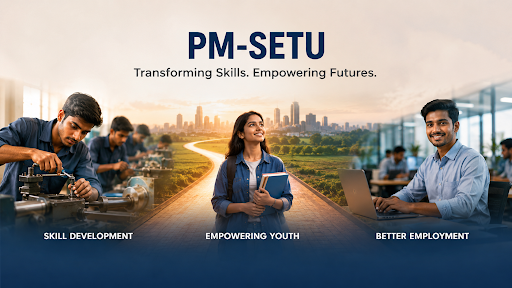
Why In News?
The Ministry of Skill Development and Entrepreneurship (MSDE) has officially initiated the nationwide rollout of the PM-SETU scheme across massive ITI clusters
What is PM-SETU?
PM-SETU (Pradhan Mantri Skilling and Employability Transformation through Upgraded ITIs) is a Centrally Sponsored Scheme to transform government ITIs into advanced, industry-managed skilling institutions.
Governance Structure: A Special Purpose Vehicle (SPV) governs the innovative Hub-and-Spoke model, where private corporations hold a 51% majority stake and the Central and State governments hold 49%.
Targeted Upgradation: The scheme upgrades 1,000 Government ITIs—categorized into 200 Hub ITIs and 800 Spoke ITIs—into world-class skilling centers.
Centres of Excellence: The initiative elevates 5 National Skill Training Institutes (NSTIs) in Bhubaneswar, Chennai, Hyderabad, Kanpur, and Ludhiana into National Centres of Excellence (NCOEs) through global partnerships.
Strategic Vision: The program builds a future-ready workforce for advanced manufacturing to align directly with the Viksit Bharat by 2047 vision.
Strategic Financing Model: A massive ₹60,000 crore budget spans five years, shared among the Centre (₹30,000 crore), States (₹20,000 crore), and Industry (₹10,000 crore).
Global Backing: The World Bank and the Asian Development Bank (ADB) co-finance the initiative through results-based loans, covering 50% of the Central share.
School-Level Integration: The scheme deploys 1,200 Vocational Skill Labs inside 600 Navodaya Vidyalayas and Eklavya Model Residential Schools to capture young talent early.
Key Features of PM-SETU
Industry Autonomy: The Section 8 SPV grants Anchor Industry Partners complete autonomy over course design, pedagogy, and trainer recruitment to eliminate bureaucratic stagnation.
Flexible Skilling Pathways: The program injects short-term courses (3-6 months), long-term diplomas, and executive education for working professionals alongside traditional ITI trades.
Credit-Based Curriculum: Training aligns with the National Credit Framework (NCrF), comprising 1,200 hours of modular instruction and 150 hours of mandatory On-the-Job Training (OJT) to yield 45 academic credits.
Corporate Collaborations: Industry leaders like Hindustan Aeronautics Limited (HAL), Hero MotoCorp, and ITC Limited inject direct capital and factory-level insights into the clusters.
Immersive Technologies: The curriculum integrates Metaverse learning, AR/VR simulators, and Digital Twins to train students safely on high-risk machinery.
Placement Mandates: The guidelines enforce Key Performance Indicators (KPIs), requiring SPVs to secure a >75% placement rate and deliver a 50% increment in average graduate salaries.
Digital Tracking (LOMS): The Learning Outcome Management System (LOMS) establishes a real-time digital interface linked to the Skill India Digital Hub (SIDH) to track trainee competency and assessment data.
Benefits of PM-SETU
Immediate Employability: Mandatory 150-hour OJT inside partner factories assimilates students into corporate culture early, ensuring zero onboarding time upon graduation.
MSME Productivity: The model empowers local MSME supply chains by training youth who join local vendor networks, reducing component defect rates across geographic clusters.
Expert-Led Instruction: Master Trainers sourced directly from industry shop floors replace theoretical instructors to deliver practical automation and production insights.
Entrepreneurial Ecosystems: The scheme transforms Hub ITIs into commercial engines by establishing incubation centers, maker spaces, and live production units.
Agile Skill Gap Reduction: SPVs introduce 4 new courses in Hub ITIs and 2 new courses in Spoke ITIs to bridge real-time local labor shortages.
Global Competitiveness: The initiative positions India as a global skill capital by modernizing infrastructure to fuel the Atmanirbhar Bharat manufacturing engine.
Financial Autonomy: The framework drives institutional self-reliance by allowing SPVs to generate alternative income via consultancy, premium non-ITI courses, and commercial production centers.
Major Challenges in Skill Development
Trainer Deficit: India faces a structural deficit in competent trainers, as existing ITI faculty lack exposure to modern automation, while industry experts often lack pedagogical skills.
Capitalist Paradox: Anchor industries hesitate to invest millions in training when rival companies can easily poach freshly skilled graduates without contributing capital.
Geographical Disparities: Corporate giants cluster around prime industrial corridors, leaving remote, hilly, or North-Eastern Spoke ITIs struggling to attract Anchor Partners.
Gender Barriers: The legacy vocational ecosystem lacks gender-inclusive infrastructure and safe transport mechanisms, which deters women from entering heavy-industry trades.
Certification Standardization: Anchor-customized curricula sometimes diverge from the National Skill Qualification Framework (NSQF), limiting the interstate mobility of graduate certificates.
Weak Contractual Linkages: The absence of legally binding apprenticeship-to-hire contracts forces graduates to operate as free agents, making corporations view training as a risk.
Administrative Gridlock: The 51:49 PPP structure causes bureaucratic friction, leaving states struggling to draft corporate tenders and stalling the pre-implementation phase.
Frameworks Supporting Skill Development
Skill India Mission: This macro-umbrella initiative delivers nationwide upskilling through networks like Pradhan Mantri Kaushal Vikas Yojana (PMKVY) and Jan Shikshan Sansthan.
National Skill Development Corporation (NSDC): Acts as the core executive and financing arm to coordinate private sector participation alongside the Directorate General of Training (DGT).
National Education Policy (NEP), 2020: Fuses vocational training into mainstream schooling through the National Credit Framework (NCrF), mandating that every 30 hours of learning equals one academic credit.
National Apprenticeship Promotion Scheme (NAPS): Reimburses and incentivizes employers who hire apprentices, serving as a vital financial pillar for practical shop-floor training.
PM Internship Scheme: Expands corporate exposure for youth, synergizing with PM-SETU's mandate of localized, intensive On-the-Job Training.
National Skill Qualification Framework (NSQF): Classifies learning by competence, with the NCVET already approving 9,026 NSQF-aligned qualifications to standardize industry roles.
National Council for Vocational Education and Training (NCVET): This supreme regulatory watchdog enforces quality standards and accredits assessment agencies across the entire TVET space.
Way Forward
Streamlined Onboarding: State governments must implement single-window clearance mechanisms to fast-track SPV incorporation and eliminate administrative drag.
Advanced Tech Integration: Institutions must fully implement the National Programme on Artificial Intelligence (NPAI) Skilling Framework to mandate standardized data science and emerging tech curricula across all Hubs.
Apprenticeship Protections: Policy should permit Anchor Partners to draft legally binding apprenticeship-to-hire contracts (18-24 months) and enforce heavy "clawback fees" on competing firms that poach graduates.
Outcome-Based Funding: Authorities must link the release of multi-crore escrow tranches directly to verified graduate wage placements and employer satisfaction indices rather than simple enrollment metrics.
Placement Tracking: SPVs must deploy dedicated career counseling staff to execute Tracer Surveys mapping graduate employment trajectories.
Pedagogical Training: Central universities should launch dedicated pedagogical diplomas designed to transform factory-floor engineers into certified, effective classroom educators.
Remote Spoke Incentives: Governments must provide enhanced tax breaks and relax capital expenditure matching requirements for Anchor Industries willing to develop infrastructure in geographically remote and tribal regions.
Conclusion
By bridging the gap between outdated academic theory and modern industrial automation, the PM-SETU scheme acts as the ultimate catalyst to convert demographic dividend into a globally dominant workforce for Viksit Bharat 2047.
Source: PIB
|
PRACTICE QUESTION Q. "Bridging India's skill gap requires not only expanding training opportunities but also ensuring alignment between education, industry and emerging technologies." Discuss. 150 words |