Why In News?
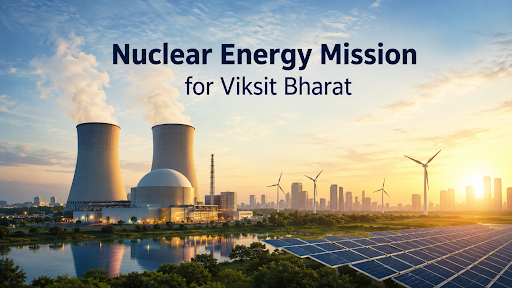
The Nuclear Energy Mission (NEM), supported by the SHANTI Act, 2025, aims to achieve 100 GWe of nuclear power capacity by 2047.
What is the Nuclear Energy Mission for Viksit Bharat?
Strategic Target: The mission establishes a comprehensive national roadmap to scale India's nuclear power capacity to 100 GW by the year 2047.
Core Vision: It delivers continuous, clean electricity to power a developed "Viksit Bharat" by 2047 and accelerates India's transition to Net Zero carbon emissions by 2070.
Key Features of the Mission
Funding for Small Modular Reactors (SMRs): Government allocates ₹20,000 crore to design and construct compact, safer reactors, targeting at least five homegrown SMRs fully operational by 2033.
Capacity Expansion: Scales India's nuclear capacity from the current 8.78 GW to 22.48 GW by 2031-32, ultimately reaching the 100 GW milestone by 2047.
Climate Alignment: Replaces fossil-fuel generation with clean energy to fulfill India's COP26 Paris Agreement commitments.
Significance of Nuclear Energy for India
Energy Independence: India leverages its 25% global thorium reserves through the Three-Stage Nuclear Power Programme to secure long-term energy sovereignty.
Decarbonization: Nuclear power offers lower life-cycle greenhouse gas emissions than solar energy, driving the Net Zero transition.
Baseload Power: Unlike intermittent solar or wind energy, nuclear plants supply reliable, 24x7 continuous electricity to sustain heavy industries.
Indigenous Technology: India deploys domestic Pressurised Heavy Water Reactors (PHWRs) and develops compact 220 MW Bharat Small Reactors (BSRs) for localized industrial use.
Major Challenges
High Capital Requirements: Nuclear installation demands massive funding, costing ₹15-16 crore per Megawatt for domestic PHWRs and ₹30-35 crore per Megawatt for imported reactors, totaling nearly ₹19 lakh crore to achieve the 100 GW target.
Prolonged Gestation Periods: Projects face timeline overruns, taking 11 to 12 years from site approval to commercial commissioning.
Waste Management: Safe storage, recycling, and disposal of highly radioactive spent fuel require advanced deep geological repositories.
Public Opposition: Safety apprehensions and radiation fears trigger local protests and the "Not in My Backyard" (NIMBY) syndrome during land acquisition.
Supply Chain Constraints: India depends heavily on imported enriched uranium and navigates restrictive trade guidelines from the Nuclear Suppliers Group (NSG).
Way Forward
Accelerate SMR Deployment: Factory-fabricating Small Modular Reactors reduces construction timelines, lowers upfront costs, and electrifies remote regions.
Adopt Fleet Mode Procurement: Bulk purchasing of reactor components provides local manufacturers with large, predictable orders, scaling domestic supply chains.
Empower Safety Regulators: The SHANTI Act, 2025 transforms the Atomic Energy Regulatory Board (AERB) into an independent, statutory body with enhanced enforcement powers.
Develop Human Capital: India must train 61,000 plant operators and 1,20,000 construction workers by 2047 to safely manage the expanded reactor fleet.
Strengthen Civil Liability Framework: Amending the Civil Liability for Nuclear Damage (CLND) Act, 2010 limits financial risks for equipment suppliers, encouraging global and domestic technology transfer.
Expand Insurance Pools: Scaling the Indian Nuclear Insurance Pool (INIP) beyond ₹1,500 crore shields private operators from catastrophic financial liabilities.
Establish a Dedicated Design Agency: Creating an independent Design and Site Support Agency assists private players in safely designing and executing complex nuclear projects.
Enhance Global Alliances: Securing bilateral government-to-government agreements ensures a steady supply of imported uranium and facilitates advanced technology sharing.
Conclusion
The Nuclear Energy Mission, empowered by the SHANTI Act, 2025 and private investments, acts as the master key to unlocking India’s energy security, achieving Net Zero by 2070, and realizing the dream of a fully developed Viksit Bharat by 2047.
Source: pib
|
PRACTICE QUESTION Q. "Nuclear energy is expected to play a pivotal role in achieving India's energy security and climate commitments." Discuss. 150 words |