Why In News?
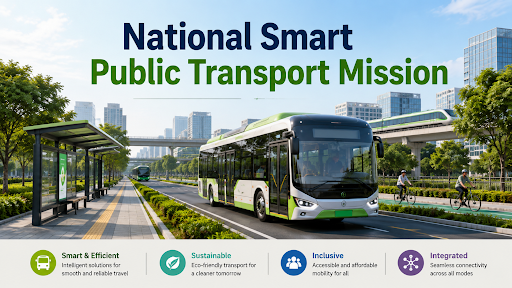
The Ministry of Housing and Urban Affairs (MoHUA) emphasized the need for a National Smart Public Transport Mission to unify India's fragmented urban mobility via digital ticketing, electric buses, and multimodal integration.
What is the National Smart Public Transport Mission (NSPTM)?
The National Smart Public Transport Mission (NSPTM) is a proposed framework designed to integrate digital technologies, interoperable ticketing, and last-mile connectivity into India's urban transport ecosystem.
Objectives
-
Create Seamless Travel: Unite different transit modes (buses, metros) using digital tools like the National Common Mobility Card (NCMC).
-
Promote Green Transit: Scale up the use of electric buses and non-motorized transport (NMT) to reduce pollution.
-
Empower Local Governments: Build the capacity of Urban Local Bodies (ULBs) to handle modern transport planning.
What are the Key Features of the Mission?
Intelligent Transport Systems (ITS): Leverages Artificial Intelligence (AI) and the Internet of Things (IoT) to monitor traffic in real-time and manage congestion.
Digital Ticketing: Promotes the National Common Mobility Card (NCMC), which operates on the "One Nation, One Card" vision.
-
Case Study: The Kerala State Road Transport Corporation (KSRTC) adopted UPI-based ticketing, which improved operational efficiency, reduced transaction time, and increased financial transparency.
Green Public Transport: Pushes for a massive shift towards Zero-Emission Vehicles (ZEVs).
-
Under the PM e-Bus Sewa, the government plans to deploy 10,000 electric buses across 169 cities via a Public-Private Partnership (PPP) model.
Multimodal Integration: The framework requires cities to develop Integrated Mobility Plans (IMPs) to ensure smooth transfers between buses, metros, and walking paths.
-
It focuses on creating connected hubs, similar to the Multimodal Logistics Parks (MMLPs) being developed under PM Gati Shakti.
What are the Major Challenges?
Funding Constraints: Building smart transport is expensive. For instance, Metro construction can cost up to INR 390 Crore per kilometer. (Source: NITI Aayog)
-
State governments often struggle to find capital for large-scale electric bus deployments.
Coordination Between Multiple Agencies: "Urban planning" is a State subject under the 7th Schedule of the Constitution.
-
This causes inconsistent implementation, as central policies must be executed by local state authorities.
Digital Infrastructure Gaps: The adoption of UPI and digital ticketing faces hurdles like poor internet connectivity, low digital literacy, and passenger resistance in rural and semi-urban areas.
Integration Across Different Transport Modes: India currently lacks unified data sharing between private operators, metro rails, and city buses, leading to a fragmented travel experience.
Capacity Building of Urban Local Bodies: Many Urban Local Bodies (ULBs) lack the technical expertise and skilled human resources needed to plan and operate high-tech Intelligent Transport Systems (ITS).
What Measures Can Strengthen Smart Urban Mobility?
Expand Electric Bus Fleets: Scale up electric buses through aggregated procurement, Gross Cost Contract (GCC), and RESCO models to reduce capital costs. The PM e-Drive Scheme has allocated ₹4,391 crore for 14,028 electric buses in major cities.
Develop Integrated Mobility Platforms: Implement Mobility-as-a-Service (MaaS) platforms with a single app for trip planning, booking, and digital payments across metro, buses, taxis, and shared mobility.
Improve Last-Mile Connectivity: Connect metro and bus terminals with electric feeder buses, e-rickshaws, bicycle-sharing systems, and pedestrian-friendly corridors to improve public transport accessibility.
Strengthen Data-Driven Urban Planning: Use platforms such as the India Urban Data Exchange (IUDX) and Unified Energy Interface (UEI) for real-time transport data sharing, AI-based traffic management, and evidence-based planning.
Encourage Public–Private Partnerships (PPP): Mobilize private investment for EV charging stations, battery swapping networks, multimodal transit hubs, and intelligent transport systems through viability gap funding and long-term concessions.
Accelerate Vehicle Scrappage: Enforce scrappage of commercial vehicles older than 15 years. Replacing old buses and trucks can reduce PM emissions by 24%, NOx and HC by 18%, and CO₂ emissions by 17%.
Establish Unified Metropolitan Transport Authorities (UMTAs): Create UMTAs in all million-plus cities to integrate planning, regulation, fares, and multimodal transport under a single authority.
Adopt Intelligent Transport Systems (ITS): Deploy AI-enabled traffic signals, GPS-based fleet tracking, adaptive signal control, and smart surveillance to reduce congestion and improve road safety.
Build Climate-Resilient Transport Infrastructure: Design flood-resilient roads, elevated bus depots, and heat-resistant transport infrastructure to ensure uninterrupted mobility during extreme weather events.
Strengthen Urban Governance: Empower Urban Local Bodies (ULBs) with greater financial and administrative autonomy to improve integrated transport planning and service delivery.
Conclusion
The National Smart Public Transport Mission can transform India's urban landscape by merging clean energy electric buses, integrated digital ticketing, and data-driven multimodal planning to create accessible, green, and efficient cities.
Source: PIB
|
PRACTICE QUESTION Q. Smart public transport is essential for achieving sustainable, inclusive and climate-resilient urban development. Discuss. 150 words |