Why In News?
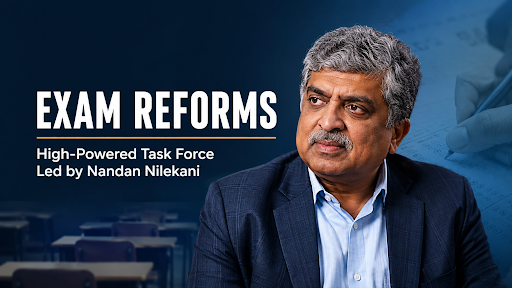
The Union Government constituted a high-powered task force under Nandan Nilekani.
Why was the Task Force constituted?
The Union Government constituted a High-Powered Exam Reforms Task Force under Nandan Nilekani, following nationwide student protests over repeated paper leaks, examination irregularities and transparency concerns in major public examinations.
Objectives of the Task Force
-
Develop a technology-driven, transparent and leak-proof examination system.
-
Recommend structural reforms for the National Testing Agency (NTA).
-
Improve cybersecurity and digital examination infrastructure.
-
Prevent paper leaks through end-to-end encryption and secure logistics.
-
Restore public confidence in competitive examinations.
-
Build a long-term roadmap for modern public examination governance.
Expected Focus Areas
-
Secure Computer-Based Testing (CBT)
-
AI-based exam monitoring
-
Biometric authentication
-
Encrypted digital question-paper delivery
-
Cybersecurity audits
-
Risk analytics and fraud detection
-
Stronger governance and accountability in NTA
-
Standardised national examination protocols
-
Digital grievance redressal system
-
Integration with India's Digital Public Infrastructure (DPI).
About Nandan Nilekani
Career Highlights
-
Co-founder of Infosys (1981), one of India's largest IT services companies.
-
Served as CEO of Infosys (2002–2007), during which the company's revenue grew nearly six-fold.
Role in India's Digital Transformation
-
Founding Chairman of the Unique Identification Authority of India (UIDAI) from 2009 to 2014, with Cabinet-rank status.
-
Led the design and implementation of Aadhaar, the world's largest biometric digital identity programme, covering more than 1.4 billion enrolments over time.
-
Played a key role in advancing Digital Public Infrastructure (DPI), including contributions to the ecosystem that enabled Aadhaar, e-KYC, DigiLocker and UPI.
Public Policy & Institutional Contributions
-
Chaired the Technology Advisory Group for Unique Projects (TAGUP).
-
Chairs the EkStep Foundation, which develops open digital learning platforms to improve foundational literacy and numeracy.
-
Serves on the boards and advisory bodies of institutions such as ICRIER and the World Economic Forum Foundation.
Books
-
Imagining India: The Idea of a Renewed Nation (2008)
-
Rebooting India: Realizing a Billion Aspirations (co-authored, 2015)
Awards & Honours
-
Padma Bhushan (2006) – India's third-highest civilian award.
-
Forbes Asia Businessman of the Year (2006).
-
Featured in TIME 100 among the world's most influential people (2006 and 2009).
Source: THEHINDU
|
PRACTICE QUESTION Q. "Technology can strengthen the integrity of public examinations only when accompanied by robust institutional reforms and accountability." Discuss. 150 words |