Why In News?
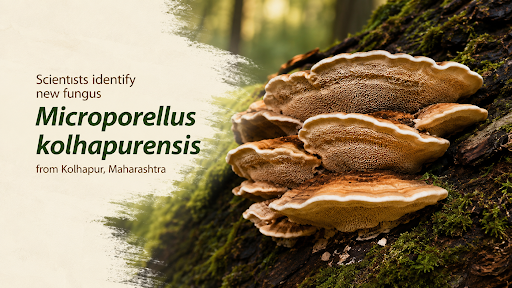
A new wood-decaying polypore fungus species, Microporellus kolhapurensis, was discovered in Kolhapur, Maharashtra.
About Microporellus kolhapurensis
Microporellus kolhapurensis is a newly discovered species of polypore (bracket) fungus found in the Western Ghats region of Maharashtra, India.
Discovery & Location
-
Geographic Origin: Discovered in the Bhudargad taluka of the Kolhapur district, Maharashtra.
-
Ecological Zone: It thrives within the eco-sensitive and biodiverse Western Ghats ecosystem.
-
Research Team: Identified by Dr. Anjali Patil and research scholar Yogesh Patil from Rajaram College, Kolhapur.
-
Official Journal: The formal description was published in Nelumbo, the official research journal of the Botanical Survey of India (BSI).
Scientific Classification & Nature
-
Taxonomic Hierarchy: It belongs to the Kingdom Fungi, Phylum Basidiomycota, and Family Polyporaceae.
-
Saprotrophic Nutrition: It is a saprotrophic fungus, meaning it derives its nutrients by breaking down dead, decaying organic matter.
-
Substrate & Season: It grows exclusively on rotting forest wood and fruits primarily during the monsoon months from July to September. It generally grows singly rather than in dense clusters.
Key Morphological Characteristics
Microporellus kolhapurensis is distinguished from its close relatives by a specific combination of traits:
-
Color: Exhibits a yellowish-orange to grayish-brown hue.
-
Structure: Possesses an umbrella-shaped cap supported by a lateral stalk (attached to one side).
-
Microscopic Features: Characterized by large pores on the underside, teardrop-shaped spores, and unique thick-walled cystidia (large, sterile cells on the spore-bearing surface that do not produce spores but aid taxonomy).
Ecological Significance
-
Nutrient Recycling: By releasing enzymes that break down complex, tough wood polymers (like lignin and cellulose), it returns essential nutrients back to the forest soil.
-
Bio-indicator: Polypore abundance and diversity serve as critical indicators of forest health and successful biodiversity conservation.
-
Global Context: Globally, the genus Microporellus contains about 36 recognized species. Previously, Microporellus obovatus was the only other species from this genus recorded in Maharashtra.
Source: TIMESOFINDIA
|
PRACTICE QUESTION Q. With reference to the newly discovered Microporellus kolhapurensis, consider the following statements: 1. It is a saprotrophic bracket fungus that thrives on living, healthy trees to derive its nutrition. 2. Prior to its discovery, the Microporellus genus was completely unknown in the state of Maharashtra. 3. Its discovery was officially published in Nelumbo, the research journal of the Botanical Survey of India. Which of the statements given above is/are correct? A) 1 and 2 only B) 3 only C) 2 and 3 only D) 1, 2, and 3 Answer: B Explanation: Statement 1 is incorrect: While Microporellus kolhapurensis is indeed a saprotrophic polypore (bracket) fungus, saprotrophic organisms derive their nutrition by decomposing dead and decaying organic matter. This species specifically thrives on rotting wood rather than living, healthy trees. Statement 2 is incorrect: The Microporellus genus was not completely unknown in Maharashtra prior to this discovery. Another species from the same genus, Microporellus obovatus, had already been recorded in the state. Statement 3 is correct: The official taxonomic description and discovery of Microporellus kolhapurensis were published in Nelumbo, which is the official peer-reviewed research journal of the Botanical Survey of India. |