Why In News?
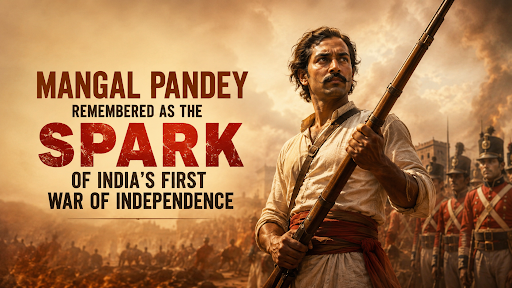
The nation commemorates the birth anniversary of Mangal Pandey on July 19, 2026.
Who is Mangal Pandey?
He was born on July 19, 1827, in Nagwa village within the Ballia district of Uttar Pradesh, belonging to a traditional Bhumihar Brahmin family.
He joined the East India Company’s (EIC) army in 1849 at the age of 22.
He serves as a private soldier (sepoy) in the 6th company of the 34th Bengal Native Infantry.
He fires the first shot that triggers the Revolt of 1857, widely recognized as the First War of Indian Independence.
His defiant actions initiate a chain of events that directly terminates the East India Company's rule over India.
The Government of India formally recognizes his contributions by issuing a commemorative postage stamp bearing his image on October 5, 1984.
Nationalist leaders like V.D. Savarkar views Pandey's motives as one of the earliest and purest manifestations of Indian Nationalism.
What Triggers Mangal Pandey's Revolt?
Introduction of the Enfield Rifle
-
Technological Shift: The British military introduced the new Pattern 1853 Enfield rifle-musket to the Bengal Army,.
-
Loading Mechanism: Sepoys had to physically bite open the cartridge wrapper to load the weapon, bringing the material into direct contact with their mouths.
Religious Concerns
-
Offensive Materials: Rumours confirmed that the British greased the new cartridges with animal fat, specifically from cows and pigs.
-
Cultural Defilement: Hindus revere the cow as holy, and Muslims view the pig as abhorrent; the forceful consumption of these fats severely hurt the religious sentiments of both communities.
Wider Discontent
Annexation of Awadh: Lord Dalhousie annexed Awadh treacherously in 1856 on the grounds of misgovernance, outrageously displacing local rulers and landlords.
Military Demographics: Awadh supplied approximately 75,000 soldiers to the Company’s army, meaning the region's political distress directly affected the morale of the sepoys.
Peasant Hardships: The sepoys filed over 14,000 petitions protesting the oppressive land revenue settlements of 1856 that confiscated taluqdar villages. Mangal Pandey embodied this deep-seated peasant outrage against British misery.
What Happened at Barrackpore?
The Incident
Open Defiance: On the afternoon of March 29, 1857, an armed Mangal Pandey paced the parade ground at the Barrackpore cantonment, vehemently calling upon his fellow sepoys to rebel and defend their religion,,.
Armed Confrontation: Pandey fired at Sergeant Major Hewson and Adjutant Lieutenant Baugh, bringing down Baugh's horse and subsequently slashing the Adjutant with a heavy talwar (sword).
Failed Arrest: Major-General John Bennet Hearsey ordered the Indian Jemadar, Ishwari Prasad, to arrest Pandey; Prasad and the quarter-guard refused to obey the British command, demonstrating widespread regimental sympathy.
Attempted Sacrifice: Realizing he would be overpowered by arriving British troops, Pandey pressed the trigger of his musket with his foot and shot himself in the chest, but failed to inflict a mortal wound.
Consequences
Swift Execution: The British court-martialled Pandey and hanged him on April 8, 1857, ten days ahead of the scheduled date to suppress potential mutiny (Source: Official Court Martial Proceedings, 1857).
Regimental Disbandment: The British disbanded the entire 34th Bengal Native Infantry "with disgrace" on May 6, 1857, for failing to restrain a mutinous soldier.
Legacy of Mangal Pandey
Symbol of Resistance: He demonstrates that an individual Indian soldier can physically challenge the superior British military apparatus.
Catalyst for the Revolt: His hanging triggers a domino effect; soon after, the 7th Awadh Regiment defies orders, and the ultimate full-scale mutiny ignites in Meerut on May 10, 1857.
Nationalist Consciousness: He lays the psychological foundation for the modern Indian nationalist movement, shifting the paradigm from passive servitude to armed assertion.
Enduring Patriotism: The Indian people continuously celebrate his legacy, establishing permanent tributes like the Shaheed Mangal Pandey Maha Udyan in Barrackpore.
Early Martyrdom: He willingly surrenders his life at the age of 30 to protect the socio-cultural fabric of India, setting a benchmark for future revolutionaries.
What is the Historical Significance of the Revolt of 1857?
End of East India Company Rule: The massive armed uprising dismantles the century-long commercial and territorial exploitation of the East India Company.
Government of India Act, 1858: The British Parliament enacts this landmark legislation to radically restructure the colonial administrative system in India.
Transfer of Power: Queen Victoria's Proclamation of 1858 transfers the governance of India directly to the British Crown, dissolving the Company's Board of Directors and appointing Lord Canning as the first Viceroy.
Reorganisation of the Indian Army: The British drastically alter military demographics by increasing the proportion of European troops and reserving artillery divisions exclusively for British soldiers to prevent future uprisings.
Beginning of Modern Nationalism: The revolt shatters the myth of British invincibility and creates a tradition of unified resistance that paves the way for the organized national freedom movement.
Source: PIB
|
PRACTICE QUESTION Q. Consider the following statements regarding the causes that provoked Mangal Pandey's actions in 1857: 1. He belonged to the 19th Bengal Native Infantry stationed at Berhampore. 2. The annexation of Awadh under the Doctrine of Lapse deeply disturbed the soldiers from that region. 3. The introduction of the Enfield rifle required sepoys to bite cartridges rumoured to be greased with animal fat. Which of the statements given above is/are correct? (a) 1 and 2 only (b) 3 only (c) 2 and 3 only (d) 1, 2, and 3 Answer: (b) Explanation: Statement 1 is incorrect: Mangal Pandey belonged to the 34th Bengal Native Infantry stationed at Barrackpore. It was the 19th Bengal Native Infantry stationed at Berhampore that had earlier refused to use the cartridges and was subsequently disbanded. Statement 2 is incorrect: While the annexation of Awadh deeply disturbed the soldiers (as a vast majority of them hailed from that region), Awadh was annexed by Lord Dalhousie in 1856 under the pretext of maladministration (misgovernance), not the Doctrine of Lapse. Statement 3 is correct: The immediate trigger for the 1857 revolt was the introduction of the new Enfield rifle. The sepoys had to bite off the paper ends of the cartridges, which were strongly rumoured to be greased with cow and pig fat, deeply offending the religious sentiments of both Hindu and Muslim soldiers. |