Why In News?
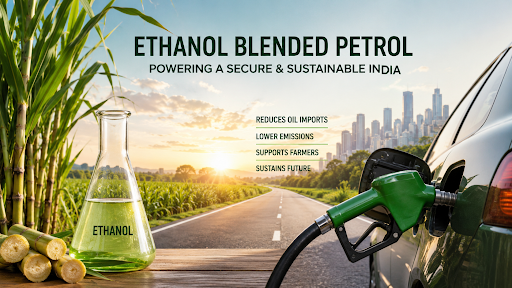
The Ministry of Petroleum and Natural Gas (MoPNG) confirms that India successfully attains the E20 (20% ethanol blending) milestone in the Ethanol Supply Year (ESY) 2025-26.
What is the Ethanol Blended Petrol (EBP) Programme?
The EBP Programme is a strategic initiative that blends anhydrous ethanol (C₂H₅OH) with standard motor petrol to substitute fossil fuels with renewable biofuels.
India initiated the pilot scheme in 2001 and formally launched the program in 2004. The blending rate stagnated at <1.5% until 2014 due to over-reliance on sugarcane.
The National Policy on Biofuels, 2018, transforms the ecosystem by allowing multiple feedstocks, including damaged food grains, maize, and surplus rice.
The program aims to enhance national energy security, support agrarian livelihoods via guaranteed secondary markets, and mitigate greenhouse gas (GHG) emissions.
Why is Ethanol Important for India?
Reduces Import Dependence: India imports over 85% of its crude oil, making the economy vulnerable to geopolitical shocks (eg.Iran-Israel war).
Supports Farmers: The program converts farmers from Annadatas (food providers) to Urjadaatas (energy providers) by providing guaranteed procurement prices, such as the Minimum Support Price (MSP) of ₹2,400/quintal for maize.
Promotes Cleaner Fuels: Ethanol provides a Research Octane Number (RON) of 108.5, improving combustion efficiency and reducing lifecycle carbon emissions by nearly 40%.
Foreign Exchange Savings: The EBP saves India over ₹1.97 lakh crore in foreign exchange between 2014 and May 2026. (Source: PIB)
What are the Major Achievements of the EBP Programme?
Rapid Blending Growth: India scales blending from under 1.5% in ESY 2013-14 to 20% in ESY 2025-26, with annual procurement surging from 38 crore litres to over 1,200 crore litres.
Distillation Capacity: Domestic production capacity expands nearly fivefold, from 421 crore litres in 2014 to roughly 2,000 crore litres in 2026.
Financial Investment: Public sector banks finance close to ₹1 lakh crore annually in ethanol plants and logistics.
Direct Income Transfer: The program transfers over ₹1.66 lakh crore to Indian farmers between ESY 2014-15 and May 2026.
Carbon Mitigation: The program cumulatively cuts approximately 952 lakh Metric Tonnes of CO₂ and substitutes over 316 lakh Metric Tonnes of crude oil.
How Does the EBP Programme Contribute to Energy Security?
Diversification: India fragments energy reliance across varied feedstocks like sugarcane, maize, and 2G biomass.
Price Stability: While global petrol prices jump 17% to 42% in neighboring countries, India’s petrol price rises merely 5.58% between 2022 and 2026.
Supply Chain Security: Oil Marketing Companies (OMCs) formalize Long-Term Off-take Agreements (LTOA) for up to 10 years.
Strategic Autonomy: India leverages its bio-economy success to spearhead the Global Biofuels Alliance (GBA).
What Challenges Continue to Affect the Ethanol Programme?
Water Intensity: Sugarcane acts as a "water-guzzler," threatening groundwater levels in Maharashtra and Karnataka.
Agri-inflation: Diverting maize and rice triggers price spikes for poultry feed and starch.
Vehicle Compatibility: Consumers report a 3% to 5% reduction in fuel economy, while Flex-Fuel Vehicles (FFVs) face regulatory hurdles regarding taxation and CAFE III norms.
Logistics Constraints: High aggregation costs for Second Generation (2G) biofuels render them more expensive than 1G fuels.
What Measures Can Strengthen India's Biofuel Ecosystem?
Promote 2G Ethanol: Scale production from agricultural residues using Viability Gap Funding (VGF) under the PM JI-VAN Yojana.
Diversify Feedstocks: Shift focus toward less water-intensive crops like maize, which currently contributes 35% of production.
Encourage FFVs: Implement fiscal incentives to lower acquisition costs for Flex-Fuel Vehicles.
Infrastructure Enforcement: Deploy independent quality surveillance and Bureau of Indian Standards (BIS) enforcement to eliminate adulteration.
Advanced R&D: Integrate ethanol into Sustainable Aviation Fuel (SAF) and utilize Carbon Capture and Utilisation (CCU) technologies.
Climate Integration: Link cultivation with the Green Credit Program (GCP) to allow farmers to trade digital carbon credits.
Conclusion
India’s Ethanol Blended Petrol Programme transforms the nation's energy trajectory by synergizing rural economic empowerment with decisive climate action and strategic fossil-fuel independence.
Source: PIB
|
PRACTICE QUESTION Q. With reference to Ethanol Blended Petrol (EBP), which of the following statements is/are correct? 1. E20 fuel inherently has a lower Research Octane Number (RON) compared to pure petrol. 2. The National Policy on Biofuels (2018) allows the use of damaged food grains and surplus rice for ethanol production. 3. Widespread diversion of maize towards ethanol production can trigger agri-inflation in poultry feed sectors. Select the correct answer using the codes given below: A) 1 and 2 only B) 2 and 3 only C) 1 and 3 only D) 1, 2, and 3 Answer: B Explanation: Statement 1 is Incorrect: Pure ethanol inherently has a higher Research Octane Number (RON) than pure petrol, which improves combustion and prevents engine knocking. When blended into petrol (such as E20, which is a blend of 20% ethanol and 80% petrol), it actually increases the overall octane rating of the fuel compared to unblended petrol. Statement 2 is Correct: The National Policy on Biofuels allows the production of ethanol from damaged food grains (such as wheat and broken rice) that are unfit for human consumption. It also permits the conversion of surplus food grains to ethanol during crop surplus years. Statement 3 is Correct: The widespread diversion of maize for ethanol production leads to a fuel vs. feed debate. Because the poultry and livestock sectors consume the majority of India's maize, shifting this crop to fuel distilleries creates a supply shortage, |