Why In News?
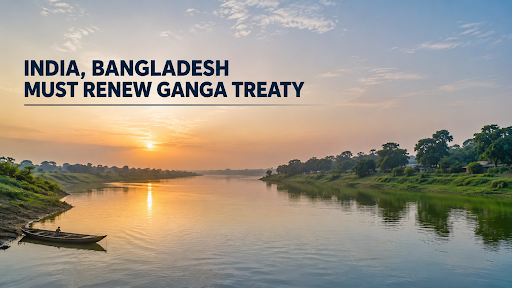
The 30-year Ganga Water Sharing Treaty expires in December 2026, prompting India to seek a short-term renewal while Bangladesh demands a comprehensive renegotiation to address modern environmental and political realities.
What is the Ganga Water Sharing Treaty?
The India–Bangladesh Ganga Water Sharing Treaty was signed in December 1996 to share the dry-season flow of the Ganga at the Farakka Barrage. It is valid for 30 years and expires in December 2026.
Objective: To ensure equitable sharing of Ganga waters during the lean season (1 January–31 May) while strengthening bilateral cooperation.
Water-Sharing Formula: The treaty allocates water based on 10-day average flows measured at Farakka:
-
≤70,000 cusecs: Shared equally (50:50).
-
70,000–75,000 cusecs: Bangladesh receives 35,000 cusecs.
-
>75,000 cusecs: India receives 40,000 cusecs, with the remainder flowing to Bangladesh.
Joint Monitoring: A Joint Committee comprising representatives from both countries monitors river discharge and submits annual implementation reports.
Periodic Review: The treaty provides for five-year reviews and consultations if flows fall below 50,000 cusecs during any 10-day period.

Why India Want to Renegotiate the Treaty?
Changing River Hydrology: The treaty is based on 1949–1988 flow data, which no longer reflects present-day river discharge affected by climate variability and upstream interventions.
Climate Change: Rising temperatures, erratic monsoons and Himalayan glacier changes have altered seasonal flows, making the fixed allocation formula less reliable.
Environmental Flow Requirements: The treaty focuses on water allocation but does not prescribe minimum ecological flows needed to sustain river ecosystems, fisheries and the Sundarbans.
Outdated Basin Approach: It covers only the Ganga at Farakka, whereas India and Bangladesh share 54 transboundary rivers, requiring integrated basin-wide management.
Increasing Water Demand: Population growth, irrigation expansion, urbanisation and industrialisation have substantially increased water demand in both countries since 1996.
Need for Real-Time Data Sharing: The treaty relies primarily on discharge measurements at Farakka and lacks real-time hydrological data exchange, satellite monitoring and digital forecasting.
Groundwater–Surface Water Linkages Ignored: The agreement does not integrate groundwater management despite increasing dependence on aquifers in the Ganga basin.
Disaster Management Gap: It lacks provisions for joint flood forecasting, drought management and climate adaptation, which are increasingly important under changing climatic conditions.
Institutional Strengthening: The Joint River Commission requires greater technical capacity, permanent data-sharing mechanisms and regular ministerial oversight for effective implementation.
Regional Water Diplomacy: Renewal offers an opportunity to integrate the treaty with broader India–Bangladesh cooperation on navigation, hydropower, flood management and blue economy, strengthening regional resilience.
What Measures Can Strengthen Future Water Cooperation?
Adopt Integrated River Basin Management (IRBM): Shift from fixed volumetric sharing to basin-wide management integrating water, ecosystems and livelihoods.
Climate-Proof the Treaty: Introduce dynamic allocation mechanisms linked to real-time river flows, rainfall forecasts and drought conditions instead of fixed historical averages.
Modernise the Joint Rivers Commission (JRC): Upgrade the JRC with permanent technical experts, digital monitoring systems and faster dispute-resolution mechanisms.
Strengthen Cooperative Federalism: Institutionalise consultations with West Bengal, Bihar and other basin States before finalising treaty provisions.
Expand Treaty Scope: Cover all 54 India–Bangladesh shared rivers through an integrated transboundary water cooperation framework rather than addressing only the Ganga.
Institutionalise Real-Time Data Sharing: Develop joint telemetry stations, satellite-based monitoring and upstream hydrological data exchange to improve transparency.
Joint Flood & Drought Management: Establish integrated forecasting systems, flood early-warning networks and coordinated disaster response mechanisms.
Broaden Cooperation Beyond Water Sharing: Integrate inland navigation, sediment management, river restoration, fisheries and blue economy initiatives into bilateral cooperation.
Promote Science-Based Negotiations: Include hydrologists, climatologists, ecologists, economists and social scientists alongside diplomats and engineers in treaty negotiations.
Develop Joint Sediment Management Plans: Coordinate dredging and sediment-flow management around the Farakka Barrage to reduce flood risk and improve river health.
Create a Permanent Basin Knowledge Platform: Build a shared India–Bangladesh database on river flows, groundwater, glacier melt, water quality and climate impacts to support evidence-based policymaking.
Conclusion
To secure long-term regional stability, India and Bangladesh must move beyond rigid arithmetic water division and embrace a climate-resilient, ecosystem-based approach to managing the Ganga basin.
Source: INDIANEXPRESS.
|
PRACTICE QUESTION Q. "The renewal of the Ganga Water Sharing Treaty offers an opportunity to transform India–Bangladesh water cooperation from a narrow water-allocation framework into a comprehensive river-basin partnership." Critically Analyze. 250 words |