Why In News?
Uttar Pradesh has classified human-animal conflicts as a state disaster to unlock emergency funding and tackle a crisis responsible for over 4,000 deaths.
What is Human–Animal Conflict?
Human-animal conflict is a negative interaction and friction between humans and wild animals, which directly threatens human safety, rural livelihoods, and wildlife survival.
Why is Human–Animal Conflict Increasing?
Habitat Loss and Fragmentation: Rapid agricultural expansion and industrialization fragment continuous forest patches, restrict animal movement, and force wildlife into human-dominated landscapes.
Encroachment into Forest Areas: Expanding human settlements encroach upon vital buffer zones, such as in Bijnor where leopards inhabit agricultural sugarcane fields because the tall crops provide perfect camouflage and easy access to livestock.
Climate Change: Extreme weather events and prolonged droughts dry up natural water bodies, pushing wild animals out of protected areas in search of hydration and food.
Decline in Natural Food Sources: Invasive Alien Species (IAS) and intense livestock overgrazing deplete natural forest fodder, driving herbivores into agricultural lands and subsequently attracting apex predators.
Linear Infrastructure: Unregulated construction of highways, railways, and irrigation canals cuts directly across vital wildlife corridors, disrupting natural migration paths and increasing road-kill incidents.
Rising Wildlife Populations: Successful conservation drives boost apex predator numbers beyond the carrying capacity of core zones, as seen in Uttar Pradesh's 18.49% increase in its tiger population to 205 tigers in 2022, forcing them to seek new territories in human fringes.
What are the Major Impacts?
Loss of Human Lives: Conflicts claim over 4,000 lives in Uttar Pradesh alone, while elephant attacks claim 148 lives in Odisha during the 2022-23 period.
Crop Damage and Livestock Loss: Herbivores like elephants and nilgai decimate seasonal crops, while predators routinely prey on village livestock, delivering crippling blows to the agrarian economy.
Decline in Wildlife Populations: Frequent conflicts cause direct loss of endangered wildlife through vehicular accidents, mob lynching, and forced captivity.
Economic Losses: Destruction of agricultural yields and loss of primary breadwinners perpetuate chronic poverty and food insecurity in forest-fringe communities.
Retaliatory Killings: Aggrieved villagers frequently resort to retaliatory poisoning, electrocution, and trapping of animals out of intense fear, anger, and financial distress.
Social Tensions: Unresolved conflicts breed hostility towards forest departments and conservation policies, leading to protests, highway blockades, and law-and-order crises.
Shift in Agricultural Practices: Farmers abandon traditional crops or leave lands entirely fallow to avoid the relentless threat of herbivore raids.

Frameworks to Address Human–Animal Conflict
Wildlife (Protection) Act, 1972: Provides the foundational legal framework, while the Wildlife (Protection) Amendment Act, 2022 strictly rationalizes schedules from six to four and regulates the proliferation of Invasive Alien Species (IAS).
National Wildlife Action Plan (2017–2031): Shifts focus toward landscape-level conservation and prioritizes comprehensive human-wildlife conflict mitigation mechanisms.
Project Tiger: Executes a core-buffer strategy to sustain viable tiger populations while strictly minimizing spillover into human settlements.
Project Elephant: Extends crucial financial and technical support to states to protect elephants, secure their corridors, and mitigate severe human-elephant conflicts.
National Board for Wildlife (NBWL): Acts as the apex regulatory body that scrutinizes and restricts developmental projects inside protected areas to prevent ecological fragmentation.
State Forest Departments: Serve as the primary execution bodies for on-ground mitigation, wildlife rescue operations, and ex-gratia compensation distribution.
Enhanced Ex-Gratia Guidelines: The Central Government enhances ex-gratia relief for human death or permanent incapacitation from ₹5 lakh to ₹10 lakh in December 2023.
What Measures Can Reduce Human–Animal Conflict?
Protect and Restore Wildlife Corridors: Legally secure and restore safe ecological passages to facilitate the movement of long-ranging megafauna, drastically reducing their dependence on human landscapes.
Scientific Land-Use Planning: Discourage farmers from cultivating tall, dense crops like sugarcane immediately adjacent to forest borders, eliminating crucial hiding spots for leopards.
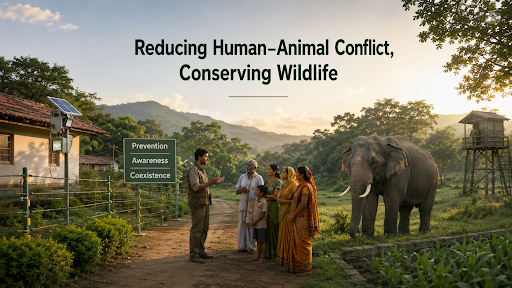
Community-Based Conservation: Deploy local volunteers as Bagh Mitras (Friends of the Tiger). In the Pilibhit Tiger Reserve, trained locals act as first responders, manage crowds, track pugmarks, and successfully prevent retaliatory killings.
Early Warning and Monitoring Systems: Establish advanced tech-driven control rooms. The Dudhwa Tiger Reserve operationalizes dedicated Rapid Response Teams (RRTs) equipped with thermal drones, camera traps, and a digital conflict dashboard.
Timely Compensation: Ensure rapid, digitized, and transparent distribution of financial compensation to prevent community alienation and curb revenge killings.
Public Awareness and Capacity Building: Integrate disaster awareness into local school curricula and mandatorily train Home Guards and Aapda Mitras as capable first responders during wildlife emergencies.
Non-Lethal Deterrent Technologies: Install bio-fencing, solar electric fences, acoustic deterrents, and predator-proof livestock enclosures to physically separate humans and wildlife.
Immunocontraception: Uttar Pradesh experimental leopard immunocontraception (laparoscopic vasectomy) in Bijnor to scientifically limit uncontrolled population booms under Section 12(bb) of the WPA, 1972.
Conclusion
Fostering peaceful coexistence between humans and wildlife necessitates a robust, multi-pronged strategy that seamlessly integrates advanced surveillance technology, strict policy enforcement, and empowered community-led frameworks like Bagh Mitras.
Source: TRIBUNEINDIA
|
PRACTICE QUESTION Q. "Human–animal conflict has emerged as one of the most significant conservation and rural livelihood challenges in India." Examine. 150 words |