Why In News?
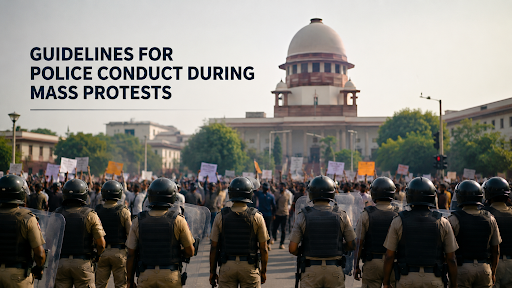
The Supreme Court intervenes to protect civil liberties by ordering the release of detained minors and initiating the creation of uniform national guidelines to regulate police conduct.
What is the Constitutional Basis of the Right to Protest?
The right to protest is not expressly mentioned in the Constitution of India. However, the Supreme Court has consistently held that it is a Fundamental Right derived from Articles 19 and 21, subject to reasonable restrictions in the interests of public order, sovereignty and integrity of India.
Constitutional Provisions
Article 19(1)(a): Freedom of Speech and Expression
-
Guarantees every citizen the right to express opinions, criticise government policies and voice dissent peacefully.
-
Forms the foundation of democratic protest.
Article 19(1)(b): Right to Assemble Peacefully and Without Arms
-
Gives citizens the right to organise peaceful demonstrations, rallies and public meetings.
-
This right applies only to peaceful and non-violent assemblies.
Article 19(1)(c): Freedom to Form Associations or Unions
-
Protects the right to form organisations, trade unions, student bodies and civil society groups for collective action and protest.
Article 21: Right to Life and Personal Liberty
-
The Supreme Court has linked peaceful dissent with the dignity, liberty and democratic participation guaranteed under Article 21.
Reasonable Restrictions
The right to protest is not absolute. The State may impose restrictions under:
-
Article 19(2) – In the interests of:
-
Sovereignty and integrity of India
-
Security of the State
-
Friendly relations with foreign States
-
Public order
-
Decency or morality
-
Contempt of court
-
Defamation
-
Incitement to an offence
-
Article 19(3) – Reasonable restrictions on peaceful assembly in the interests of:
-
Sovereignty and integrity of India
-
Public order
Judicial Interventions
Himat Lal K. Shah vs Commissioner of Police (1973)
-
Citizens have the right to hold public meetings on public streets, subject to reasonable regulation—not arbitrary prohibition.
Mazdoor Kisan Shakti Sangathan (MKSS) vs Union of India (2018)
-
Peaceful protest is an essential feature of democracy.
-
The State must balance citizens' right to protest with public convenience and traffic management.
Amit Sahni vs Commissioner of Police (Shaheen Bagh Case, 2020)
-
Public protests cannot occupy public roads indefinitely.
-
Fundamental rights must be balanced with the rights of other citizens.
Recent Supreme Court Observation (2026)
-
The Court reiterated that "peaceful and lawful protest is absolutely guaranteed under the constitutional scheme."
-
It observed that mere agitation cannot justify police excesses or lathi-charge, while emphasizing the need to balance civil liberties with public order.
Why is the Supreme Court Considering Uniform Guidelines?
Protect Fundamental Rights: Ensure peaceful protests under Articles 19(1)(a), 19(1)(b) & 21 are not curtailed through arbitrary police action.
Prevent Arbitrary Detention: Standardise arrest, detention and release procedures, especially for women, children and peaceful protesters.
Ensure Proportionate Use of Force: Enforce the principles of necessity and proportionality, preventing indiscriminate lathi-charge and tear-gas use.
Regulate Less-Lethal Weapons: Frame national protocols on the use of pellet guns, electric batons, rubber bullets and tear-gas launchers.
Increase Accountability: Mandate body-worn cameras, CCTV preservation, drone footage and visible name badges during crowd-control operations.
Uniform National Standards: Eliminate inconsistent crowd-control practices arising from different State Police Manuals.
Protect Journalists & Human Rights Defenders: Prevent unlawful obstruction or targeting of accredited media and legal observers during protests.
Reduce Human Rights Violations: Minimise custodial violence, unlawful detention and excessive force through nationally applicable SOPs.
Strengthen Judicial Oversight: Create measurable standards to review police conduct and determine accountability.

Major Challenges
Defining "Unlawful Assembly": Difficulty in determining when a peaceful protest legally becomes unlawful.
Disproportionate Force: Premature use of lathi-charge, tear gas or kinetic projectiles without exhausting de-escalation measures.
No Uniform SOPs: Different State manuals produce inconsistent policing standards.
Poor Crowd Engineering: Inadequate exit routes and barricade planning increase stampede risks.
Police Safety: Violent elements can attack officers, complicating calibrated responses.
Weak Accountability: Delays in disciplinary action reduce public confidence.
Political Interference: Operational decisions may be influenced by executive pressure.
Misuse of Preventive Powers: Frequent use of Section 163 BNSS can unnecessarily restrict peaceful assemblies.
-
Section 163 allows magistrates to issue preventive orders, while Section 148 provides the statutory power to disperse unlawful assemblies.
Digital Misinformation: Social media rumours can rapidly escalate crowd violence.
Inadequate Non-Lethal Equipment: Many police forces lack calibrated crowd-control technology and protective gear.
Insufficient Body Cameras: Limited deployment weakens evidence collection and transparency.
Limited De-escalation Training: Police academies often provide inadequate training in mediation and negotiation.
Way Forward
Uniform National SOPs: Notify legally enforceable crowd-control SOPs based on the UN Basic Principles on the Use of Force and the Supreme Court's proposed pan-India protocol.
Graduated Use of Force: Mandate the sequence Dialogue → Warning → Negotiation → Non-lethal measures → Minimum force, with firearms only as a last resort.
Mandatory Body-Worn Cameras: Equip every crowd-control unit with body cameras and preserve CCTV, drone and wireless recordings as digital evidence.
Independent Police Complaints Authorities: Fully implement Prakash Singh (2006) by operationalising State and District Police Complaints Authorities with independent members.
Specialised Public Order Units: Create dedicated crowd-management units trained in negotiation, mediation and crowd psychology, instead of relying on general police deployment.
Mandatory Pre-Protest Liaison: Institutionalise liaison officers to coordinate with organisers on routes, timings, medical support and dispersal plans before demonstrations.
Ban High-Injury Weapons: Phase out or strictly regulate pellet guns, metal pellets and electric batons, replacing them with internationally accepted less-lethal alternatives.
Independent Judicial Probe: Make Judicial Inquiry/SIT investigation mandatory for every protest-related death or grievous injury.
Medical Response Protocol: Deploy ambulances and trauma teams during large demonstrations and ensure immediate treatment of injured protesters and police personnel.
Restrict Preventive Orders: Ensure Section 163 BNSS is invoked only when it satisfies the constitutional tests of necessity and proportionality, avoiding routine or prolonged prohibitory orders.
Limit Internet Shutdowns: Follow the Supreme Court's proportionality standard and avoid blanket internet suspensions during peaceful protests unless strictly necessary.
Mandatory Officer Identification: Require all field personnel to display visible name and identification badges to strengthen accountability.
Conclusion
Establishing uniform guidelines on police conduct during protests will transform colonial-era crowd control into democratic policing, harmonizing the fundamental right to dissent with the essential need for public order.
Source: THEHINDU
|
PRACTICE QUESTION Q. "The right to peaceful protest is fundamental to constitutional democracy, but its exercise must coexist with the maintenance of public order." Discuss. 150 words |