Why In News?
The India Meteorological Department (IMD) forecasts a deficient 2026 southwest monsoon at 90% of the Long Period Average (LPA), triggering severe drought-like conditions across 397 out of 741 districts in the Gangetic plains.
Why is the Southwest Monsoon Important for India's Economy?
Primary Precipitation Source: The southwest monsoon delivers the vast majority of India's annual precipitation, directly dictating soil moisture levels across the subcontinent.
Agricultural Production Support: The agricultural sector contributes 18.3% to 20% of the national Gross Value Added (GVA) and relies heavily on June-July rains for vital Kharif crop sowing.
Rural Livelihood Sustenance: Agriculture employs 46% of India's workforce and sustains the livelihoods of nearly 55% of the population, directly linking weather outcomes to extreme poverty alleviation.
Water Infrastructure Replenishment: Monsoon rains fill 166 major reservoirs across the country, securing water availability for drinking, winter irrigation, and uninterrupted hydropower generation.
What are the Major Economic Impacts of a Weak Monsoon?
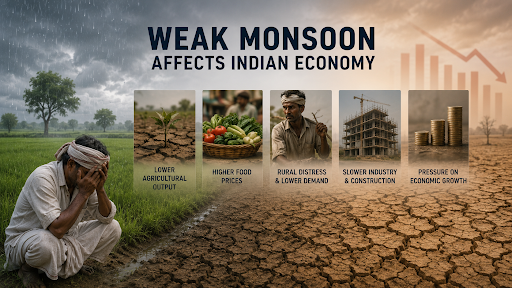
Lower Agricultural Output: Total kharif sowing plummets by approximately 16% (down to 53.12 million hectares in July 2026), heavily impacting essential crops like paddy, pulses, and oilseeds.
Rising Food Inflation: Consumer food price inflation jumps to 4.78% early in the season, fueled by supply shortages in vegetables and cereals.
Weakening Rural Demand: Every 1% deviation in monsoon rainfall trims 0.5-0.7 percentage points off rural consumption, severely impacting the Fast-Moving Consumer Goods (FMCG) sector as households shift to cheaper alternatives.
Slower Industrial Growth: Rural income loss drastically contracts the non-farm sector, causing a sharp slowdown in construction, tractor, and two-wheeler sales.
Energy Sector Pressure: A severe El Niño triggers a 17.7 Terawatt-hour (TWh) power generation gap as massive cooling demand overtakes dwindling hydro and wind energy, forcing India to ramp up coal dependency and adding 17 million tonnes of CO2 emissions.
Fiscal Strain: The government faces immense budgetary strain, releasing a ₹41,533 crore Nutrient-Based Subsidy for fertilizers to shield farmers from increasing input costs linked to geopolitical tensions.
Deteriorating Trade Balances: Deficient harvests threaten India's agri-exports (which currently make up 12% of core exports) and force the state to increase imports, widening the Current Account Deficit (CAD).
What are the Wider Macroeconomic Implications?
Slower GDP Growth: A combined shock of El Niño and agricultural drought shaves 20–65 basis points off India's overall GDP growth.
Higher Inflationary Pressures: Prolonged food inflation spirals into wage-setting expectations and core inflation, limiting the RBI's ability to cut the repo rate (currently 5.25%) to spur growth.
Water Stress: Reservoir storage critically drops to 47.725 BCM (against a normal of 48.402 BCM), straining urban water supply grids and completely halting hydroelectric operations in some regions.
Climate Risk to Economic Stability: High climate variability acts as a non-linear macroeconomic shock, continuously undermining fiscal planning and drastically increasing the required national outlay for disaster recovery.
What are the Major Challenges?
Large Rain-Fed Agricultural Area: An alarming 68% of India's cultivated area remains heavily drought-prone, functioning without safety nets against prolonged dry spells.
Climate Change Intensifying Rainfall Variability: Global warming alters monsoon patterns, creating a 10% to 15% spatial variability where some districts flood while others face acute deficits.
Limited Irrigation Coverage: Out of India's 180.11 Mha cultivated land, only 43 Mha possess full irrigation capabilities, showcasing massive infrastructure gaps.
Regional Rainfall Imbalances: Central hubs like the Gangetic plains face heavy distress, with districts like Bhadohi (88% deficit) and Jaunpur (75% deficit) experiencing catastrophic failures in paddy transplantation.
Dependence on Agriculture for Rural Livelihoods: Over 85% of the farming demographic consists of small and marginal farmers (averaging <1 hectare) who lack credit access to survive multi-year crop failures.
Rampant Land Degradation: Roughly 146.7 Mha (44% of total land area) suffers from degradation—primarily water erosion—stripping soil of its crucial moisture-retaining organic carbon.
What Government Initiatives Help Mitigate Monsoon Risks?
Pradhan Mantri Fasal Bima Yojana (PMFBY): Operates as a critical weather-index insurance mechanism, injecting financial liquidity into rural households during monsoon failures.
PM Krishi Sinchai Yojana (PMKSY): Promote precision agriculture by expanding micro-irrigation (drip and sprinkler systems) to maximize water-use efficiency in parched zones.
National Mission for Sustainable Agriculture (NMSA): Integrates climate-resilient farming techniques, heavily subsidizing conservation agriculture and targeting highly vulnerable agro-ecological zones.
National Innovations on Climate Resilient Agriculture (NICRA): Deploys sophisticated digital vulnerability mapping and seeds stress-tolerant germplasms directly to the field.
District-Level Crop Contingency Plans: Utilizing the Bharat Forecast System, authorities issue targeted advisories allowing farmers to pivot to short-duration crops when the monsoon stalls.
Pradhan Mantri Dhan-Dhanya Krishi Yojana: ₹24,000 crore intervention targeting 100 underperforming districts to boost crop diversification, alternate cropping, and soil health.
What Measures Can Reduce India's Monsoon Vulnerability?
Expand Irrigation Infrastructure: Accelerate the expansion of sustainable irrigation to a 60 Mha target, prioritizing 70% water-use efficiency via micro-irrigation by 2030.
Promote Climate-Resilient Agriculture: Fast-track the adoption of stress-tolerant seeds (like heat-resistant wheat or short-duration mungbean) to blanket 50% of vulnerable areas.
Strengthen Weather Forecasting and Advisory Services: Implement the AI-enabled Bharat-VISTAAR platform to link AgriStack data directly with farmers, granting hyper-local, real-time risk mitigation strategies.
Diversify Cropping Systems: Decouple the rural economy from water-guzzling paddy by incentivizing the cultivation of millets, pulses, and high-value coastal crops like cashew and cocoa.
Improve Water Harvesting and Groundwater Recharge: Revive indigenous water architecture by mandating the construction of farm ponds and check dams under MGNREGA convergence frameworks.
Enhance Rural Non-Farm Employment Opportunities: Fund SME growth via the Self-Reliant India Fund and establish processing infrastructure, absorbing labor displaced by drought.
Implement a National Data-Driven Agro-Stress Management Mission: Fuse spatial data from IMD, ISRO, and ICAR to engineer a predictive dashboard that automatically triggers relief funds prior to catastrophic crop failure.
Conclusion
Building economic resilience against monsoon deficits requires an urgent paradigm shift from reactive disaster relief to proactive, climate-smart structural investments in water management and rural diversification.
Source: DECCANHERALD
|
PRACTICE QUESTION Q. "A weak monsoon has consequences that extend far beyond agriculture, influencing inflation, growth, energy security and fiscal stability." Critically analyze. 150 words |