Why In News?
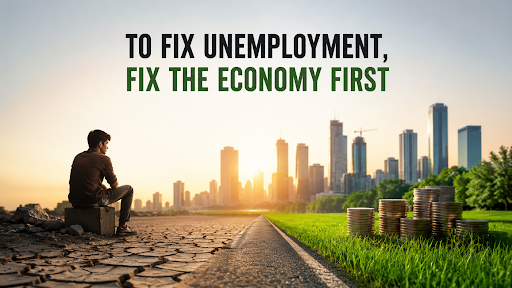
The Periodic Labour Force Survey (PLFS) 2023-24 reveals a high youth unemployment rate of 11.9% among India's Gen Z, highlighting a severe gap between education and job creation.
Why Strong Economic Growth is Essential?
Job Creation Depends on Economic Growth: India must sustain 8.0–8.5% annual GDP growth to generate 90 million additional non-farm jobs by 2030. A lower growth path would create only about 6 million net jobs over the decade. (Source: McKinsey)
-
India's GDP growth has become capital-intensive, resulting in weak employment generation despite rising output.
Skills Alone Cannot Create Jobs: Only 4.9% of Indian youth (15–29 years) have received formal vocational training, indicating that employability constraints are structural rather than cyclical. (Source: PLFS)
Employment Quality Matters: Nearly 87% of India's workforce (about 634 million workers) is employed in the informal economy, characterised by low productivity, low wages and limited social security. (Source: PLFS)
-
Only 14.1% of employed Gen Z workers have formal employment contracts, reflecting widespread informal and insecure employment. (Source: PLFS)
Demographic Pressure: India needs to create about 12 million gainful non-farm jobs annually through 2030 to absorb 60 million new workers and transition 30 million agricultural workers into more productive sectors. (Source: McKinsey)
Major Causes of Unemployment in India
Low Employment Elasticity: India's employment elasticity was only 0.04 (2004–2012), indicating that economic growth generated very few additional jobs. (Source: Employment-Unemployment Survey Report).
The "Missing Middle": Large factories constitute only 22% of manufacturing units but employ 79% of formal manufacturing workers, reflecting the inability of small firms to scale up. (Source: Annual Survey of Industries).
Micro-Enterprise Informality: India has about 7.9 crore unincorporated non-agricultural enterprises, many dependent on self-employment and unpaid family labour instead of regular wage employment. (Source: Annual Survey of Unincorporated Sector Enterprises)
Graduate Underemployment: Rapid expansion of higher education has outpaced the creation of high-skilled jobs, resulting in education–occupation mismatch.
Female Workforce Exclusion: Urban young women face an unemployment rate of 22.6%, while over 27% of Gen Z women remain outside employment due to unpaid domestic and care responsibilities. (Source: PLFS)
Slow Structural Transformation: A large share of workers remains trapped in low-productivity agriculture because manufacturing has not expanded sufficiently to absorb surplus labour.
Automation & Capital Deepening: Firms increasingly adopt automation and AI, reducing demand for routine and low-skilled labour while increasing demand for specialised skills.
MSME Growth Constraints: Limited access to formal finance, technology and markets restricts MSME expansion and employment generation.
Weak Labour Mobility: High urban housing costs, inadequate rental markets and poor transport infrastructure constrain migration to productive employment centres.
Low Labour-Intensive Exports: India's export basket remains relatively less labour-intensive than successful East Asian economies, limiting large-scale manufacturing employment.

Major Challenges to Employment Generation
Low Employment Growth: Employment grew by only 0.8% annually during 2000–2019, reflecting persistent jobless growth despite economic expansion. (Source: McKinsey)
Weak School-to-Work Transition: Young people face prolonged delays between education and employment due to weak industry linkages and limited apprenticeship opportunities.
Self-Employment Trap: 55.8% of India's workforce is self-employed, with much of it concentrated in low-productivity and informal activities. (Source: Economic Survey 2025–26)
Regional Employment Imbalance: Organised manufacturing employment remains concentrated (60%) in seven States, creating unequal access to quality jobs across regions.
AI & Automation Risks: Around 26% of Indian workers are in occupations with high AI exposure, including 12% in jobs at higher risk of displacement. (Source: IMF)
Slow Manufacturing Expansion: Manufacturing has not grown fast enough to absorb surplus labour leaving agriculture, limiting structural transformation.
MSME Scaling Constraints: Limited access to finance, technology and markets prevents MSMEs from becoming medium-sized job creators.
High Informality: A large share of new jobs remains informal, resulting in low wages, weak productivity and limited social security.
Steps Taken by the Government to Promote Employment
Four Labour Codes (2019–2020): Consolidated 29 Central labour laws into four Codes to simplify compliance while strengthening worker protection.
Employment Linked Incentive (ELI) Scheme: Incentivises formal job creation by supporting first-time employees and employers generating additional employment.
Production Linked Incentive (PLI) Scheme: Promotes manufacturing in sectors such as electronics, pharmaceuticals, textiles and automobiles to generate formal employment.
PM Vishwakarma Scheme: Supports traditional artisans through skill training, toolkit incentives, concessional credit and market access.
PMEGP (Prime Minister's Employment Generation Programme): Provides credit-linked subsidies for establishing micro-enterprises in rural and urban areas.
National Career Service (NCS): Mobilised over 2.3 crore vacancies during the first six months of FY2025–26, improving job matching. (Source: Economic Survey 2025–26).
e-Shram Portal: Registered over 31 crore unorganised workers, expanding access to social security and welfare schemes. (Source: Economic Survey 2025–26).
Skill India Mission: Promote industry-aligned skilling, Recognition of Prior Learning (RPL) and apprenticeship-based training.
National Apprenticeship Promotion Scheme (NAPS): Expands apprenticeship opportunities through financial support to employers.
Measures to Promote Employment-Led Growth
Expand Labour-Intensive Manufacturing: Scale sectors such as textiles, footwear, food processing, furniture and electronics through PLI and industrial clusters.
Improve MSME Credit Access: Expand digital credit, credit guarantees and fintech-based lending to enable MSME expansion.
Increase Public & Private Investment: Raise infrastructure investment to crowd in private capital and generate employment across construction and manufacturing.
Industry-Led Skilling: Align vocational education with industry demand through apprenticeships, dual-training models and outcome-based certification.
Increase Female Labour Force Participation: Expand childcare, safe transport, flexible work arrangements and hostel facilities to improve women's access to formal employment.
Develop Tier-2 & Tier-3 Growth Centres: Promote digital services, logistics, tourism and green industries beyond metropolitan cities to reduce regional disparities.
Formalise Gig & Platform Work: Operationalise social security under the Code on Social Security, 2020 for gig and platform workers.
Promote Export-Led Manufacturing: Integrate Indian firms into global value chains to expand labour-intensive exports and formal employment.
Support AI-Ready Workforce: Prioritise reskilling, digital literacy and AI adoption in line with the Economic Survey 2025–26 recommendations on application-led AI innovation.
Conclusion
To convert demographic youth surge into a true economic dividend, India must achieve an 8.0% to 8.5% GDP growth rate fueled by structural labor reforms, manufacturing expansion, and inclusive job creation.
Source: THEHINDU
|
PRACTICE QUESTION Q. "Addressing unemployment requires an employment-intensive growth strategy rather than relying solely on education and skill development." Discuss. 150 words |