Why In News?
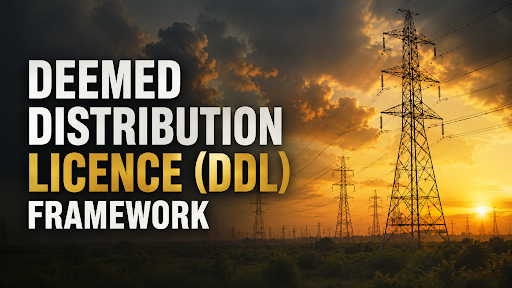
The Andhra Pradesh government's policy proposing a Deemed Distribution Licence (DDL) for hyperscale AI data centres—ignited a major national debate over state electricity regulatory autonomy.
What is a Deemed Distribution Licensee (DDL)?
Under the Section 14 of the Electricity Act, 2003, certain entities engaged in the transmission or distribution of electricity are legally "deemed" to be distribution licensees without having to undergo the formal, elaborate application process before the Central or State Electricity Regulatory Commissions.
Historically, DDL status has been statutorily reserved for specific institutional entities like the Indian Railways (for traction power), Port Trusts, Cantonment Boards, and Special Economic Zone (SEZ) Developers under Section 49 of the Special Economic Zones Act, 2005.
A DDL operates as an autonomous local power utility within its demarcated boundary, empowered to procure electricity directly through bilateral Power Purchase Agreements (PPAs) with renewable developers or energy exchanges (IEX/PXIL), establish internal transmission substations, and supply electricity to end-consumers within the zone.
The Data Centre Controversy (2026)
The DDL model has sparked an intense policy debate after the Andhra Pradesh government proposed granting DDL status to private hyperscale AI data centres (such as the Google-Adani AI hub in Visakhapatnam) with a connected load of over 300 MW.
Arguments in Favour
-
Massive Energy Needs: AI data centres consume power at the scale of entire municipalities, requiring infrastructure autonomy.
-
Attracting Big-Tech FDI: Offering cheaper, surcharge-free green energy helps states compete globally for digital infrastructure investments.
-
Relieving Grid Stress: Private developers foot the bill to build their own massive substations, saving public utility capital.
Arguments Against
-
Financial Crippling of State DISCOMs: Indian power tariffs use a cross-subsidy model where commercial/industrial users are overcharged to fund free or cheap electricity for low-income homes and farmers.
-
If giant tech corporations exit the general grid pool via DDL status, state utilities stand to lose their highest-paying customers, crushing their finances.
-
Legal Unsustainability: Relying on executive orders to grant DDL status to private developers conflicts with the Supreme Court's mandate that self-consumption is not a distribution activity. It also bypasses the statutory domain of independent State Electricity Regulatory Commissions (SERCs).
Source: THEHINDU
|
PRACTICE QUESTION Q. "The rapid expansion of power-intensive hyperscale AI data centers has created a complex policy dilemma between attracting high-tech foreign investments and safeguarding the financial sustainability of state power utilities." Discuss. (15 Marks, 250 Words) |