Why In News?
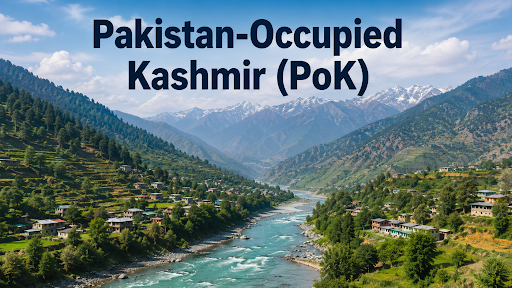
Widespread protests across Pakistan-Occupied Kashmir (PoK) signal a deepening legitimacy crisis as residents reject Islamabad’s centralized, extractive administration.
About Pok
Pakistan-Occupied Kashmir (PoK) refers to the part of the erstwhile princely State of Jammu & Kashmir that has been under Pakistan's control since the 1947–48 India-Pakistan War.
India considers the entire region an integral and inalienable part of India, while Pakistan administers it as Azad Jammu & Kashmir (AJK) and Gilgit-Baltistan.
The UN Security Council Resolution 47 (1948) called for Pakistan to first withdraw its forces and tribesmen before any plebiscite could be considered, a condition that was never fulfilled.
What Triggered the Recent Protests?
Reserved Assembly Seats: The Supreme Court of Azad Kashmir ruled that the 12 legislative seats reserved for refugees in Pakistan cannot be abolished without a constitutional amendment, sparking a boycott of the July 2026 general election.
Economic Hardships: Persistent inflation, rising food prices and high fuel costs have sharply reduced household purchasing power, fuelling public anger.
Rising Cost of Living: Local traders face severe financial losses because the government fails to deliver subsidized wheat, forcing purchases at high market rates.
Mangla Dam Paradox: Despite hosting the Mangla Hydropower Project, residents face national electricity tariffs rather than lower local costs, making affordable power a core protest demand.
Governance Deficit: Protests have expanded into demands for greater political autonomy, transparency, accountability and reduced federal interference in regional governance.

Strategic Importance and India's Position
Geostrategic Location: Gilgit-Baltistan lies at the junction of South Asia, Central Asia and China, bordering India, Pakistan, China and Afghanistan, making it critical for regional connectivity, border security and the Karakoram Highway.
CPEC Concerns: The US$62–65 billion China-Pakistan Economic Corridor (CPEC), the project of China's Belt and Road Initiative (BRI), passes through Gilgit-Baltistan.
-
India has consistently opposed CPEC as it traverses territory claimed by India, citing concerns over sovereignty and territorial integrity.
Water Security: Gilgit-Baltistan forms the upper Indus Basin, containing major glaciers that feed the Indus River System, making it strategically important for regional water security, hydropower and climate resilience.
Security Concern: The region is central to the China–Pakistan strategic partnership, with expanding transport and energy infrastructure under CPEC raising India's concerns over the possibility of dual-use civilian and military infrastructure.
Regional Connectivity: Gilgit-Baltistan serves as Pakistan's land gateway to China through the Khunjerab Pass, making it a critical node for trans-Himalayan trade, logistics and regional economic connectivity under the BRI framework.
India's Position: India maintains that the entire Union Territories of Jammu & Kashmir and Ladakh, including Gilgit-Baltistan, are integral and inalienable parts of India.
Human Rights Concerns: India has repeatedly raised concerns over restrictions on civil liberties, political freedoms and fundamental rights in Pakistan-administered territories.
UN Framework: India maintains that any unilateral alteration of the status of Gilgit-Baltistan is inconsistent with the broader framework of the UN Security Council resolutions on Jammu & Kashmir.
Source: THEHINDU
|
PRACTICE QUESTION Q. The "Mangla Dam Paradox," often cited in discussions of governance failure in Azad Jammu and Kashmir (AJK), primarily refers to: A) A technical failure in the dam's reservoir which has stopped power generation. B) A boundary dispute between Gilgit-Baltistan and AJK over water sharing. C) Local residents paying high, uniform national electricity tariffs despite hosting a massive hydroelectric source that generates low-cost power. D) The ecological destruction of local wetlands due to the rapid growth of the China-Pakistan Economic Corridor. Answer: C Explanation: The Mangla Dam Paradox describes a profound distributive injustice where residents of the region hosting the dam suffer from high electricity tariffs and power cuts because their rates are tied to national averages reflecting expensive imported thermal fuels, while cheap clean hydropower is exported to Pakistan's national grid. |