Why In News?
The Delhi High Court ruled that the media performs a "public function" and can face writ petitions under Article 226 for violating an individual's right to privacy.
What is Freedom of the Press?
Freedom of the press represents the right of news media to investigate, publish, and broadcast information without unconstitutional state censorship or coercion.
Article 19(1)(a) of the Constitution protects press freedom by guaranteeing the freedom of speech and expression to all citizens.
-
The Supreme Court folds press freedom into this fundamental right, as the text of the Constitution does not explicitly mention the "press".
Why is Freedom of the Press Important?
Strengthens Democratic Governance: The press acts as the fourth pillar of democracy and provides the essential information necessary for democratic functioning, prompting the Supreme Court to describe it as the "ark of the covenant of democracy".
Promotes Transparency and Accountability: Media institutions expose corrupt practices, policy failures, and governance deficits to shape public demand for good governance.
Protects the Public's Right to Know: The press supplies citizens with a broad spectrum of facts, views, and opinions to enable informed electoral decisions.
Facilitates Informed Public Debate: Media platforms provide diverse viewpoints, foster civic discourse, and protect the rights of marginalized communities.
Acts as a Watchdog Against Abuse of Power: Independent journalists investigate both the State apparatus and private monopolies to check authoritarian tendencies.

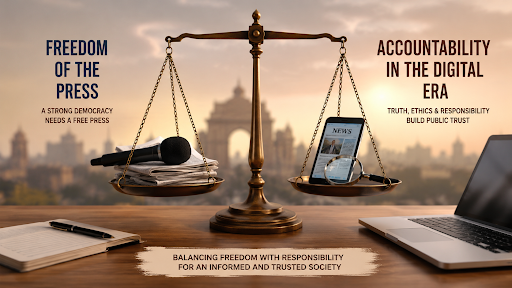
Why is Media Accountability Important?
Prevents Misinformation and Fake News: Unaccountable media platforms rapidly circulate misinformation, which triggers communal disharmony and manipulates voter behavior.
Protects Individual Reputation and Privacy: Responsible journalism prevents severe intrusions into personal privacy.
-
For example, the Delhi High Court penalizes a private news channel for illegally broadcasting identifying details of a minor sexual assault victim, applying the right to privacy horizontally against the media.
Upholds Journalistic Ethics: Accountability structures stop sensationalism and force reporters to adhere to truth, objectivity, and fairness.
Enhances Public Trust in Media: Holding newsrooms accountable for ethical breaches restores the public’s declining faith in institutional journalism.
Ensures Responsible Use of Digital Platforms: Regulation prevents influencers and digital creators from using aggressive tactics, such as thrusting microphones at citizens and creating misleading public narratives.
What are the Key Challenges in the Digital Media Ecosystem?
Rise of Self-Styled Digital Reporters: Smartphone-equipped individuals bypass professional standards, demand instant responses from citizens, and frame silence as evasion.
Spread of Unverified Information: Digital networks facilitate the viral spread of fake news, utilizing deepfakes and algorithmic amplification to distort reality.
Absence of Uniform Regulatory Standards: Overlapping boundaries between professional journalists and social media influencers leave a regulatory gap, as print and broadcast media face distinct regulations while the digital space remains largely unmonitored.
Balancing Free Speech with Public Order: Regulators struggle to curb inflammatory content without violating legitimate free speech rights, especially during sensitive incidents.
Platform Accountability and Algorithmic Amplification: Global tech companies prioritize engagement over accuracy, transforming independent journalism into an attention economy that rewards emotional storytelling over factual reporting.
What are the Major Challenges in Regulating the Press?
Risk of Over-Regulation: India registers the highest number of state-ordered internet shutdowns globally, which cripples independent journalism.
-
The government sets up entities like the Fact Check Unit (FCU) under the Press Information Bureau (PIB), which critics argue creates sweeping self-censorship.
Protecting Editorial Independence: State actors frequently misuse colonial-era laws like Sedition (Section 124A) and anti-terror legislation like the Unlawful Activities (Prevention) Act (UAPA) to target critics, resulting in the arrest of approximately 40% of journalists facing criminal cases between 2012-2022.
Regulating Digital-Only Media: The rapid platformisation of news blurs the line between a registered news outlet and a digital creator, making formal media regulation obsolete in the attention economy.
Preventing Political Misuse of Regulation: State agencies like the Enforcement Directorate (ED) and Income Tax Department allegedly raid media organizations, conducting 44 cases of raids and summons against media houses between 2018-2023.
Preserving Investigative Journalism: The horizontal application of the right to privacy against media houses risks creating a chilling effect, where corrupt public figures use privacy writs to block legitimate investigative reporting.
What Measures Can Strengthen Both Press Freedom and Accountability?
Strengthening Self-Regulatory Mechanisms: Industry bodies like the News Broadcasting Standards Authority (NBSA) and the Broadcasting Content Complaints Council (BCCC) must enhance powers to levy stricter penalties for ethical breaches.
Promoting Ethical Journalism Standards: Stakeholders must cultivate a universal code of ethics that applies equally to legacy media and emerging digital influencers.
Enhancing Digital Media Literacy: Educational initiatives must equip citizens with the skills to identify misinformation and critically evaluate the credibility of diverse digital sources.
Establishing Transparent Regulatory Frameworks: India must create an independent, statutory media regulator—similar to the UK's Leveson Inquiry recommendations—that operates free from direct government interference to improve its standing on the World Press Freedom Index 2026, where it currently ranks 157 out of 180 countries.
Safeguarding Editorial Independence: Judicial screening mechanisms must protect reporters from Strategic Lawsuits Against Public Participation (SLAPP) and arbitrary arrests under anti-terror laws.
Encouraging Fact-Checking Ecosystems: Supporting independent, non-partisan fact-checking units counters deepfakes and algorithmic misinformation without defaulting to state-run censorship boards.
Conclusion
To preserve democracy, India must implement a medium-agnostic regulatory framework that protects editorial independence while holding purveyors of misinformation and privacy violations strictly accountable.
Source: THEHINDU
|
PRACTICE QUESTION Q. "Freedom of the press and media accountability are complementary pillars of a constitutional democracy rather than competing values." Critically Analyse. 150 words |