Why In News?
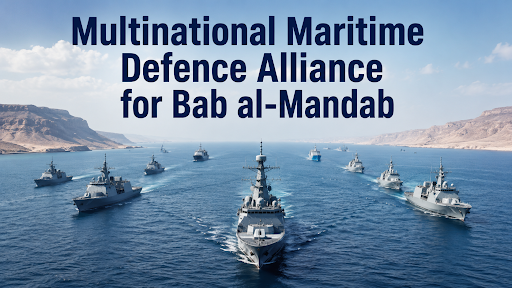
Saudi Arabia has officially launched a 14-nation maritime defence alliance to protect commercial ships and secure global trade routes in the Red Sea and the Bab al-Mandab Strait.
What is the Multinational Maritime Defence Alliance?
It is a Saudi Arabia-led regional naval security coalition announced in July 2026 to safeguard commercial shipping in the Red Sea, Bab al-Mandab Strait, and Gulf of Aden.
The coalition will be headquartered in Riyadh.
Representatives from 43 countries and the European Union attended the founding meeting, while 14 countries formally endorsed the initiative, including Saudi Arabia, Kuwait, Bahrain, Qatar, Jordan, Egypt, Pakistan, Türkiye, Bangladesh, Yemen, Sudan, Djibouti, Somalia, and Nigeria.
Objectives
-
Protect freedom of navigation
-
Secure global trade and energy supply routes
-
Strengthen maritime domain awareness
-
Enhance intelligence sharing
-
Conduct joint naval exercises
-
Coordinate escort operations for commercial vessels
-
Improve interoperability among member navies.
|
Water Body / Feature |
Physical Geography |
Economic & Strategic Value |
|
Red Sea |
• Narrow, elongated semi-enclosed basin separating Africa from the Arabian Peninsula. • Connects to the Mediterranean Sea via the Suez Canal. • Bordered by Egypt, Saudi Arabia, Sudan, Yemen, Eritrea, and Djibouti. |
• Carries roughly 12% to 15% of all global maritime trade. • Acts as a major trunk route for electronics, consumer goods, machinery, and agricultural inputs. • Contains critical global fiber-optic telecommunication cables on its seabed. |
|
Bab al-Mandab Strait |
• A strategic 30-kilometre-wide maritime chokepoint between Yemen and Djibouti/Eritrea. • Divided into two navigable paths by Perim Island. • Often referred to as the "Gate of Tears". |
• Serves as the third busiest oil transit chokepoint in the world. • Handles approximately 8.7% of total global seaborne commerce. • Composed of roughly 30% global container traffic and millions of daily barrels of Persian Gulf oil. |
|
Gulf of Aden |
• Deep-water gulf positioned directly south of the Arabian Peninsula. • Bordered by Yemen, Somalia, and Djibouti. • Opens seamlessly into the broader Arabian Sea and Indian Ocean. |
• Serves as the vital southern gateway connecting East Asia and India to European markets. • Requires heavy international naval patrols due to high piracy and regional conflict exposure. • Hosts major international military bases in Djibouti (US, China, France) to secure global shipping. |

Why Has the Alliance Been Formed?
Rising Security Threats: Escalating attacks by Yemen's Houthi rebels using drones, ballistic missiles, and unmanned surface vehicles (USVs) have targeted commercial vessels and oil tankers in the Red Sea, threatening one of the world's busiest shipping corridors.
Protecting International Trade: War-risk insurance premiums for vessels transiting the Red Sea have increased to 1–2% of a ship's value, while many shipping companies are rerouting via the Cape of Good Hope, adding nearly 3,500 nautical miles, 10–14 extra days, and higher fuel and freight costs. (Source: S&P Global Market Intelligence; UNCTAD)
Collective Maritime Security: Gulf and regional countries seek to assume greater responsibility for protecting regional waters through a Saudi-led defensive coalition that enables real-time intelligence sharing, coordinated naval patrols, and commercial vessel escort operations.
Securing Energy Supply Chains: The coalition aims to ensure uninterrupted movement of crude oil, LNG, and other strategic commodities through the Red Sea and Bab al-Mandab, thereby reducing disruptions to global energy markets.
Reducing Dependence on External Navies: The initiative reflects the Gulf states' effort to develop an indigenous regional maritime security architecture alongside existing multinational missions.
Why is Development Important for India?
Trade Interests: Saudi Arabia is India's fifth-largest trading partner, with bilateral trade over US$41 billion in FY 2025–26. Indian exports—including engineering goods, petroleum products, rice, textiles, and chemicals—depend heavily on secure Red Sea shipping routes.
Energy Security: Saudi Arabia is one of India's largest energy suppliers. India imported about 33.14 Million Metric Tonnes (MMT) of crude oil and 3.34 MMT of LPG from Saudi Arabia, making secure transit through the Bab al-Mandab Strait vital for India's energy security.
Supports SAGAR Vision: The initiative complements India's SAGAR (Security and Growth for All in the Region) doctrine, which promotes secure sea lanes, maritime cooperation, and a free, open, and rules-based Indo-Pacific.
Strengthens Naval Cooperation: India has maintained continuous naval deployments under Operation Sankalp to protect merchant shipping in the Arabian Sea and Gulf of Aden.
-
India and Saudi Arabia have also conducted bilateral naval exercises such as Al Mohed Al Hindi, enhancing interoperability and maritime security cooperation.
Supports IMEEC and Supply Chains: Secure Red Sea navigation is essential for the proposed India–Middle East–Europe Economic Corridor (IMEEC) and helps maintain resilient supply chains while reducing freight costs for Indian exports.
Enhances Regional Stability: Greater maritime security in the Red Sea and Gulf of Aden supports India's strategic interests by ensuring uninterrupted commerce, protecting the Indian diaspora in the Gulf, and strengthening stability across the western Indian Ocean.
Source: TIMESOFINDIA
|
PRACTICE QUESTION Q. Maritime chokepoints have become central to contemporary geopolitics and global economic security. Discuss. 150 words |