Why In News?
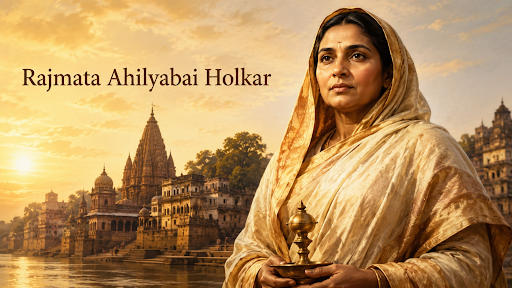
Maharashtra Chief Minister announced that the government is drawing inspiration from Rajmata Ahilyabai Holkar's legacy of water conservation and infrastructure development to drive modern rural transformation agenda.
Who was Ahilyabai Holkar?
-
She was born on 31 May 1725 in the Chondi village, in present-day Ahmednagar district, Maharashtra — a district officially renamed "Ahilyanagar" in her honour as part of the anniversary commemorations.
-
Her father, Mankoji Rao Shinde, was the village head; she was married in 1733 to Khanderao Holkar, son of Malhar Rao Holkar, founder of the Holkar dynasty.
-
Became Queen of Malwa, ascending the throne after the deaths of her husband (1745, at the siege of Kumher Fort) and later her father-in-law, despite societal resistance to a woman ruling in her own right.
-
Established her capital at Maheshwar, on the banks of the Narmada river in present-day Madhya Pradesh.
-
Ruled from 1767 to 1795, and passed away on 13 August 1795.
What was Her Approach to Governance?
-
Practised welfare-oriented administration, prioritising the needs of ordinary subjects.
-
Maintained accessible governance, reportedly hearing petitions and grievances directly from her people.
-
Invested consistently in public infrastructure — roads, wells, and rest houses.
-
Prioritised local development, strengthening towns and rural areas within her domain.
-
Extended religious and cultural patronage across a wide geography, including sites outside her own kingdom.
-
Maintained a reputation for administrative efficiency, with governance structures that outlasted her reign.
Water Management Legacy
-
She commissioned numerous wells across drought-prone regions.
-
Built stepwells, a traditional Indian water-harvesting architecture suited to semi-arid zones.
-
Constructed tanks for water storage and irrigation support.
-
Built ghats along rivers, improving both water access and pilgrimage infrastructure.
-
Her works significantly improved water access for ordinary communities.
-
This infrastructure contributed materially to better drought management in regions prone to water scarcity.
Contribution to Rural Development
-
She extended agricultural support to farming communities within her domain.
-
Invested in local infrastructure, strengthening rural connectivity.
-
Her road and infrastructure projects improved market connectivity for rural producers.
-
Provided support for artisans, particularly weavers — her patronage is closely linked to the historic Maheshwari textile tradition, still practised today.
-
Her policies contributed to the promotion of local employment across trade, textiles, and public works.
Contribution to Cultural Heritage
-
She undertook extensive temple restoration across India, including at sites like Kashi Vishwanath (Varanasi) and other major pilgrimage centres.
-
Financed the construction of ghats along the Ganga and other major rivers.
-
Dilt dharamshalas to support pilgrims travelling long distances.
-
Her works substantially expanded pilgrimage infrastructure across the subcontinent.
-
Collectively, these efforts amounted to significant preservation of cultural sites, many of which remain functional today.
Leadership Skills
-
She stands as a landmark example of women in governance, ruling in her own right in an era of severe gender restrictions.
-
Her rule is widely cited as a model of ethical administration, grounded in accountability and public service.
-
Her governance approach anticipated elements of a modern welfare state, prioritising public infrastructure and welfare.
-
She maintained strong public accountability, reportedly through direct engagement with subjects.
-
Her policies reflected genuinely inclusive development, benefiting both her own kingdom and pilgrims/travellers from across India.
-
Her administration is frequently cited as an early example of grassroots-oriented governance.

Source: NEWSONAIR
|
PRACTICE QUESTION Q. With reference to Rajmata Ahilyabai Holkar, consider the following statements:
Which of the statements given above is/are correct? (a) 1 and 2 only (b) 2 and 3 only (c) 1 and 3 only (d) 1, 2 and 3 Answer: (a) Explanation: Statement 1 is correct: She managed and governed the Malwa region, moving her administrative seat and royal capital to Maheshwar on the banks of the Narmada River in 1767, ruling until 1795. Statement 2 is correct: She belonged to the Holkar royal family of the Maratha Confederacy/Empire. Statement 3 is incorrect: Her philanthropic and architectural footprint was pan-Indian. She built and restored major temples, dharamshalas, and ghats across the Indian subcontinent, from Kashi (Varanasi) and Somnath to Dwarka, Badrinath, Gaya, and Rameswaram. |