Why In News?
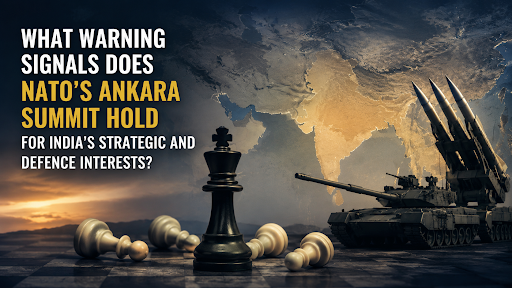
The 32-member NATO alliance concludes its 2026 Ankara Summit, shifting its strategic focus toward rapid rearmament and long-term military readiness.
About NATO
The North Atlantic Treaty Organization (NATO) is an intergovernmental military alliance currently comprising 32 member states from Europe and North America.
Established by the North Atlantic Treaty (also known as the Washington Treaty) in 1949, its primary objective is to guarantee the collective freedom and security of its members through political and military cooperation.
Core Principles
-
Collective Defence: Enshrined in Article 5, an attack on one member is officially treated as an attack on all.
-
Historical Invocations: Article 5 has only been activated once in history, following the September 11 terrorist attacks against the United States in 2001.
-
Consultation Mechanics: Enshrined in Article 4, members consult together whenever a nation's territorial integrity or security is threatened.
-
Decision-Making: All major alliance decisions require unanimous consensus across every single member state.
Headquarters: The civilian administrative arm is located in Brussels, Belgium.
Founding Members: The alliance was started by 12 countries, including the United States, Canada, the United Kingdom, France, and Italy.
Recent Expansion: Security concerns prompted traditionally neutral nations to join, with Finland entering in 2023 and Sweden becoming the 32nd member in March 2024.
Defense Funding: Member states commit to a target of spending at least 2% of their national GDP on domestic defense.
Key Outcomes of the Ankara Summit
Defence Spending Expansion: NATO members endorse the "Hague defence commitment," pledging to spend at least 5% of their GDP on defence by 2035.
Procurement Surge: The alliance announces over $50 billion in fresh defence procurements and pledges €70 billion in military equipment and training for Ukraine in 2026.
Defence Industrial Base (DIB): NATO vows to build a high-technology, Europe-wide DIB to scale up mass production, aiming to reduce the current 50% dependency on US-sourced defence spending observed between 2022-2024.
Emerging Technologies: The alliance prioritizes investments in Artificial Intelligence (AI), cybersecurity, autonomous systems, and space capabilities through programs like the Defence Innovation Accelerator for the North Atlantic (DIANA).
Strategic Implications for India
Supply Chain Competition: Aggressive NATO buying creates severe shortages of precision-guided munitions and air defence interceptors, pushing non-NATO buyers like India to the back of the queue.
Modernisation Delays: India faces bottlenecks, such as the delayed delivery of General Electric F-404 jet engines for the Tejas Light Combat Aircraft (LCA) programme.
Ammunition Depletion: Recent conflicts, such as the US-Israel campaign against Iran, consumed over 850 Tomahawk cruise missiles, illustrating how rapidly global stocks deplete and impact Asian allies.
Russia-India Relations: NATO’s formal designation of Russia as its primary threat complicates India’s strategic calculus, as Moscow deepens its "no limits" partnership with China.
Technology Gap: Rapid NATO integration of AI and uncrewed drone networks risks leaving India behind if the military relies solely on traditional imported hardware.
Opportunities for India
Atmanirbhar Bharat: Global defence supply shortages create strong incentives to accelerate Atmanirbhar Bharat in defence through indigenous production of missiles, engines, electronics and ammunition, reducing import dependence.
Diversified Procurement: India can leverage its policy of strategic autonomy by expanding defence cooperation with France, Israel, Japan and other European partners, reducing overdependence on any single supplier.
Manufacturing Hubs: As Europe expands its defence-industrial capacity, India can emerge as a manufacturing base for aerospace systems, precision engineering, and electronics, benefiting from technology partnerships and skilled manpower.
Joint Ventures: Indian defence ecosystem can attract joint ventures with Western companies in AI-enabled warfare, autonomous systems, drones, cyber technologies and digital battlefield management.
Export Potential: India's defence exports reached a record ₹23,622 crore in FY 2024–25, reflecting a 34-fold increase since FY 2013–14. Global supply constraints provide an opportunity to expand exports.
Source: THEHINDU
|
PRACTICE QUESTION Q. In the context of global defence dynamics, the term 'Defence Innovation Accelerator for the North Atlantic (DIANA)' is associated with which organisation? A) European Union B) Quad C) NATO D) Shanghai Cooperation Organisation Answer: C Explanation: The correct answer is C) NATO, as the Defence Innovation Accelerator for the North Atlantic (DIANA) is an organization established by the North Atlantic Treaty Organization to accelerate dual-use technology innovation. |