Why In News?
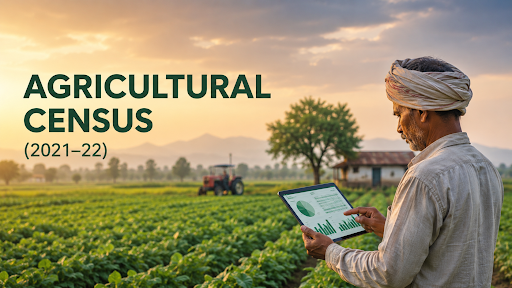
The Ministry of Agriculture & Farmers Welfare initiates the 11th Agricultural Census (2021-22) to capture agrarian data across the nation.
What is the Agricultural Census?
The census serves as a large-scale statistical operation that collects and derives quantitative information regarding the structural aspects of agriculture in India, conducted every five years.
The government defines the operational holding as the fundamental unit, encompassing all land used wholly or partly for agricultural production and operated as a single technical unit, regardless of legal ownership.
Authorities categorize holdings into Individual, Joint, and Institutional types. The census records the de facto cultivator rather than the de jure owner. For example, in Telangana, individual holdings constitute 99.99% of total holdings with an operating area of 99.85%.

Key Features of the 11th Agricultural Census
Three-Phase Execution:
-
Phase-I: Enumerators conduct a complete enumeration of all villages to gather primary characteristics like the number of holdings and operated area.
-
Phase-II: Officials collect detailed data on cropping patterns and irrigation status from a randomly selected 20% of sample villages.
-
Phase-III: Investigators collect granular data on input use patterns (e.g., fertilizers) from a randomly selected 7% of sample villages.
Digital Transformation: The census utilizes digitized land records and web-based software, enabling real-time monitoring and swift data uploading.
Nationwide Coverage: The central government executes the census in collaboration with all States and Union Territories.
Gender and Social Focus: The census records woman-operated land holdings to drive gender-specific interventions and maps data for Scheduled Castes (SC) and Scheduled Tribes (ST).
Importance of the Census
Policy Formulation: It acts as the primary data source for researchers and planners striving to uplift the agrarian economy.
Landholding Patterns: It exposes land stress; for instance, the average holding size in Telangana shrank from 1.00 hectare in 2015-16 to 0.89 hectare in 2021-22.
Resource Allocation: Data informs the efficient allocation of subsidies, credit facilities, and rural development programs.
Food Security: It supports national strategies by aiding in precise crop mapping and identifying tenancy trends.
Diversification and Mechanization: Policymakers use census inputs to plan land utilization, irrigation expansion, and mechanization.
Major Challenges
Fragmentation: Continuous land division creates a massive volume of micro-units. In Telangana, marginal and small holders account for 91.31% of all holdings.
Updating Records: Accurate data requires perfectly computerized village land records; discrepancies in state-level digitization hinder extraction.
Data Harmonisation: Integrating scattered part-holdings that span multiple villages or administrative boundaries requires meticulous effort.
Timely Publication: While digital tools target delays, historical manual aggregation caused significant time lags.
Tenant Farming: Identifying the actual cultivator (oral vs. written lease) remains difficult due to the de facto collection approach.
Un-surveyed Areas: Cultivated zones within state forests or urbanized villages often lack revenue records and face exclusion.
Way Forward
Complete Digitisation: States must accelerate the computerization of land databases.
GIS Integration: Synchronizing holding data with spatial technologies enables accurate crop mapping and yield estimation.
Real-Time Databases: Sustaining the use of mobile apps ensures instant data uploading and error correction.
Inter-departmental Synergy: Collaboration between Revenue, Agriculture, and Forest departments prevents the exclusion of marginalized cultivators.
AI and Analytics: Advanced analytics can predict agrarian distress and design targeted credit interventions.
Enumerator Training: Proficiency in digital survey apps guarantees accurate data collection regarding complex tenancy and cropping details.
Conclusion
The transition to digital data collection in the 11th Agricultural Census revolutionizes agrarian statistics, creating a rapid, evidence-based framework to empower smallholder farmers and secure sustainable agricultural growth.
Source: PIB
|
PRACTICE QUESTION Q. Analyze the trends of land fragmentation in India as highlighted by the Agricultural Census. Examine the policy measures required to make marginal and small landholdings economically viable. (250 words) |