Why In News?
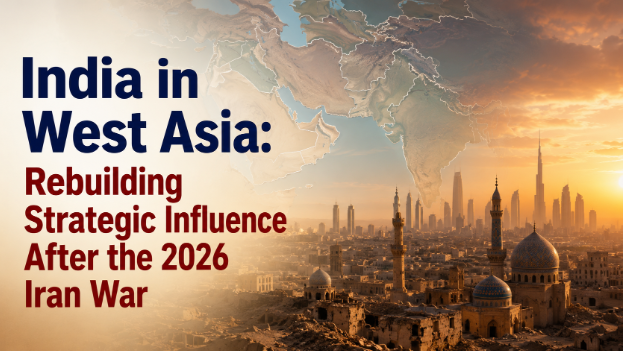
The 2026 Iran war and the freezing of Chabahar, IMEC, and INSTC have exposed how India's West Asia strategy depends on fragile corridors and volatile alliances, forcing New Delhi to rethink its regional approach.
Details
India faces growing strategic competition in West Asia, intensified after the 28 February 2026 US-Israel strikes on Iran that killed Supreme Leader Ali Khamenei, triggering the 2026 Iran war.
The conflict has frozen India's key westward infrastructure: Chabahar Port, the International North-South Transport Corridor (INSTC), and the India-Middle East-Europe Economic Corridor (IMEC) all suspended progress amid the fighting.
India needs to deepen regional engagement as Gulf powers recalibrate their own alliances amid US-Iran-Israel rivalries that have reshaped the security landscape.
The balance among Gulf powers is changing, with Iran under a new Supreme Leader, Mojtaba Khamenei, and regional states hedging between US, Chinese, and independent strategic tracks.
West Asia's importance for India has only grown, even as the war exposed India's vulnerability to disruptions in energy, remittances, and connectivity.
Why Is West Asia Strategically Important for India?
Energy Security
West Asian stability directly impacts India's economic security. In 2024–25, India depended on crude imports for 88% of its needs, with petroleum making up 23% of gross imports.
The Gulf remains an important energy supplier. The UAE is India’s 4th-largest crude-oil source and 2nd-largest LNG/LPG source, making bilateral energy ties strategically important.
Trade & Investment
The GCC is India’s largest regional trading bloc. Bilateral trade with the GCC exceeded US$162 billion in 2023-24, while cumulative GCC FDI in India was about US$20 billion.
The UAE is particularly significant: India-UAE total trade stood at US$83.63 billion in 2023-24, including US$35.62 billion exports and US$48.01 billion imports.
Saudi Arabia contributed another US$43.36 billion, making it a major source of both energy imports and a growing destination for Indian goods and investment.
Diaspora & Remittances
The Gulf is a major pillar of India’s diaspora diplomacy. About 9.3 million Indians lived across GCC countries in 2024, creating a powerful economic and people-to-people bridge.
Remittances strengthen India’s external-sector resilience. RBI reported India as the world’s largest remittance recipient, while the World Bank estimated US$135 billion in inflows for FY25.
Maritime Security
West Asian chokepoints directly affect India’s energy and trade flows. Hormuz connects Gulf producers with global markets, while Bab-el-Mandeb links the Red Sea with the Indian Ocean.
India therefore needs maritime resilience, not only diplomatic engagement. The 2026 disruption demonstrates the importance of alternative suppliers, strategic petroleum reserves and secure sea-lanes.
Connectivity to Europe & Central Asia
IMEC offers India an alternative to traditional sea routes . Its rail-sea network links India to the Gulf and Europe, incorporating power, digital, and clean-hydrogen links.

INSTC provides a complementary northern route. India and Central Asian countries have specifically called for greater use of INSTC and Chabahar to expand trade connectivity with Central Asia.

Major Pillars of India-West Asia Relations
Energy partnerships, spanning crude oil, LNG, and increasingly green hydrogen cooperation.
Trade and investment, anchored in major bilateral trade volumes with the UAE and Saudi Arabia.
Defence and security cooperation, including joint military exercises like Desert Flag and Cyclone with Gulf and regional partners.
Diaspora diplomacy, given the scale of the Indian workforce across Gulf economies.
Technology cooperation, particularly in digital public infrastructure and fintech.
Connectivity partnerships, through IMEC and Chabahar-linked INSTC routes.
Development cooperation, including infrastructure and capacity-building support to regional partners.

Importance of India-UAE Relations
-
The Comprehensive Economic Partnership Agreement (CEPA) anchors deep bilateral trade ties.
-
Investment cooperation flows both ways, with UAE sovereign funds active in Indian infrastructure.
-
A robust energy partnership covers crude oil, LNG, and renewable energy collaboration.
-
Defence cooperation has expanded through joint exercises and strategic dialogues.
-
Technology cooperation spans digital infrastructure and fintech.
-
The UAE anchors India's participation in I2U2 (India-Israel-UAE-US) and the IMEC connectivity initiative.
Importance of India-Saudi Arabia Relations
-
The Strategic Partnership Council provides an institutional mechanism for high-level bilateral engagement.
-
Energy cooperation remains foundational, given Saudi Arabia's role as a major crude oil supplier.
-
Saudi Arabia is an important source of investment into Indian infrastructure and industry.
-
Defence cooperation has grown through expanded military-to-military engagement.
-
Bilateral infrastructure partnerships extend to joint industrial and logistics projects.
-
Cooperation also extends to food security, given Saudi interest in agricultural investment abroad.
Importance of India-Qatar Relations
-
LNG security is central to this relationship, anchored by the $78 billion, 20-year LNG supply agreement.
-
Trade ties have deepened alongside the energy relationship.
-
Qatar hosts a significant Indian diaspora, integral to bilateral labour ties.
-
Investment flows from Qatari sovereign wealth into Indian markets.
-
Maritime connectivity links Qatar to India's broader Gulf trade network.
-
Energy cooperation extends beyond LNG into broader hydrocarbon partnerships.
Why Is Iran Important for India?
-
Chabahar Port gives India a strategic gateway to Afghanistan and Central Asia, bypassing Pakistan.
-
It enables connectivity to Central Asia, reducing India's dependence on land routes through hostile territory.
-
Chabahar anchors India's role in the International North-South Transport Corridor (INSTC), connecting Mumbai to Moscow.
-
Iran remains relevant to India's broader energy security calculations, despite sanctions constraints.
-
Iran's stability affects India's Afghanistan policy, given historical reliance on Iranian routes for access.
-
Maintaining ties with Iran supports India's regional balance, preventing over-dependence on any single bloc.
-
Despite intense US pressure during the 2026 war, India reportedly fulfilled its $120 million investment commitment for Chabahar Port, while "de-risking" by shifting operational duties to local manpower.

Major Gaps in India's West Asia Policy
India continues to have a limited regional security role, unable to shape conflict outcomes directly.
Weak institutionalised multilateral engagement persists, despite growing bilateral ties.
Connectivity delays, now compounded by the 2026 war's disruption of Chabahar, INSTC, and IMEC, remain a persistent weakness.
Heavy dependence on energy imports leaves India exposed to regional supply shocks, as seen when the Strait of Hormuz crisis disrupted shipping in 2026.
Limited defence-industrial cooperation constrains India's ability to offer security value to regional partners.
India's approach has often been marked by reactive crisis diplomacy, responding to events rather than shaping them proactively.
How Is China Expanding Its Influence?
|
Why Does India Need a More Active Regional Strategy?
A more active strategy is essential for protecting energy security amid recurring regional shocks.
It is necessary for securing trade routes that remain vulnerable to chokepoint disruptions like the Strait of Hormuz.
Active engagement helps in supporting Indian workers, whose safety was tested during the 2026 conflict's regional spillover.
It enables expanding investment flows in both directions with Gulf partners.
It is critical for countering strategic competition from China's growing regional presence.
It strengthens maritime security, essential given India's reliance on Gulf-linked sea lanes.
What Should India Do?
Multi-Alignment & Strategic Autonomy
Avoid Bloc Politics: Refuse to choose sides between competing regional power axes (such as the Gulf states, Iran, or Israel).
Deepen Gulf Momentum: Leverage existing comprehensive economic partnerships with the UAE and Saudi Arabia to transition from a buyer-seller relationship to joint investment frameworks.
Broaden the Footprint: Expand diplomatic and economic ties into Egypt and Jordan, preventing India's regional presence from being overly concentrated in the Persian Gulf.
Present a BRI Alternative: Frame Indian investments as transparent, sustainable, and demand-driven. Avoid the debt-trap and sovereignty-compromising pitfalls associated with China's Belt and Road Initiative.
Connectivity & Infrastructure Resilience
Preserve the Iran-Central Asia Axis: Treat Chabahar and the International North-South Transport Corridor (INSTC) as critical continental gateways. Maintain active administrative infrastructure there despite external sanctions or short-term operational handovers.
Incorporate IMEC Disruption Lessons: Treat the India-Middle East-Europe Economic Corridor (IMEC) as a long-term goal by prioritizing modular, bi-national connectivity segments that can function independently during regional instability.
Build Transit Redundancies: Establish alternative logistics paths and transshipment hubs. Ensure Indian supply chains are not crippled by a shutdown of any single chokepoint like the Bab-el-Mandeb or the Strait of Hormuz.
Integrated Security and Maritime Diplomacy
Address Chokepoint Vulnerabilities: Formulate robust maritime security partnerships with regional navies to counter asymmetric threats, secure vital sea lanes, and guarantee freedom of navigation.
Enhance High-Tech Defence Cooperation: Deepen co-development and technology transfers with tech leaders like Israel, specifically focusing on drone tech, cyber defense, and border surveillance.
Merge Economy and Security: Economic influence requires security backing. Pair infrastructure investments with security cooperation, anti-piracy training, and joint maritime domain awareness.
Conclusion
India's West Asia strategy must build redundancy and strategic depth, since the 2026 Iran war has shown how quickly single-corridor dependence can freeze India's regional ambitions.
Source: THEHINDU
|
PRACTICE QUESTION Q. Discuss the strategic importance of West Asia for India's energy security, diaspora, and connectivity interests. Suggest measures India should adopt to rebuild its strategic influence in the region. (250 words) |