Why In News?
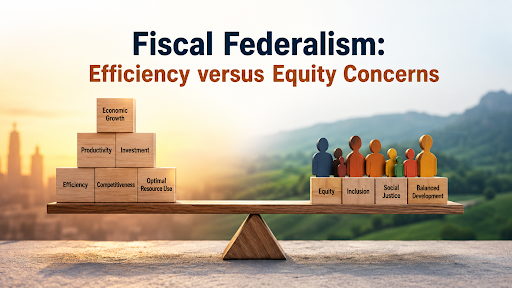
The 16th Finance Commission compromises fiscal federalism by substituting need-based equalisation grants with performance-linked incentives, prioritizing economic efficiency over regional equity.
What Is Fiscal Federalism?
Fiscal federalism refers to the constitutional distribution of taxation powers, expenditure responsibilities and inter-governmental fiscal transfers between the Union and States to ensure both efficiency and equity.

Why Is Fiscal Federalism Important for India?
Strengthens Cooperative Federalism: Predictable tax devolution reduces fiscal friction between the Union and States.
-
The Supreme Court in State (NCT of Delhi) vs Union of India (2023) reaffirmed that Indian federalism is based on constitutional trust and collaborative governance.
Promotes Inclusive Development: Equalisation transfers enable fiscally weaker states such as Bihar, Jharkhand and Odisha to invest in health, education and infrastructure, reducing regional disparities. The income-distance criterion (42.5%) reflects this objective.
Supports Fiscal Sustainability: The 16th Finance Commission projects the combined Centre-State debt ratio to decline from 77.3% of GDP (2026–27) to 73.1% (2030–31) through fiscal discipline, subsidy rationalisation and debt management reforms.
Improves Fiscal Responsibility: The Commission recommends limiting state fiscal deficits to 3% of GSDP, eliminating off-budget borrowings and expanding the debt definition to improve transparency.
Encourages Competitive Federalism: The shift towards performance-linked grants, urban reforms and power-sector reforms incentivises governance improvements rather than dependence on unconditional transfers.
Strengthens Local Governance: The Commission recommended ₹4.4 lakh crore for rural local bodies and ₹3.6 lakh crore for urban local bodies, with 80% basic and 20% performance-based grants, reinforcing grassroots fiscal decentralisation under the 73rd and 74th Constitutional Amendments.
Supports National Development Goals: The National Institute of Public Finance and Policy (NIPFP) notes that retaining 41% tax devolution, combined with fiscal consolidation and performance-linked incentives, seeks to balance national macroeconomic stability with state-level developmental autonomy.
What Is the Role of the Finance Commission in Strengthening Fiscal Federalism?
Constitutional institution: Established under Article 280 every five years, the Finance Commission (FC) recommends tax devolution, grants-in-aid and measures to augment State finances, thereby operationalising cooperative fiscal federalism.
Vertical fiscal balance: The 16th Finance Commission retained States' share at 41% of the divisible pool (after excluding cesses, surcharges and collection costs), balancing national expenditure needs with States' fiscal autonomy.
Horizontal equity: The Commission revised the devolution formula to Income Distance (42.5%), Population (17.5%), Demographic Performance (10%), Area (10%), Forest & Ecology (10%) and Contribution to GDP (10%), attempting to reconcile equity with efficiency.

Grants-in-aid: It recommended ₹9.47 lakh crore during 2026–31, primarily for local governments (₹7.91 lakh crore) and disaster management (₹1.56 lakh crore), while discontinuing Revenue Deficit Grants, Sector-specific Grants and State-specific Grants to encourage fiscal self-reliance.
Macroeconomic stabiliser: By periodically recalibrating transfers, the FC reduces vertical and horizontal fiscal imbalances, strengthening cooperative federalism. However, since its recommendations are advisory, implementation ultimately depends on the Union Government.
Case Study: The introduction of "Contribution to GDP" (10%) in the 16th FC responds to long-standing demands from economically productive States for greater recognition of fiscal efficiency while retaining Income Distance as the dominant criterion to protect poorer States.
Efficiency vs Equity in Fiscal Federalism
Efficiency-Based Approach (Performance-Oriented Transfers)
Rewards better governance: States with stronger tax effort, fiscal discipline, GDP contribution and demographic management receive greater incentives, encouraging competitive federalism.
Promotes fiscal prudence: The 16th Finance Commission recommended limiting states' fiscal deficit to 3% of GSDP, phasing out off-budget borrowings and moving towards debt sustainability, reinforcing responsible public finance.
Enhances productive public spending: The Commission recommended greater reliance on performance-linked local body grants, encouraging measurable outcomes in governance rather than unconditional transfers.
Improves economic competitiveness: The introduction of 10% weight for "Contribution to GDP" recognises states driving national economic growth, encouraging investment, industrialisation and revenue mobilisation.
Case Study: Gujarat, Maharashtra and Karnataka, with stronger industrial bases and higher GSDP contribution, gain under the newly introduced GDP criterion, reflecting a shift towards rewarding economic efficiency.
Equity-Based Approach (Need-Based Transfers)
Addresses fiscal disparities: The Income Distance criterion (42.5%), the largest weight in the horizontal devolution formula, transfers relatively more resources to states with lower per capita GSDP to narrow developmental gaps.
Promotes balanced regional development: Higher transfers enable poorer states to expand health, education and infrastructure despite weaker revenue bases, advancing cooperative federalism.
Recognises ecological constraints: Forest & Ecology (10%) compensates states with large forest cover for the opportunity cost of conservation, aligning fiscal transfers with environmental sustainability.
Supports disaster resilience: The Commission recommended ₹9.47 lakh crore in grants for local bodies and disaster management during 2026–31, improving basic public services and resilience across fiscally weaker states.
Case Study: North-Eastern and Himalayan states benefit from the Forest & Ecology criterion, recognising limited revenue-generating capacity arising from ecological preservation and difficult terrain.
What Are the Key Challenges?
Balancing efficiency and equity: The 16th Finance Commission reduced the weight of Income Distance (45% → 42.5%), introduced Contribution to GSDP (10%), and removed the Tax & Fiscal Effort criterion, reviving concerns that efficiency incentives have weakened while equity remains contested.
Persistent regional disparities: Southern and western states argue that fiscal prudence, demographic transition and higher tax effort are inadequately rewarded, whereas poorer states contend that stronger equalisation remains essential to fulfil the constitutional vision of balanced regional development.
Population-based devolution debate: Continued reliance on the 2011 Census (17.5% weight) remains contentious, as states that achieved early population stabilisation perceive a fiscal disadvantage despite the inclusion of a 10% demographic performance criterion.
Growing fiscal stress: Rising expenditure on health, education, pensions, climate resilience and welfare schemes has constrained states' fiscal space, while the 16th FC retained the 3% of GSDP fiscal deficit ceiling, limiting borrowing flexibility.
Shrinking divisible pool: Increasing dependence on cesses and surcharges, which are constitutionally excluded from the divisible pool under Article 270, reduces the effective volume of tax devolution despite the 41% vertical share remaining unchanged.
Demand for greater fiscal autonomy: During consultations, 18 states sought a 50% share in the divisible pool, reflecting concerns over expanding state responsibilities in social and infrastructure sectors.
Grant restructuring concerns: The discontinuation of Revenue Deficit Grants, Sector-specific Grants and State-specific Grants has raised concern among fiscally weaker states regarding transitional fiscal support.
Weak local fiscal capacity: Despite recommending ₹9.47 lakh crore in grants for local bodies and disaster management during 2026–31, many Urban Local Bodies continue to exhibit low own-source revenue mobilisation and weak financial governance.
Way Forward to Strengthening Fiscal Federalism
Reinforce both equity and efficiency: Retain Income Distance as the principal equalisation criterion while restoring an independent Tax/Fiscal Effort parameter to incentivise revenue mobilisation and prudent fiscal management.
Rationalise cesses and surcharges: Progressively merge suitable cesses into shareable taxes to improve transparency and strengthen cooperative fiscal federalism, while remaining within the constitutional framework governing the divisible pool.
Strengthen state fiscal capacity: Broaden state tax bases through better property taxation, user charges and improved GST compliance, reducing excessive dependence on central transfers.
-
The RBI's State Finances reports have consistently emphasised improving states' own tax revenue and expenditure quality.
Improve transfer transparency: Publish a periodic estimate of the Vertical Fiscal Imbalance and enhance disclosure of transfer calculations to make devolution debates evidence-based and predictable.
Deepen cooperative federalism: Institutionalise regular fiscal dialogue through the GST Council (Article 279A) and the Inter-State Council (Article 263) to address emerging Centre-State fiscal issues beyond the five-year Finance Commission cycle.
-
Case Study: The GST Council has demonstrated that consensus-based fiscal decision-making can reconcile diverse state interests, offering a model for resolving future devolution disputes through institutional dialogue.
Link grants with measurable outcomes: Expand performance-based grants for local bodies based on audited accounts, service delivery, digital governance and climate resilience.
Strengthen fiscal responsibility frameworks: The 16th Finance Commission recommends eliminating off-budget borrowings, improving debt transparency and adopting medium-term fiscal frameworks to ensure sustainable public finances.
Conclusion
Fiscal federalism works only when the Finance Commission's formula rewards performance without abandoning its constitutional duty to equalise opportunity across unequal states.
Source: THEHINDU
PRACTICE QUESTIONQ. Discuss how the growing reliance on cesses and surcharges has structurally weakened vertical fiscal devolution in India. Suggest measures to restore the balance between the Union and the states. (250 words) |