Why In News?
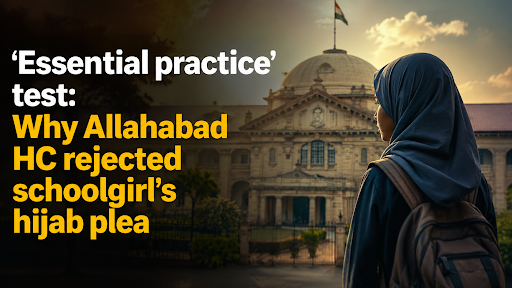
The Allahabad High Court rejected a Muslim student's petition to wear a hijab with her school uniform, holding that wearing a hijab is not an Essential Religious Practice in Islam.
Highlights of the Allahabad High Court Judgement
In Sukaina Rizvi vs State of U.P. and Others (2026), the court rejected the petition of a minor student from Tagore Public School, Prayagraj, on the following legal grounds.
Failure to Satisfy the Essential Religious Practice (ERP) Test: The Court held that the petitioner produced no scriptural, theological, or statutory evidence to prove that wearing a headscarf is an obligatory, core, and non-negotiable tenet of Islam under Article 25 of the Constitution.
No Enforceable Right Derived from Past Inaction: The petitioner argued that she had worn a headscarf from Class VI to Class X without objection.
-
The Court held that a school's past silence or non-enforcement—whether arising from "lethargy, inaction, courtesy, or hesitation"—does not create a legally enforceable right or promissory estoppel to violate school dress codes in subsequent classes.
Primacy of Institutional Uniform and Discipline: The Court ruled that private, self-financed schools possess the administrative autonomy to prescribe uniform policies to promote equality, unity, and a secular learning environment among students.Individual Discretion Cannot Override Uniform Rules: Allowing individual students to alter uniform rules based on personal preference would transfer institutional authority to students, dismantling educational discipline.
Reliance on Judicial Precedents: The Bench relied on the Karnataka High Court Full Bench judgment (2022), Bombay High Court (2002), and Kerala High Court (2018), which held that school dress codes are reasonable, non-discriminatory restrictions.

What is the Essential Religious Practice (ERP) Test?
The Essential Religious Practice (ERP) Test is a judicial doctrine formulated by the Supreme Court to determine which rituals, practices, and customs form the fundamental, core, and non-negotiable essence of a religion and thus qualify for constitutional protection under Articles 25 and 26.
Origin in Shirur Mutt Case (1954): A seven-judge Constitution Bench in The Commissioner, Hindu Religious Endowments, Madras vs Sri Lakshmindra Thirtha Swamiar of Sri Shirur Mutt established that "what constitutes the essential part of a religion is primarily to be ascertained with reference to the doctrines of that religion itself."
Evolution into the 'Integrality' Test: In Durgah Committee, Ajmer vs Syed Hussain Ali (1961), Justice P.B. Gajendragadkar narrowed the doctrine, holding that courts must distinguish between genuinely essential religious practices and secular, superstitious, or peripheral accretions.
The Irreversibility Standard: A practice is deemed "essential" only if its omission results in a fundamental alteration of the religion itself. If a faith can exist without the practice, it is not protected under Article 25(1).

|
Relevant Constitutional Provisions |
||
|
Constitutional Article |
Constitutional Guarantee / Scope |
Application in Dress Code Disputes |
|
Article 25(1) |
Freedom of conscience and free profession, practice, and propagation of religion. |
Subject to public order, morality, health, and other Fundamental Rights in Part III. |
|
Article 19(1)(a) |
Right to freedom of speech and expression. |
Includes personal choice of clothing and appearance, subject to reasonable restrictions under Article 19(2). |
|
Article 21 |
Right to life and personal liberty, privacy, and personal dignity. |
Encompasses bodily autonomy and identity as affirmed in K.S. Puttaswamy (2017). |
|
Article 21A |
Right of children to free and compulsory education (6–14 years). |
Uniform bans must not create structural barriers leading to school dropouts of female students. |
|
Article 14 & 15 |
Equality before the law and prohibition of discrimination on grounds of religion, race, caste, sex. |
Dress codes must be uniform, neutral, and applied without discriminatory bias. |
|
Article 28 |
Freedom from religious instruction in state-funded educational institutions. |
Maintains secular nature of state and aided schools. |
|
Article 29(1) |
Protection of distinct language, script, or culture of minorities. |
Protects cultural expressions of minority communities. |
What are the Major Concerns?
Educational Disenfranchisement of Minority Girls: Strict hijab bans force conservative families to withdraw girls from secular schools, pushing them into madrasas or causing permanent dropouts.
Conflict with the Right to Education (Article 21A): Prioritizing uniform symmetry over educational access conflicts with state commitments to maximize female literacy.
Inconsistency in Permitting Other Religious Symbols: Questions arise over why Sikh turbans, Hindu sacred threads (Janeu), tilaks, and Christian crucifixes are routinely accommodated in uniforms while headscarves face prohibition.
Absence of Legal Finality: Conflicting High Court rulings and the pending Supreme Court split verdict create nationwide legal uncertainty for school administrators and students.
Way Forward
Adjudication by Supreme Court Constitution Bench: A Constitution Bench of the Supreme Court must resolve the split verdict on hijab bans, balancing Article 25 religious freedom, Article 19(1)(a) expression, and institutional discipline on the bedrock of constitutional morality.
Adoption of the 'Reasonable Accommodation' Doctrine: Educational institutions must adopt the constitutional doctrine of 'Reasonable Accommodation' to permit minor, non-disruptive modifications to school uniforms (such as matching headscarves or turbans) unless they cause demonstrable pedagogical disruption or threaten public safety..
Protection of Minority Girl Child Education: "State education policies must ensure that uniform rules and school entry norms do not become structural barriers that exclude minority and marginalized girl students from formal schooling." — Recommended by the Sachar Committee Report (2006).
Transition from ERP to Fundamental Rights & Proportionality Test: The constitutional judiciary should phase out the Essential Religious Practices test and evaluate state restrictions against the objective standards of non-discrimination, bodily autonomy, equality, and proportionality. — Proposed by the Law Commission (2018).
Consultative Uniform Guidelines via School Management Committees: State education departments must formulate transparent, consultative, and non-coercive school uniform regulations through School Management Committees (SMCs) comprising parents, teachers, and student representatives.
Conclusion
Reconciling classroom discipline with religious freedom requires the Supreme Court to replace rigid theological Essential Practice tests with the doctrine of Reasonable Accommodation under Article 21 and Article 25.
Source: indianexpress
|
PRACTICE QUESTION Q. Under Article 25 of the Constitution of India, the freedom of conscience and the right to freely profess, practise, and propagate religion are subject to which of the following limitations? 1. Public order 2. Morality 3. Health 4. Other provisions of Part III of the Constitution Select the correct answer using the code given below: (a) 1, 2, and 3 only (b) 1 and 2 only (c) 1, 3, and 4 only (d) 1, 2, 3, and 4 Answer: (d) 1, 2, 3, and 4 Explanation: Article 25(1) explicitly states that the right is subject to "public order, morality, and health and to the other provisions of this Part (Part III)". |